
Calm, control and predictability in modern implant dentistry in Schiedam
Written by Danilo Di Vico | Dentist with a focus on endodontics, digital implant dentistry and restorative dentistry at 3D Tandarts Schiedam
Last updated: 23 September 2026
Short answer
Fear of implant treatment is completely normal. Most patients are not afraid of the implant itself, but of pain, complications or the unknown. Thanks to modern diagnostics, digital planning and careful preparation, implant treatment today is often more controlled and more comfortable than many people expect.
A missing tooth often has more impact than patients first expect. Not only on chewing or speaking, but also on self-confidence, social interactions and the sense of being in control of your own health. Even so, many people put off implant treatment for years. Not out of unwillingness, but out of uncertainty.
Fear of implant treatment is rarely irrational. It is usually a combination of earlier negative dental experiences, stories from other people, worries about pain, doubts about how long implants last, or a lack of clarity about the treatment process itself.
That is exactly why modern implant dentistry has changed so much in recent years.
Digital dentistry has made treatment not only more accurate, but also more predictable, calmer and, in many cases, less demanding for the patient. In a modern practice, implant dentistry is less and less about “major surgery” and more and more about controlled precision, minimal strain on the tissue and long-term stability.
At 3D Tandarts, that predictability is central. Not only technically, but emotionally too: patients understand what is happening, why certain choices are made and how risks are reduced.
What exactly is implant dentistry?
Implant dentistry is the field of dentistry concerned with replacing missing teeth with implants: artificial tooth roots, usually made of titanium, that are placed surgically in the jawbone. A crown, bridge or full set of replacement teeth is then attached to the implant.
The aim of implant dentistry is to replace missing teeth and restore function, chewing comfort and aesthetics with a solution suited to the individual oral situation.
Implant treatment may be suitable for:
- one missing tooth
- several missing teeth
- unstable dentures
- full-mouth rehabilitation
- complex restorative situations
Important factors include:
- general health
- quality of the jawbone
- gum health
- smoking status
- bite forces
- oral hygiene
An intake appointment with 3D diagnostics usually gives the most realistic picture of what is possible. You can book an implant consultation with 3D Tandarts via this link.

Why are so many people afraid of implant treatment?
Most patients are not afraid of the implant itself. They are afraid of the unknown.
Fear often does not come from the treatment itself, but from uncertainty. Many patients have had an unpleasant dental experience in the past or do not really know what to expect during implant treatment. That is why, during a consultation, we take plenty of time to explain every step calmly.
Common worries include:
- “Does placing an implant hurt?”
- “What if the implant fails?”
- “Is my jawbone still good enough?”
- “How long will I be without teeth?”
- “Will there be a lot of cutting?”
- “How natural will it look?”
- “What if I have problems later on?”
Patients aged 40 to 70 in particular often have a longer dental history. Sometimes with old bridges, root canal treatments, recurring infections or disappointing experiences from the past. That understandably leads to caution about new treatments.
Good implant dentistry therefore starts not with technique, but with explanation.
Would you like to know more about pain after an implant? You may also like our detailed article “Does a dental implant hurt?“.
Can fear of implant treatment be reduced?
Fear of implant treatment is completely normal. Most people who hesitate are not afraid of the implant itself, but of the unknown: what exactly will happen, will it hurt, and what if something goes wrong? That uncertainty is often bigger than the procedure itself. Fortunately, fear can be reduced considerably in several ways.
Take time for a consultation
A good consultation is the first step in taking away fear. During this conversation we look not only at the clinical situation, but also at how you feel about the idea of treatment. There is room to get to know the dentist, the practice and the way we work at your own pace. Trust is rarely built in five minutes, which is why we deliberately take the time.
Ask all your questions
No question is too small or unnecessary. How long does the procedure take? What exactly will I feel during treatment? What does recovery look like? What happens if there is too little jawbone? By talking through everything on your mind, vague fears disappear and make way for concrete, realistic information.
Understand the treatment plan
Fear is often fuelled by lack of clarity. When the full treatment plan is explained step by step, from diagnosis to planning, placement and aftercare, you know exactly what to expect. There is no room left for guesswork. A clear plan gives you a sense of control, and control reduces tension.
Digital planning often brings more peace of mind
Because an implant is now largely prepared digitally, the outcome is already largely predictable before the procedure. Based on 3D scans, intraoral scans and digital bite registration, the exact position of the implant is determined virtually in advance. This means fewer surprises during the treatment itself. For many patients, this insight, knowing that everything has been carefully calculated before anything is touched, is an important source of calm.
How digital implant dentistry can reduce fear
Less uncertainty thanks to digital planning
One of the biggest psychological benefits of digital implant dentistry is visibility. Digital technology does not replace the dentist’s experience, however. It supports the dentist in making accurate decisions and helps patients better understand what is going to happen.
When patients see their own 3D scan, they better understand:
- where the implant will go
- how much bone is available
- why certain choices are made
- how the crown will fit later
- which risks are avoided
That makes implant dentistry more concrete and less abstract.
In conventional dentistry, many decisions had to be estimated during the treatment. Modern digital workflows make it possible to plan in advance exactly how deep, at what angle and in which position an implant will be placed.
That not only increases precision, but often also gives patients more peace of mind.
Guided surgery and minimally invasive treatment
Many patients expect major surgery. In reality, implant placement today can often be relatively limited and controlled.
With guided surgery a surgical guide based on the digital planning is used. This allows the implant to be placed very accurately.
Guided surgery is not an end in itself, however. It is one of the tools that, when the situation is suitable, can contribute to controlled and accurate placement of implants.
The benefits can include:
- smaller incisions
- less trauma to the tissue
- less swelling
- shorter treatment time
- faster recovery
- higher precision
Not every situation is suitable for fully flapless surgery, but digital guidance generally makes treatment more controlled and less invasive.
For anxious patients, that predictability makes a big difference.
Does placing an implant hurt?
This is probably the most frequently asked question in implant dentistry.
Afterwards, patients often find the experience milder than they expected.
Local anaesthetic is used during the treatment, so pain is normally well under control. After the treatment, many patients feel a bruised, pressing sensation rather than sharp pain.
How much pain you have afterwards depends on factors such as:
- amount of bone
- need for bone grafting
- location of the implant
- complexity of the procedure
- individual healing
Digital precision can help reduce strain on the surrounding tissue, which can have a favourable effect on recovery.
More importantly still: patients who understand well in advance what to expect usually experience less stress around the treatment.
Would you like to know more about this topic? Visit this page on our website.
Why preserving bone matters in implant dentistry
When a tooth is lost, the natural load on the jawbone at that spot stops. The body gradually starts to break the bone down.
Why jawbone can slowly disappear
This process is called bone resorption.
Many people do not notice it straight away, but over the years it can lead to:
- sunken facial contours
- less support for the lips
- more difficult implant placement
- changes in facial aesthetics
- reduced stability of dentures
That is why timing sometimes plays an important role.
Immediate implants and bone preservation
In certain situations, an implant can be placed directly after an extraction. This is called an immediate implant.
This is not always possible, but when the circumstances are favourable it can offer advantages for:
- restoring function in the area of the missing tooth
- preserving the gum contour
- aesthetics
- treatment duration
The decision requires accurate diagnostics using CBCT scans and clinical evaluation.
Careful consideration matters more than speed.
How reliable are implants in the long term?
Implant dentistry is one of the best-researched disciplines in dentistry worldwide.
Success does not depend on the implant alone, however.
Long-term stability is influenced by:
- quality of the jawbone
- accurate positioning
- oral hygiene
- smoking habits
- loading of the implant
- quality of the crown
- regular aftercare
- gum health
Osseointegration, the process by which bone bonds to the implant, is the biological basis of success.
Modern implant dentistry is therefore increasingly focused on long-term predictability rather than simply placing the implant.
Want to know more? You can find detailed information here.
Peri-implantitis: why prevention matters more than repair
A topic patients increasingly come across online is peri-implantitis.
This is an inflammation around implants that can lead to bone loss.
Although implants can be very durable, good maintenance protocols remain essential.
Risk factors include:
- inadequate cleaning
- untreated periodontitis
- smoking
- overloading
- poorly fitting restorations
Digital precision again plays an important role here. A well-planned implant position makes cleaning easier and reduces unfavourable loading.
Aftercare is therefore not an afterthought, but an integral part of implant dentistry.
Why modern implant dentistry is increasingly about predictability
In traditional dentistry, experience was often combined with clinical estimation during the treatment.
Digital dentistry adds something fundamental to that: measurable predictability.
Through a combination of:
- CBCT technology
- intraoral scanning
- digital smile analysis
- virtual implant planning
- guided surgery
- digital prosthetics
a treatment can be analysed accurately in advance.
For patients that usually means:
- less uncertainty
- clearer communication
- better insight into the treatment path
- fewer unexpected complications
- greater reproducibility
That builds trust.
Not through marketing, but through transparency.
Fear after earlier negative experiences
Many patients who postpone implant treatment have had difficult dental experiences before.
For example:
- painful treatments in the past
- inadequate anaesthesia
- unexpected costs
- poor communication
- failed crowns or bridges
- long-standing problems
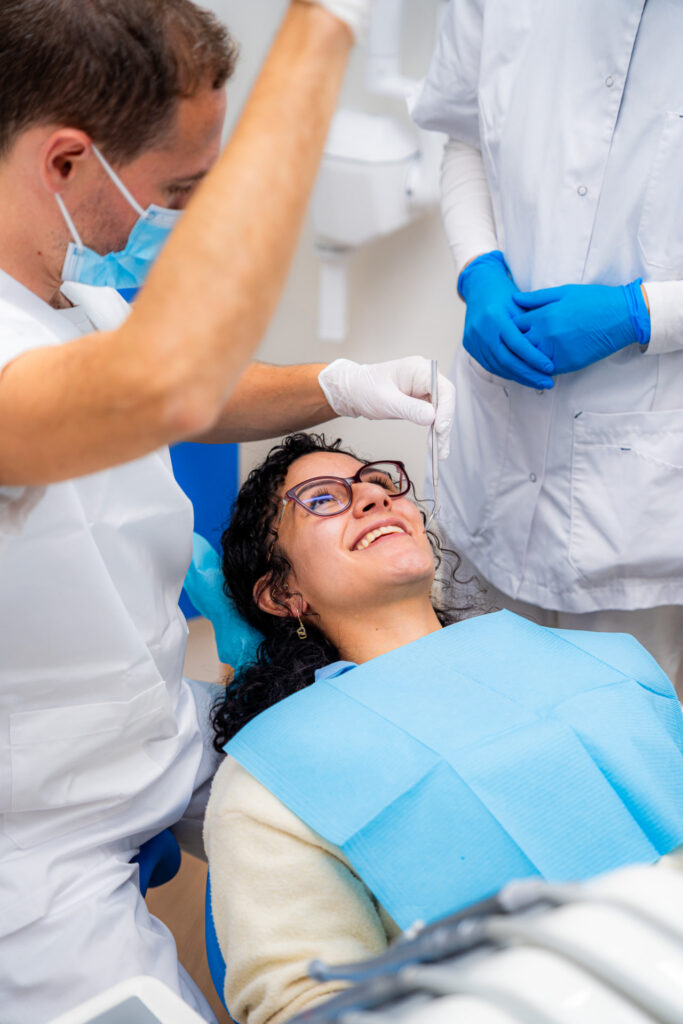
Those experiences often affect the nervous system more strongly than people realise.
A calm environment, clear explanation and step-by-step guidance are therefore not a luxury, but an essential part of modern patient care.
In a digital workflow it also helps when patients can actively follow the scans, planning and treatment options. Understanding reduces tension.
Why patients from Rotterdam, Delft and Vlaardingen increasingly choose digital dentistry
Patients research treatments far more thoroughly today than ten years ago.
Especially in regions such as Rotterdam, Schiedam, Vlaardingen and Delft, demand is growing for:
- less invasive dentistry
- digital precision
- transparent treatment planning
- durable solutions
- preservation of natural tissue
- long-term oral health
For many patients, technology gives not only a more modern feel, but above all more confidence in how predictable the treatment is.
Frequently asked questions
Frequently asked questions about fear of implant treatment (FAQ)
How long does recovery take after an implant?
That differs from situation to situation. Many patients quickly resume daily activities, while full osseointegration usually takes a few months.
Is a dental implant safe?
Implants are among the best-researched and most predictable restorative treatments in modern dentistry, provided diagnostics, placement and aftercare are carried out carefully.
Can anyone have implants?
Not always. Factors such as bone volume, gum health, smoking and general health play an important role.
What happens if I wait too long?
Long-term tooth loss can lead to progressive bone loss, which can make treatment more complex later. Read the full article here.
Is digital implant dentistry better?
Digital workflows can improve the accuracy, planning and predictability of treatment. The quality of the execution remains essential, however.
Can an implant feel natural?
When the implant, crown and bite are well matched, many patients come to experience the implant as a natural part of their teeth over time.
Can I ask for a short pause during the treatment?
Yes. We take your comfort into account during treatment. If you want to stop for a moment or need a short break, you can almost always say so.
Is placing an implant more painful than having a tooth extracted?
Many patients find afterwards that placing an implant was less demanding than they expected. How the treatment is experienced depends on the situation and the extent of the procedure.
Does a CBCT scan help to plan the treatment more safely?
When a CBCT is indicated, it provides three-dimensional information about the bone, the nerves and the anatomy. That helps with careful planning.
Do I have to decide straight away during the consultation?
No. The consultation is meant to assess your situation and discuss all the options calmly. You can then decide in your own time.
Calm and clarity are often more important than speed
In implant dentistry, trust is not only about technical expertise.
It is also about:
- taking time to explain
- transparency about the options
- realistic expectations
- careful planning
- attention to comfort
- thinking long term
For many patients, fear does not diminish because risks are denied, but because the treatment process becomes understandable and manageable.
Digital dentistry supports exactly that.
Conclusion
Fear of implant treatment is understandable. Especially when earlier dental experiences have caused uncertainty or when information online feels contradictory.
Modern implant dentistry has evolved considerably, however.
Digital planning, CBCT technology, guided surgery and minimally invasive techniques make treatment today more accurate, more predictable and often less demanding than many patients expect.
At 3D Tandarts, the focus is not only on placing implants, but on lasting oral health, transparent communication and a treatment path in which patients understand what is happening, step by step.
It is precisely that combination of precision, calm and long-term vision that makes modern implant dentistry more accessible to many people than they expect.

Focus areas: endodontics, surgery and digital implant dentistry · BIG registration: 29919697202 · Last updated: 23 September 2026 · Written by Danilo Di Vico — digital implant dentistry at 3D Tandarts Schiedam
Knowledge base
Latest articles

Hidden root canals: why a tooth can keep causing problems after root canal treatment
Pain after root canal treatment? Learn how a hidden or missed canal happens and how the microscope and CBCT help. Book an assessment in Schiedam.

Surgical microscope for root canal treatment in Schiedam
What does a surgical microscope do in root canal treatment? See how precision and CBCT help save your tooth. Book at 3D Tandarts in Schiedam.
Implant consultation in Schiedam: find out which treatment suits you
Is a dental implant right for you? Find out what an implant consultation in Schiedam involves: examination, advice and a treatment plan. Book today.
Questions about your situation?
During a consultation we look at your situation and discuss the options.