
Endodontics
Retreatment of a root canal (root canal retreatment) in Schiedam
Do you have pain, sensitivity, or swelling again in a tooth that has already had a root canal treatment? That can indicate a new or persistent inflammation at the root tip. At 3D Tandarts, we first examine carefully what is going on. Afterwards, we discuss whether root canal retreatment is appropriate. Often, a tooth that causes problems again can still be preserved.
Request appointment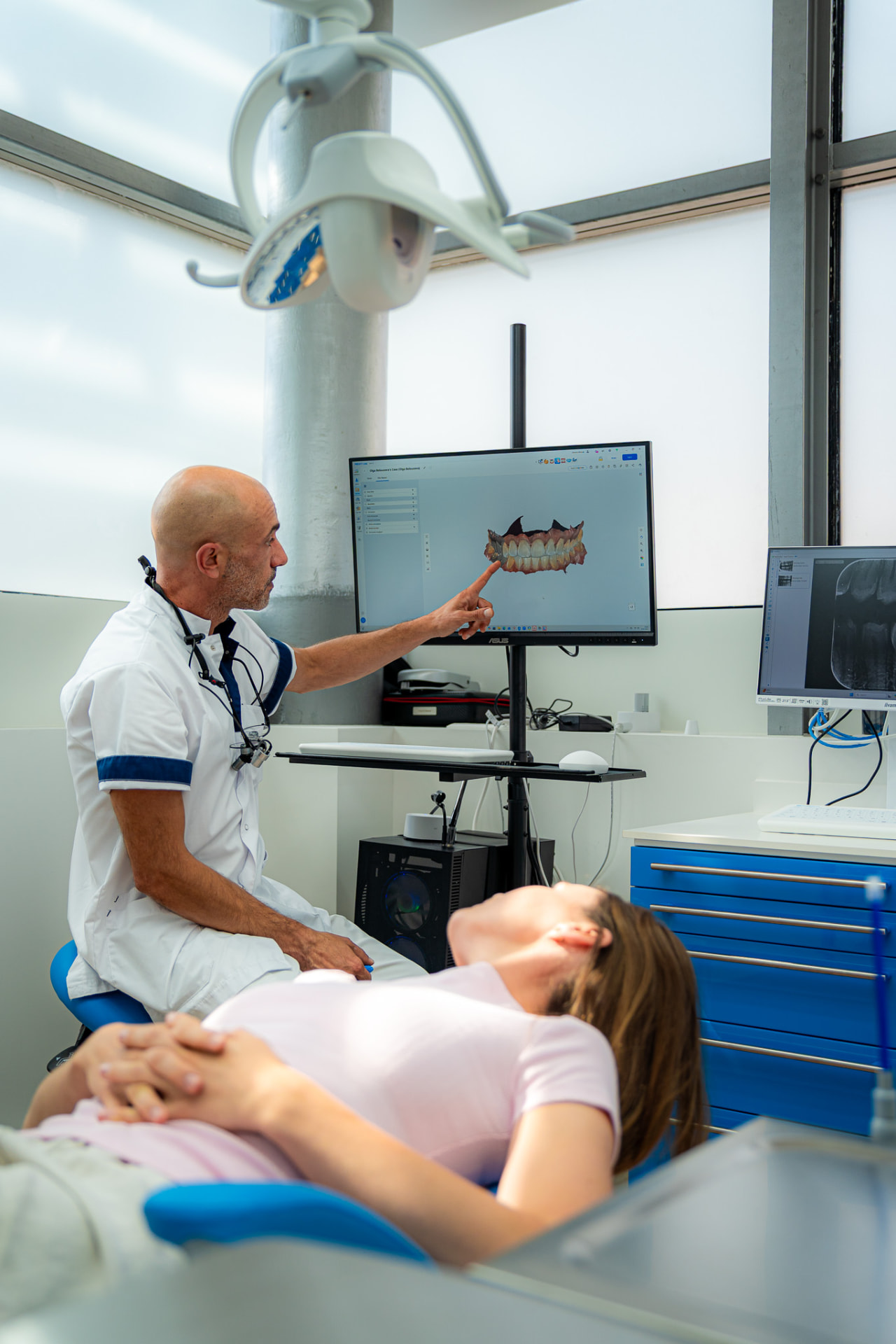
What is a root canal retreatment?
In a root canal retreatment, a root canal that has already been treated is treated again. The old filling material is removed, the canals are cleaned again, disinfected, and sealed. Afterwards, the tooth is restored with a filling or crown.
Why can a treated tooth cause symptoms again?
- A canal was not found at the time or was not completely cleaned, for example an extra or curved canal
- The filling or crown no longer seals properly, allowing bacteria to enter again
- A new cavity or a crack in the tooth
- An infection that did not completely disappear after the first treatment
What do we do during the examination?
The dentist assesses the tooth, the previous treatment, and the X-rays. If regular X-rays are not clear enough, a CBCT scan (3D X-ray) can help detect hidden canals, inflammation at the root tip, or cracks. This way, you know in advance what is and is not feasible.
How does root canal retreatment proceed?
- Examination and diagnosis: X-ray and, if necessary, a CBCT scan.
- Anesthesia and rubber dam: for a clean, dry, and safe working area.
- Removal of old material: under magnification (microscope), so the canals can be assessed accurately.
- Cleaning and disinfecting: with fine files and rinsing solution, supplemented with a diode laser if necessary.
- Filling: the canals are completely resealed.
- Restoring the tooth: a permanent filling or crown, depending on how much tooth structure remains.
A retreatment is often technically more difficult than a first treatment and usually takes more time, sometimes multiple appointments.
Is a retreatment always possible?
Not always. It depends, among other things, on the condition of the tooth, the previous treatment, and whether there is, for example, a fracture in the root. The dentist discusses the chances of success, the limitations, and the alternatives, such as a root-end procedure (apicoectomy), a referral to a specialist, or extracting the tooth and replacing it with an implant.
What does a retreatment cost?
The costs depend on the tooth, the number of canals, the complexity, and the number of appointments (according to the NZa rates). You will receive a clear estimate in advance.
Why choose 3D Tandarts?
- Examination and treatment under magnification
- CBCT scan and laser where it helps
- Explanation in Dutch, English, and Italian
- Directly at NS station Schiedam Centrum, accessible from Rotterdam, Vlaardingen, Delft, and Maassluis
Carefully assessed
Personal assessment
The dentist assesses your oral health and discusses your wishes, possibilities and alternatives before recommending root canal retreatment.
Our approach
A clear process
Digital diagnostics and modern techniques are used where appropriate. We explain each step before you make a decision together with the dentist.
What matters
Careful examination before treatment
Clear explanation of options and alternatives
Planning tailored to your personal situation
Frequently asked questions
Root canal retreatment
When is a root canal retreatment considered?
If a previously treated tooth causes complaints again, or if an X-ray shows an infection at the root tip.
Does a root canal retreatment hurt?
The treatment is performed under local anesthesia. Afterwards, the tooth may be sensitive for a few days.
What is the difference from a regular root canal treatment?
In a retreatment, the old filling material must first be removed and the cause of the recurring complaints must be found. This often makes the treatment more complicated.
What if a retreatment is not possible?
Then we discuss the alternatives, such as an apicoectomy, a referral, or tooth extraction.
Discuss your situation
Request an appointment. The dentist will assess which care suits your situation.