
Bone loss, implant dentistry and long-term oral health in Rotterdam and Schiedam
Written by Danilo Di Vico | Dentistry, Digital Implantology and Endodontics at 3D Tandarts Schiedam
– Last updated: 2 October 2026
Short answer
Yes. The longer a tooth is missing, the greater the chance of bone loss, shifting of the surrounding teeth and more complex treatment in the future. That does not mean an implant is impossible later, but a timely assessment often gives more treatment options and a more predictable result.
Many people lose a tooth at some point and at first think: “It doesn’t really bother me that much.” Especially when the missing tooth is at the back of the mouth, treatment is often put off for months or even years. Yet more changes after tooth loss than many patients realise.
A missing tooth affects not only appearance or chewing, but also:
- the jawbone
- the stability of the surrounding teeth
- the bite
- the load on your teeth
- long-term oral health
The longer a tooth is missing, the greater the chance that the jawbone slowly begins to shrink.
For many patients in Rotterdam, Schiedam and the rest of South Holland, implant treatment therefore becomes technically more complex over time than if action had been taken sooner.
Table of contents
- What happens after losing a tooth?
- Why does the jawbone begin to shrink?
- How quickly does bone loss occur?
- What consequences can delay have?
- Why does implant treatment sometimes become more complex?
- What if there is not enough jawbone?
- When is an implant still possible?
- Why digital diagnostics matter
- Frequently asked questions
What happens after losing a tooth?
After a tooth is lost, the situation in the mouth changes gradually.
Many patients notice few symptoms at first, especially when it concerns a molar at the back of the mouth.
Yet the body begins to adapt to the missing tooth root straight away.
A natural tooth root normally stimulates the jawbone during chewing forces.
When that stimulation disappears, the bone receives less functional load.
As a result, the jawbone can slowly begin to shrink.
This process is usually gradual and painless, so many patients do not notice it for a long time.
Why does the jawbone begin to shrink?
Jawbone stays healthy through load and stimulation.
With natural teeth this happens automatically when speaking, eating and chewing.
When a tooth is lost, that load disappears too.
The body therefore begins to slowly break down the bone in that place.
This is called bone resorption.
Bone loss can affect:
- the stability of the surrounding teeth
- gum support
- facial structure
- bite function
- options for future implant treatment
Especially in the first period after tooth loss, the bone can change relatively quickly.
How quickly does bone loss occur?
That varies greatly from patient to patient.
Factors that play a role include:
- the location of the missing tooth
- the quality of the jawbone
- smoking
- general health
- oral hygiene
- the load on your teeth
In some patients the situation stays relatively stable for years.
In others the jawbone can shrink faster.
That is precisely why an early assessment is often important. Not because immediate treatment is always necessary, but because a timely analysis helps to better understand future options.
What happens after 3 months, 1 year and 5 years?
The speed at which the jawbone changes differs from person to person. Even so, we often see a number of general developments.
After about 3 months
Healing of the wound is usually complete. At the same time, the jawbone begins to adapt to the absence of the tooth root. This happens without pain and is usually not noticeable.
After about 1 year
The bone may have noticeably shrunk. The surrounding teeth may also slowly move towards the gap, and the bite may begin to adjust. Not every patient notices this straight away, but it can affect future treatments.
After several years
When a tooth has been missing for years, the situation can become more complex. Sometimes there is less bone available for an implant, or additional treatments such as bone grafting are needed. Even so, this does not automatically mean that implant treatment is no longer possible.
How quickly these changes occur varies greatly from person to person. That is why an individual assessment is more important than the number of months or years a tooth has been missing.
What consequences can delay have?
When a tooth is missing for a long time, several changes can occur.
Shifting of teeth
The surrounding teeth can slowly shift towards the gap.
As a result, the bite can change.
Overload
Other teeth sometimes have to absorb more chewing force, which adds extra strain.
Bone loss
The longer a tooth is missing, the greater the chance that the available jawbone shrinks.
With severe bone loss, implant treatment can become technically more challenging.
Sometimes additional treatments are needed, such as bone grafting or sinus lift procedures.
Is it ever too late for an implant?
Many patients think they have “waited too long”.
Fortunately, that is far from always the case.
Even when a tooth has been missing for years, there are often still several treatment options. Sometimes an implant can be placed straight away. In other cases additional diagnostics or bone grafting are needed first.
It is not the time that has passed that determines whether implant treatment is possible, but your current oral situation, the amount of bone available and your general health.
Only a clinical examination and – when needed – a CBCT scan can give a reliable answer.
Why does implant treatment sometimes become more complex?
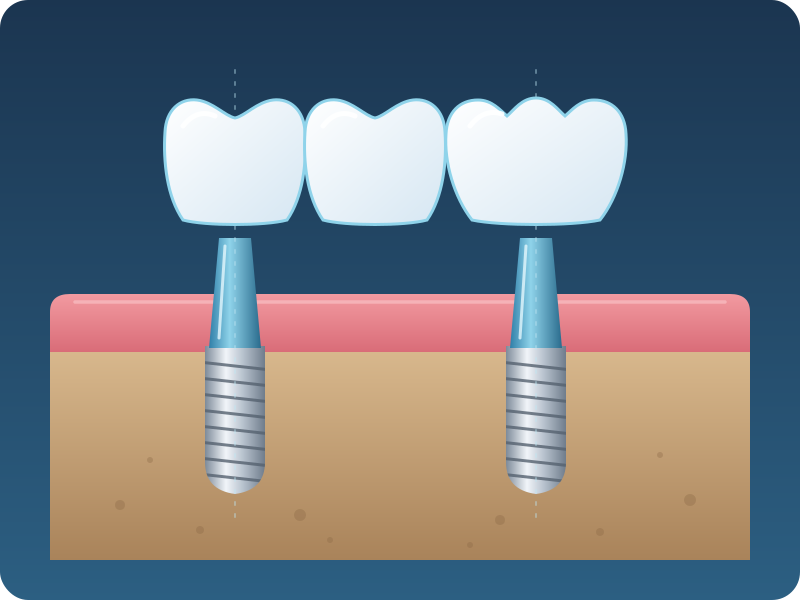
A stable implant needs enough healthy jawbone.
When a tooth has been missing for a long time, the amount of bone available can decrease.
As a result, placing implants sometimes becomes more difficult.
In modern implant dentistry we therefore look carefully beforehand at:
- bone volume
- bone density
- anatomical structures
- nerve pathways
- the load on your teeth
- aesthetic integration
With modern CBCT 3D diagnostics, this can be assessed in great detail.
This makes it possible to assess not only whether an implant is possible, but also which treatment offers the greatest chance of a stable result in the long term.
What if there is not enough jawbone?
Not enough jawbone does not automatically mean that implant treatment is impossible.
In some situations, bone grafting can be considered to create extra support.
Which treatment is suitable depends on several factors:
- the amount of remaining bone
- the location in the mouth
- general health
- functional load
- long-term prognosis
For many patients bone grafting sounds drastic at first, but modern digital planning often makes these procedures far more predictable today than in the past.
Not enough jawbone therefore does not automatically mean that an implant is impossible. It mainly means that a careful assessment is needed to determine which treatment is the most predictable in your situation.

When is an implant still possible?
One of the most frequently asked questions is: “Have I waited too long for an implant?” In many cases the answer is: no.
Some patients wrongly think they are “too late” for implant treatment.
In reality, there are often several treatment options today, even with greatly reduced bone volume.
That is why modern implant dentistry always starts with accurate diagnostics and personal analysis.
At our dental practice 3D Tandarts in Schiedam we use the following for this:
- CBCT 3D scans
- digital implant planning
- analysis of the jaw structures
- guided implant surgery
- assessment of functional load
This often makes it possible to determine more accurately which treatment is technically and biologically the most suitable.
Why digital diagnostics matter today
Modern implant dentistry has become highly digital.
In the past we worked mainly with two-dimensional X-ray images and manual estimation; today we use three-dimensional analysis.
With CBCT 3D diagnostics, important structures can be assessed accurately, including:
- bone volume
- bone density
- nerve structures
- sinus position
- available space
- implant position
This digital preparation helps to carry out treatments in a more controlled, accurate and predictable way.
For many patients this brings more peace of mind and confidence before treatment starts.
Frequently asked questions
Frequently asked questions
Is bone loss always visible?
No. Bone loss often happens gradually and without obvious symptoms.
Is implant treatment still possible after years of tooth loss?
In many cases yes, but sometimes additional treatments are needed.
What happens if the surrounding teeth shift?
This can affect bite function, how easily the teeth can be cleaned and the space available for implants.
Does everyone have enough jawbone for implants?
Not always. That is why individual diagnostics with CBCT 3D scans are important.
What is bone grafting?
Bone grafting is a treatment in which extra bone volume is created to better support implants.
Would you like to know more? Then read our detailed article about bone loss and bone grafting via this link.
Can I still get an implant after five years?
Yes, in many cases that is still possible. Additional diagnostics or bone grafting may be needed, however. Only an individual examination can give a definite answer.
How do I know whether I have bone loss?
Bone loss usually happens without pain or obvious symptoms. A clinical examination and – when needed – a CBCT scan can show how much bone is present.
Does every missing tooth have to be replaced?
Not always. Whether treatment is wise depends on the position of the tooth, your bite, your oral health and your personal situation.
Personal advice about implant dentistry in Schiedam
Are you unsure about implants, or do you wonder how much jawbone is still present? You can book an implant consultation with us via this link.
At 3D Tandarts we combine modern technology, digital precision and personal guidance for patients from all over South Holland.
Conclusion
After the loss of a tooth, the mouth often changes gradually, even when this causes few symptoms at first.
Bone loss, shifting teeth and changes in the bite can make implant treatment more complex later on.
Modern digital implant dentistry makes it possible today to analyse these changes much more accurately thanks to CBCT 3D diagnostics and digital treatment planning.
For many patients this means not only replacing a missing tooth, but above all preserving stability, function and long-term oral health.
Not sure whether you have waited too long?
An implant consultation gives clarity about your current situation and shows which treatment options are still possible today.
Feel free to book an appointment via this link.

Focus areas: Digital Implantology and Endodontics · BIG registration: 29919697202 · Last updated: 2 October 2026
Knowledge base
Latest articles

Hidden root canals: why a tooth can keep causing problems after root canal treatment
Pain after root canal treatment? Learn how a hidden or missed canal happens and how the microscope and CBCT help. Book an assessment in Schiedam.

Surgical microscope for root canal treatment in Schiedam
What does a surgical microscope do in root canal treatment? See how precision and CBCT help save your tooth. Book at 3D Tandarts in Schiedam.
Implant consultation in Schiedam: find out which treatment suits you
Is a dental implant right for you? Find out what an implant consultation in Schiedam involves: examination, advice and a treatment plan. Book today.
Questions about your situation?
During a consultation we look at your situation and discuss the options.