Last updated: 30 September 2026
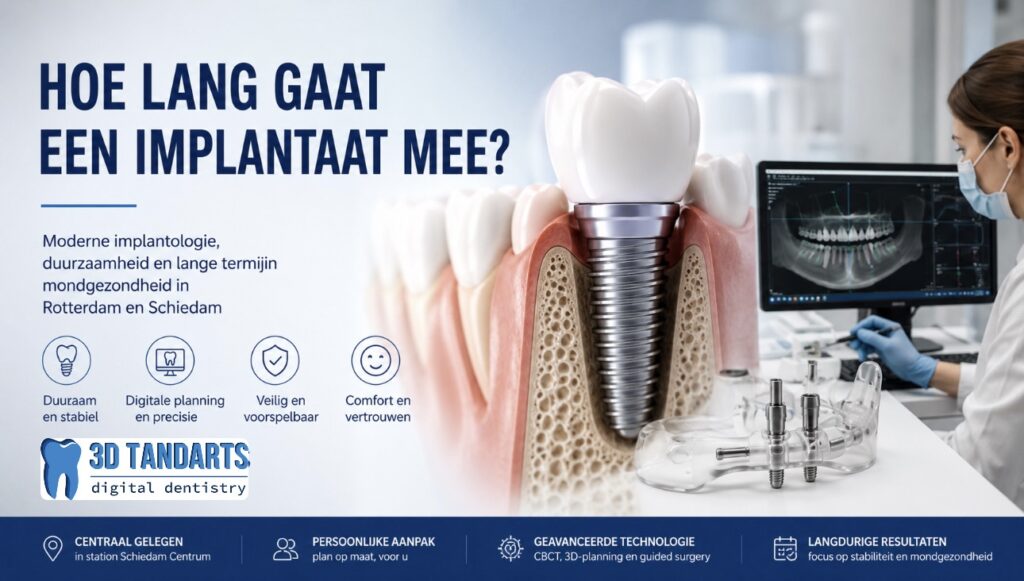
Today, a dental implant can last for decades, provided it is carefully planned, placed and maintained.
Success depends not only on the implant itself, but above all on the biological and functional conditions in the mouth: jawbone, gums, load and oral hygiene.
Modern implant dentistry is therefore not only about replacing a tooth, but about creating a stable, predictable and durable situation in the mouth for the long term.
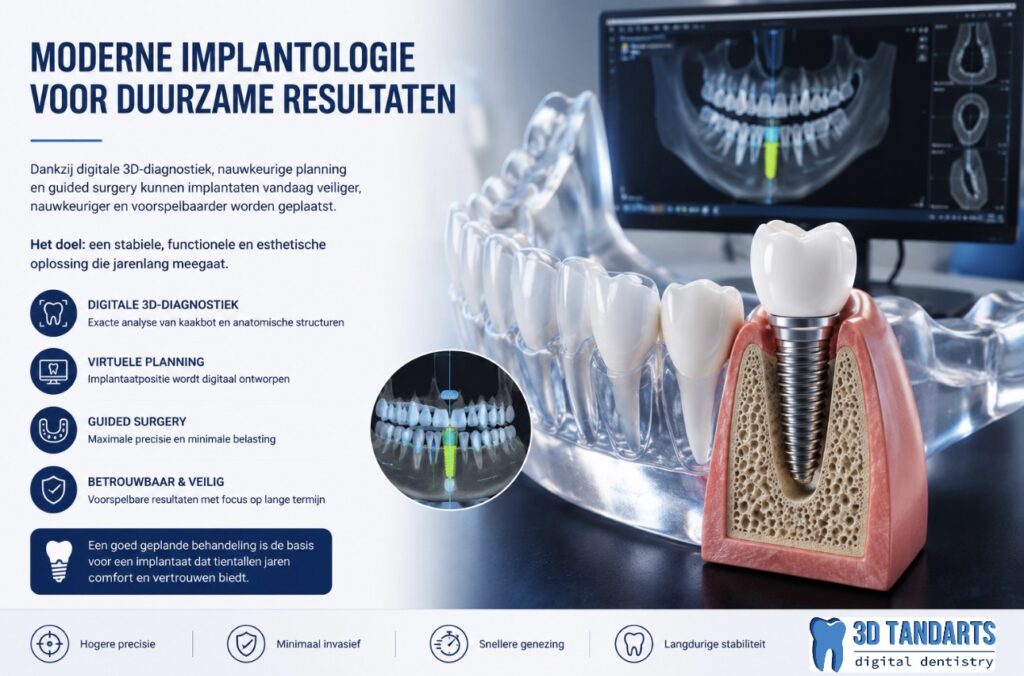
Thanks to techniques such as CBCT 3D diagnostics, digital implant planning and guided surgery, an implant can today be placed far more precisely than in the past.
For patients from Rotterdam, Schiedam and the rest of South Holland, this means not only a restored smile, but above all being able to eat, speak and smile comfortably and with confidence again.
At 3D Tandarts, every implant treatment is planned digitally on an individual basis, aiming for a predictable and durable result that fits the patient’s anatomy and functional situation.
How long does an implant last on average?
When an implant is properly indicated, placed precisely and followed up with good aftercare, it can function for a very long time.
Many implants remain stable for decades and function without significant problems.
The success of an implant rarely depends on a single factor, but on a combination of planning, bone quality, load and maintenance.
What determines its lifespan?
- good oral hygiene
- stable gums
- sufficient jawbone
- correct positioning of the implant
- precise digital planning
- regular professional check-ups
An implant is therefore often seen as a long-term investment in function, comfort and oral health.
When is it important to take action?
After the loss of a tooth, the jawbone slowly changes. The longer replacement is postponed, the greater the chance of bone loss.
This can make treatment more complex later on.
That is why early assessment is important: not because it is always urgent, but because it can improve the predictability of the result.
Why do so many patients choose implants?
Today an implant is much more than an aesthetic replacement.
The aim of modern implant dentistry is to restore full oral function and preserve healthy surrounding structures.
Implants contribute to:
- restored chewing function
- a fixed, independent replacement for missing teeth
- preservation of healthy adjacent teeth, as they usually do not need to be prepared
- long-term oral health
Many patients notice above all the difference in everyday comfort: being able to eat, speak and smile normally again without self-consciousness.
Implant dentistry has evolved considerably
Modern implant dentistry has changed greatly in recent years.
In the past, work was often based on two-dimensional X-rays and estimation; today we use digital 3D technology.
In practice this means:
- CBCT 3D scans for exact bone analysis
- intraoral digital scans
- virtual implant planning
- guided surgery
- individual analysis of anatomy and load
This digital workflow helps to prepare the treatment carefully and, depending on the situation, can contribute to a less invasive procedure.
At 3D Tandarts, every implant treatment therefore starts with a detailed digital analysis of bone structure, function and aesthetics — not a standard solution, but a tailor-made plan.
Why experience and planning are crucial
The success of an implant depends not only on technology, but above all on clinical experience and treatment planning.
Important factors are:
- correct diagnosis
- the clinician’s experience
- digital implant planning
- knowledge of the jawbone and chewing forces
- precise positioning
- structured aftercare
Modern implant dentistry is therefore a combination of surgery, digital planning and restorative precision.
For patients looking for an implant dentist in Rotterdam or Schiedam, this is often decisive in choosing a treatment.
Which factors determine the lifespan of an implant?
The lifespan is determined by a combination of biological, technical and behavioural factors.
Jawbone quality
An implant needs sufficient, healthy jawbone to integrate stably.
That is why we first look at:
- bone volume and bone density
- the position of nerves and anatomy
- available space
- functional load
CBCT scans give a very precise picture of the situation.
Positioning of the implant
The exact position determines:
- distribution of chewing forces
- aesthetic result
- ease of cleaning
- long-term stability
A digitally planned position helps to limit risks and make the result predictable.
Oral hygiene
An implant also needs daily care.
When bacteria build up around the implant, peri-implantitis can develop: an inflammation of the gum and bone around the implant.
Good oral hygiene therefore remains essential for long-term preservation.
What is peri-implantitis?
Peri-implantitis is an inflammation around an implant in which the surrounding bone can be affected.
Without timely treatment, this can affect stability.
Risk factors:
- insufficient oral hygiene
- smoking
- too few professional check-ups
- overloading
- individual biological factors
Early detection is crucial to limit damage.
Lifestyle habits and implants
Daily habits affect the lifespan of implants.
- smoking increases the risk of inflammation
- teeth grinding (bruxism) causes overloading
- poor oral hygiene increases the bacterial load
- excessive chewing forces can cause mechanical stress
With teeth grinding, a protective night guard (occlusal splint) can often be recommended.
Regular implant check-ups
Aftercare plays a central role in preserving implants.
During check-ups we look at:
- gum health
- stability of the implant
- bone level
- ease of cleaning
- wear of the crown or bridge
Preventive aftercare can help to identify problems early and treat them in good time.
Implants and changes in the jawbone
After a tooth is lost, the jawbone in that area undergoes natural remodelling and its volume may decrease. An implant transfers chewing forces to the surrounding bone, but it does not completely prevent these changes. For that reason, when planning treatment we assess both the amount of bone present and the position of the future restoration.
What can patients do themselves?
The success of an implant depends heavily on daily care:
- good oral hygiene
- regular check-ups
- professional cleaning
- stopping smoking
- protection against teeth grinding
- a healthy lifestyle
A well-maintained implant generally has a very favourable long-term prognosis.
Why do patients in South Holland choose digital implant dentistry?
More and more patients from Rotterdam, Schiedam, Delft, The Hague and Leiden choose digital implant dentistry because of:
- precise 3D diagnostics
- guided implant surgery
- predictable results
- minimally invasive techniques
- a focus on long-term stability
- preservation of healthy structures
The combination of technology, precision and personal guidance makes modern implant dentistry increasingly predictable.
Easy to reach from Rotterdam and the surrounding area
The 3D Tandarts practice is located in Schiedam Centrum station and is easy to reach from:
- Rotterdam
- Delft
- The Hague
- Leiden
- Maassluis
- Utrecht
For implant treatment involving several appointments, easy access is an important practical advantage.
Frequently asked questions
Frequently asked questions
How long does a dental implant last?
With good oral hygiene and regular check-ups, implants can last for decades.
Can an implant lose stability?
Yes, in some cases because of inflammation, overloading or insufficient bone support.
Does smoking affect implants?
Yes, smoking considerably increases the risk of complications.
How often should an implant be checked?
That depends on the individual situation, but regular check-ups are essential.
Is an implant stronger than a natural tooth?
Implants are very strong, but still depend on correct loading and maintenance.
What happens if an implant fails?
In some cases, a new treatment or a replacement implant may be possible after healing.
Personal advice on implant dentistry in Schiedam
During a consultation, the situation is carefully assessed with CBCT 3D diagnostics and digital planning.
We look at:
- bone quality
- ideal implant position
- functional load
- aesthetic possibilities
- long-term prognosis
Many patients find that a clear digital analysis beforehand brings calm, insight and confidence.
At 3D Tandarts, an individual and predictable approach is central, with a focus on durability and precision.
Conclusion
An implant can last for decades, but the result always depends on a combination of factors: planning, bone quality, oral hygiene, lifestyle and professional follow-up.
Modern digital implant dentistry today offers more ways to plan and carry out implant treatment carefully.
For many patients this means not only restored function and aesthetics, but above all a stable, durable and comfortable solution for the long term.
Knowledge base
Latest articles

Hidden root canals: why a tooth can keep causing problems after root canal treatment
Pain after root canal treatment? Learn how a hidden or missed canal happens and how the microscope and CBCT help. Book an assessment in Schiedam.

Surgical microscope for root canal treatment in Schiedam
What does a surgical microscope do in root canal treatment? See how precision and CBCT help save your tooth. Book at 3D Tandarts in Schiedam.
Implant consultation in Schiedam: find out which treatment suits you
Is a dental implant right for you? Find out what an implant consultation in Schiedam involves: examination, advice and a treatment plan. Book today.
Questions about your situation?
During a consultation we look at your situation and discuss the options.