
Microscopic endodontics at 3D Tandarts: modern precision for saving teeth
Written by: Danilo Di Vico — Dentistry and Digital Implantology at 3D Tandarts Schiedam, with a special interest in microscopic endodontics, diagnostics and implantology.
Last updated: 26 September 2026
Reading time: 8 minutes.
In brief
In endodontics, the surgical microscope provides superior lighting and magnification. This allows the dentist to see the smallest details inside the tooth, so that hidden root canals, fine cracks and persistent infections can be treated accurately. Modern endodontics combines, among other things, the use of a surgical microscope, digital diagnostics and, when indicated, CBCT imaging to carry out root canal treatment as precisely as possible. At 3D Tandarts Schiedam these techniques are a standard part of our endodontic approach, not only in complex cases.
What is a surgical microscope in root canal treatment?
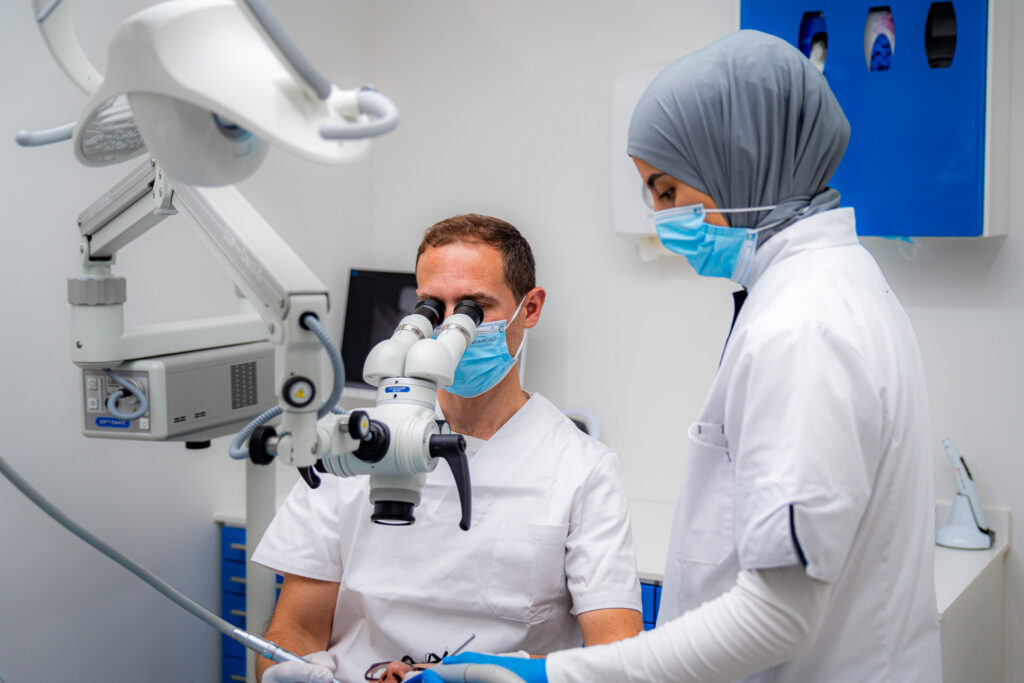
A surgical microscope is a special dental microscope that gives the dentist a highly magnified, brightly lit view of the tooth during root canal treatment or root canal retreatment. This makes small anatomical details visible that are difficult or impossible to see with the naked eye or a dental loupe. In modern endodontics, this helps to locate, clean and seal root canals more accurately.
Modern endodontics demands precise working
A root canal treatment twenty years ago and a root canal treatment today look similar on the surface: remove the bacteria, clean the canal, seal it hermetically. But the way this is done has fundamentally changed.
In the past, the naked eye and touch determined how thoroughly a root canal system could be examined. Today, digital diagnostics make it possible to know much more about the anatomy of a tooth beforehand. And where part of the canal system simply used to remain invisible, a surgical microscope now brings details into view down to a fraction of a millimetre.
That precision is not a luxury. It is the reason why natural teeth can be saved more often and more predictably than before.
Modern endodontics is not only about carrying out a treatment, but about making the right diagnosis and the right decision to save your tooth.
Would you like to know what modern endodontic precision can mean for your tooth? Book a consultation today and discover the possibilities for lasting tooth preservation. You can easily book here.
The surgical microscope is part of our standard approach
At 3D Tandarts Schiedam, the surgical microscope is a standard part of our endodontic approach. Together with digital diagnostics, modern disinfection techniques and, when indicated, CBCT imaging, it forms the basis for a root canal treatment that is as precise as possible.
This means the microscope is not brought in as an exception for the occasional difficult case, but is a fixed part of how we approach every root canal treatment.
The microscope does not work alone
A surgical microscope is powerful, but it is not a stand-alone solution. A good root canal treatment is the result of several elements working together:
- clinical examination — the basis of every correct diagnosis;
- digital X-rays — for a first impression of the anatomy;
- CBCT, when needed — for a three-dimensional view of the roots and surrounding bone;
- the surgical microscope — for strongly magnified vision and better illumination during the treatment itself;
- modern disinfection techniques — to clean the root canal system thoroughly;
- careful sealing — to prevent reinfection;
- a durable restoration — to protect the tooth in the long term.
None of these elements replaces the others. Together they form what we regard as modern endodontics: an approach in which technology and clinical experience reinforce each other, rather than one having to compensate for the other.
What the surgical microscope makes possible in practice
- Locating extra and hidden root canals. Subtle differences in colour and texture in the dentine reveal where a canal entrance is, even when it cannot be seen with the naked eye.
- Finding calcified canals. A canal that has become blocked is sometimes no more than a hair-thin line — a trail that can only be followed under strong magnification and targeted lighting.
- Recognising micro-cracks and perforations early, instead of only months later when symptoms return.
- Removing old fillings precisely during a retreatment, with minimal loss of healthy tooth structure.
- Checking the quality of cleaning and sealing, step by step during the treatment itself.
- Preserving as much healthy tooth structure as possible, because the work can be targeted instead of done by feel.
Important
A surgical microscope does not make a treatment successful on its own. The dentist’s experience, a correct diagnosis, good disinfection of the root canal system and a good restoration remain at least as important.
Your natural tooth deserves the best chance of being saved. You can book here in just 2 minutes.
The role of CBCT in modern endodontics
In straightforward cases, a two-dimensional X-ray is often enough to assess and treat a tooth. When more diagnostic information is needed, a CBCT scan provides a three-dimensional view of the anatomy and helps to plan the treatment more precisely — for example in the case of a complex root shape, a suspicion of extra canals, or when previous treatments did not give the desired result.
A surgical microscope and a CBCT scan complement each other: the microscope shows what is inside the tooth, the CBCT scan what is happening around it.
When does this approach add the most value?
Although the surgical microscope is a standard part of our approach, the added value is most noticeable in:
- retreatment of a previously treated tooth;
- heavily calcified root canals;
- extra or hard-to-find root canals;
- a broken instrument in the canal;
- a suspected perforation;
- complex anatomy with multiple roots or side branches;
- doubt about a vertical root fracture.
Without versus with this approach
- Traditional approach: Limited magnification; Modern endodontics: High magnification, up to approximately 25×
- Traditional approach: Diagnostics mainly based on 2D X-rays; Modern endodontics: Digital diagnostics, CBCT when indicated
- Traditional approach: Less detail visible during treatment; Modern endodontics: Small anatomical details clearly visible
- Traditional approach: More difficult with complex anatomy; Modern endodontics: More control in complex cases
- Traditional approach: Way of working depends on the case; Modern endodontics: Fixed, integrated approach for every treatment
Our philosophy
At 3D Tandarts Schiedam we do not believe in isolated techniques, but in a coherent approach. The surgical microscope does not stand on its own: it is integrated with digital diagnostics, CBCT where needed, and a careful treatment plan tailored to the individual patient.
Want to know more about related topics? Also read our articles on root canal treatment, root canal retreatment, CBCT diagnostics and implant or root canal treatment.
Frequently asked questions
Frequently asked questions (FAQ)
What is modern endodontics?
Modern endodontics is an approach in which digital diagnostics, a surgical microscope, modern disinfection techniques and, when needed, CBCT imaging are used together to carry out root canal treatment as precisely as possible.
Is a surgical microscope the same as a dental loupe?
No. A loupe offers limited, fixed magnification without powerful coaxial lighting. A surgical microscope offers much higher, adjustable magnification combined with strong, targeted lighting.
Can a microscope replace a CBCT scan?
No. A surgical microscope shows what is inside the tooth, while a CBCT scan shows what is around the tooth. The two techniques complement each other.
Is a CBCT scan taken for every root canal treatment?
No. In straightforward cases a two-dimensional X-ray is often enough. A CBCT scan is used when additional three-dimensional information is needed for the diagnosis or the treatment plan.
Does this approach make the treatment take longer?
Treatment time depends mainly on how complex the tooth is. In many cases the treatment actually runs more efficiently, because canals are found faster and more precisely.
Will the treatment feel different?
No. The treatment is carried out under local anaesthetic and feels no different to you than a regular root canal treatment. The difference lies in the precision with which we work, not in what you experience.
Do all dentists work this way?
No. Not every practice has a surgical microscope, CBCT or the specific training needed to apply these techniques in an integrated way. At 3D Tandarts Schiedam this is our standard way of working.
Can every tooth be treated this way?
This approach can be used for almost every root canal treatment. Whether a tooth can ultimately be saved depends on factors such as the amount of healthy tooth structure remaining and the original diagnosis.
Conclusion
Modern endodontics is not about a single instrument, but about a coherent approach in which digital diagnostics, a surgical microscope, CBCT where needed and careful clinical execution come together. Precision is not an afterthought here, but the core of how we try to save a natural tooth as well as possible.
Would you like to know how we apply this approach to your treatment? Book an appointment for a consultation at 3D Tandarts Schiedam.
Written by: Danilo Di Vico — Dentistry and Digital Implantology at 3D Tandarts Schiedam, with a special interest in microscopic endodontics, diagnostics and implantology.
This article has been prepared for general information and does not replace personal dental advice. During a consultation we assess your situation and draw up a treatment plan that suits your oral health.
Last updated: 26 September 2026

Focus areas: Endodontics, Surgery and Digital Implantology · BIG registration: 29919697202
Knowledge base
Latest articles

Hidden root canals: why a tooth can keep causing problems after root canal treatment
Pain after root canal treatment? Learn how a hidden or missed canal happens and how the microscope and CBCT help. Book an assessment in Schiedam.

Implant consultation in Schiedam: find out which treatment suits you
Is a dental implant right for you? Find out what an implant consultation in Schiedam involves: examination, advice and a treatment plan. Book today.
Night guard in Schiedam for teeth grinding and jaw clenching
Struggling with teeth grinding or jaw clenching? Learn when a custom night guard makes sense and why diagnosis matters. Book an assessment in Schiedam.
Questions about your situation?
During a consultation we look at your situation and discuss the options.