What is the best choice for your tooth?
Written by Danilo Di Vico — Dentistry and Digital Implantology at 3D Tandarts Schiedam, with a special interest in microscopic endodontics, diagnostics and implantology.
– Last updated: 3 October 2026
Are you torn between a dental implant and root canal treatment? Then you probably don’t just want to know what each treatment involves. Above all, you want to know: what is the sensible choice for my tooth, in my situation?
As dentists, we regularly see in practice that patients think an implant is always better than their own tooth. In reality, the decision mostly comes down to the restorability and prognosis of the tooth.
The short answer: if your own tooth can still be predictably saved and durably restored, root canal treatment usually deserves serious consideration. If the tooth can no longer be reliably saved, for example because of a vertical root fracture, deep decay, too little tooth structure, serious problems with the supporting tissues or a poor prognosis after earlier treatment, then a dental implant may be the better choice.
So the right question is not: “Is an implant better than root canal treatment?”
The right question is: “What is the prognosis of this specific tooth?”
Unsure about an implant or root canal treatment?
Book a diagnostic consultation at 3D Tandarts. You can easily book an appointment online by clicking here.
At 3D Tandarts in Schiedam, we therefore look first at the diagnosis, how restorable the tooth is, the gums, the jawbone, the bite load and the expected lifespan. Only then can we properly judge whether saving the tooth, root canal retreatment, extraction, a bridge or an implant is the most sensible choice for your situation.
When to save the tooth and when to choose an implant?
Short answer:
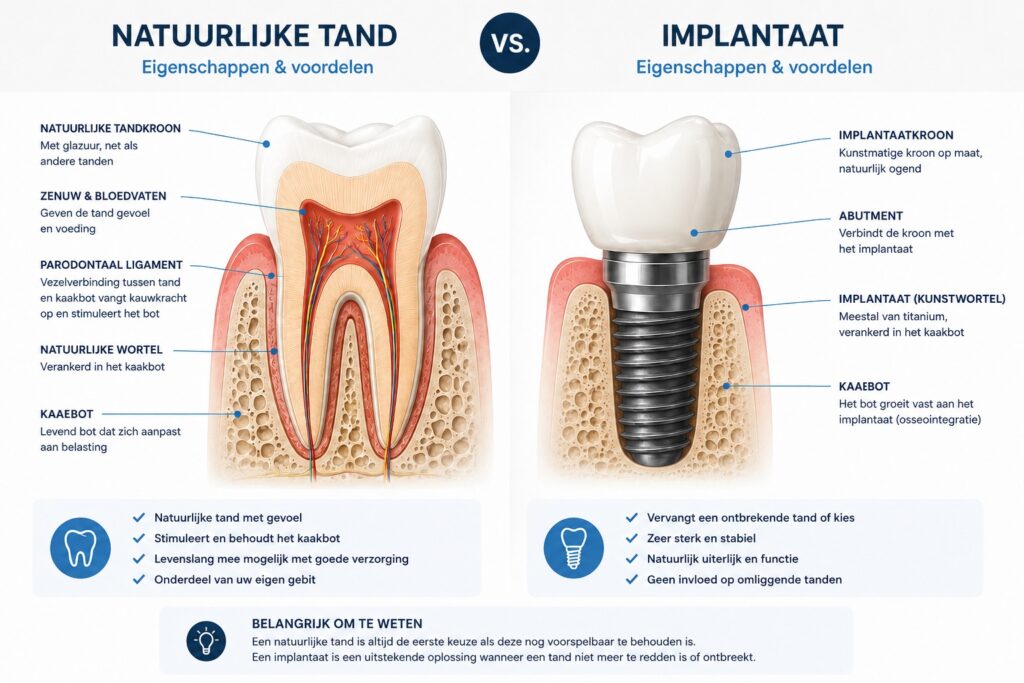
Root canal treatment (also known as a nerve treatment) tries to save your own tooth. The dentist removes inflamed or infected tissue from the root canals, cleans and disinfects the canals and seals them. You can read more about root canal treatment here.
A dental implant replaces a tooth that is missing or can no longer be predictably saved. The implant is an artificial tooth root, usually made of titanium, onto which a crown is later placed.
In short:
- Situation: The tooth is still well restorable; Usually more logical to consider: Root canal treatment
- Situation: The infection is treatable and the root is intact; Usually more logical to consider: Root canal treatment
- Situation: An earlier root canal treatment is of poor quality, but retreatment has a good chance; Usually more logical to consider: Retreatment or specialist assessment
- Situation: Vertical root fracture; Usually more logical to consider: Extraction and replacement
- Situation: Too little tooth structure for a durable build-up; Usually more logical to consider: Extraction and replacement
- Situation: The tooth can no longer be reliably saved; Usually more logical to consider: Dental implant, bridge or other replacement
- Situation: Jawbone and gums are suitable; Usually more logical to consider: Dental implant possible
- Situation: You are unsure because of conflicting advice; Usually more logical to consider: Diagnostic consultation or second opinion
A dental implant can be an excellent treatment. But it is not automatically better than your own tooth. A natural tooth has sensation, its own ligament attachment to the jawbone and a biological role in your bite. If that tooth can be saved, that is often valuable.
The key question: can the tooth still be durably restored?
Root canal treatment only makes sense if the tooth can afterwards also be properly built up and sealed. This is often underestimated.
A dentist assesses, among other things:
- how much healthy tooth structure is still present;
- whether there is a fracture in the root;
- whether the decay extends below the gum or bone level;
- how large and active the infection is;
- whether the root canals are accessible and can be cleaned properly;
- whether an earlier treatment can be redone;
- whether a filling, build-up or crown is predictably possible;
- how healthy the gums and jawbone are;
- how much chewing force falls on the tooth;
- whether you grind or clench your teeth;
- how good oral hygiene and follow-up are likely to be.
A technically good root canal treatment can still have a limited prognosis if the tooth cannot be restored properly afterwards. That is why at 3D Tandarts we look not only at the root canals, but at the whole tooth: crown, root, gums, jawbone, bite and future restoration.
What happens during root canal treatment?
During root canal treatment, the dentist removes inflamed, infected or dead nerve tissue from the inside of the tooth. The root canals are then cleaned, disinfected and filled.
Root canal treatment may be needed in cases of:
- deep decay;
- a leaking filling;
- a crack or fracture;
- trauma;
- a broken molar;
- an inflamed nerve;
- a dead nerve;
- an infection at the root tip;
- problems after an earlier root canal treatment.
Common symptoms are:
- prolonged sensitivity to hot or cold;
- pain when chewing or biting;
- throbbing pain;
- a feeling of pressure;
- swelling;
- a fistula or pimple on the gum;
- an unpleasant taste from draining pus;
- pain that returns after having temporarily gone away.
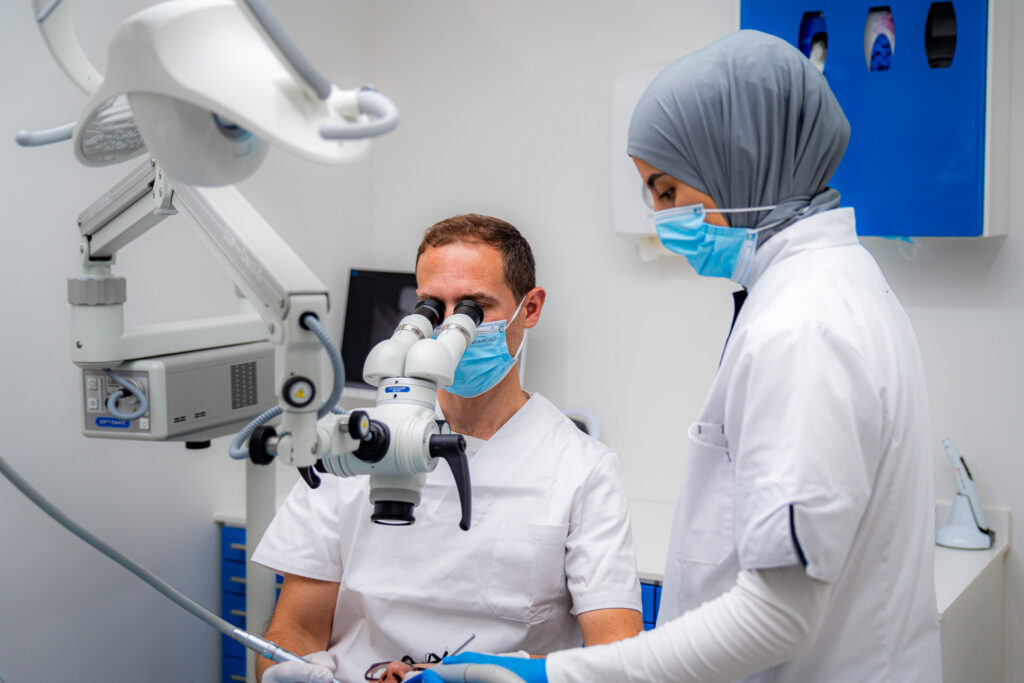
At 3D Tandarts we use a surgical microscope for root canal treatment. This lets us look at, clean and treat the root canals more accurately, especially with complex anatomy, narrow canals, extra canal entrances or root canal retreatment.
The surgical microscope is not only used during treatment, but can also be valuable in diagnostics. Magnification helps in assessing fine cracks, hidden canal entrances, old leaks and other abnormalities that are hard to see with the naked eye.
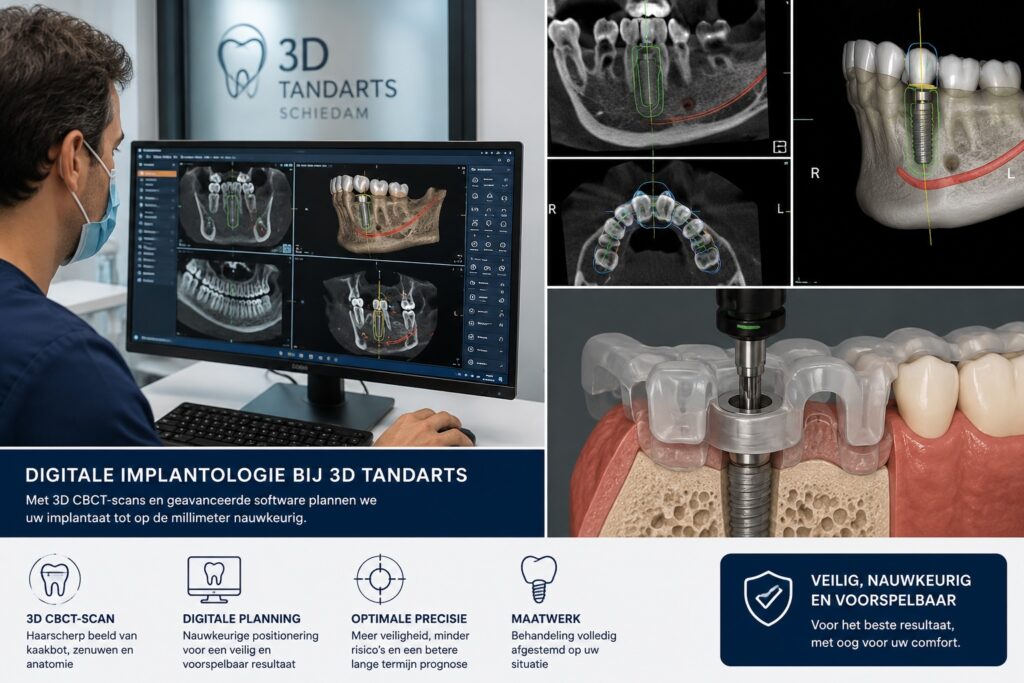
If there is doubt about a root fracture, persistent symptoms, unclear pain or an earlier unsuccessful root canal treatment, additional imaging such as a CBCT scan can provide extra information. An accurate diagnosis is essential, because the choice between saving the tooth, retreatment or extraction often depends on details that are not always visible on a standard X-ray.
The microscope is not only used for complex cases, but also, for example, in diagnostics. Magnification can help detect fine cracks, hidden canal entrances, old leaks and other abnormalities that are hard to see with the naked eye. If there is doubt about a root fracture, persistent symptoms or an earlier unsuccessful treatment, additional imaging such as a CBCT scan can provide extra information. An accurate diagnosis is essential, because the choice between saving the tooth, retreatment or extraction often depends on details that are not always visible on a standard X-ray.
When is root canal treatment a good choice?
Root canal treatment is especially worthwhile when:
- the tooth is still structurally strong enough;
- the root is not vertically fractured;
- the infection appears treatable;
- the canals are easily accessible;
- the tooth can be properly sealed after treatment;
- a build-up or crown is possible;
- the supporting tissue is sufficiently healthy;
- the bite load is manageable;
- you are willing to commit to regular check-ups and maintenance.
With molars, a crown is often needed after root canal treatment, especially if a lot of tooth structure has been lost. Molars take a lot of chewing force. Thin walls can break over time. A crown can then help protect the tooth better.
A crown is not always required, but it must be factored into the prognosis and into the cost comparison.
What happens with a dental implant?
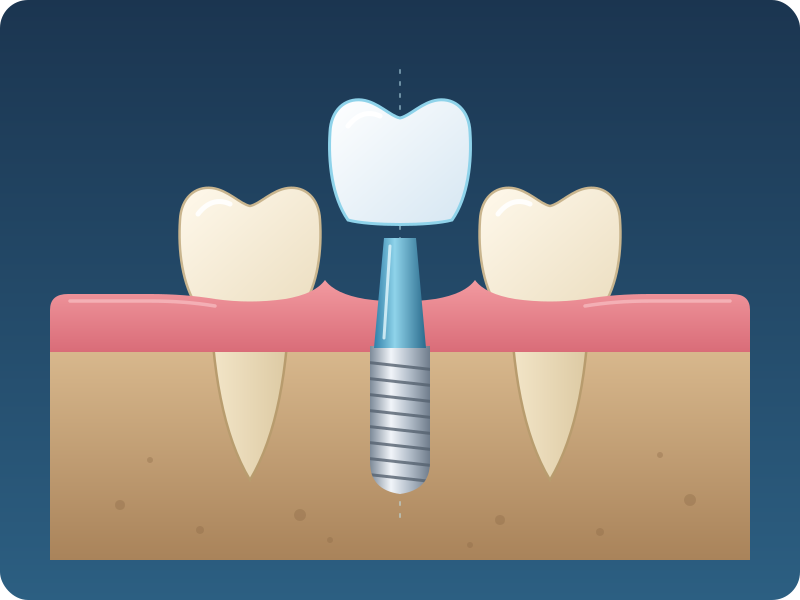
A dental implant is an artificial tooth root that is placed in the jawbone. After healing, a build-up, also called an abutment, is attached to it, followed by a crown.
An implant therefore replaces a tooth that is missing or has to be extracted first. It does not treat the existing tooth.
Implant treatment often involves several phases:
- diagnosis and treatment planning;
- extraction, if needed;
- healing of the bone and gums;
- bone grafting, if needed;
- placement of the implant;
- osseointegration (the implant fusing with the jawbone);
- placement of the abutment and crown;
- check-ups and maintenance.
A dental implant can restore a great deal of comfort, chewing function and aesthetics. Even so, it is not a new natural tooth. An implant has no nerve, no natural ligament attachment and needs careful maintenance.
When is an implant the wiser choice?
An implant may be the wiser choice when the natural tooth can no longer be reliably saved.
This may be the case with, for example:
- a vertical root fracture;
- deep decay below the gum or bone level;
- too little remaining tooth structure;
- severe tooth mobility due to loss of supporting tissue;
- an unfavourable fracture;
- repeated infection with a poor prognosis;
- an unsuccessful earlier root canal treatment where retreatment has little chance of success;
- a tooth that can no longer be properly built up;
- a situation where saving the tooth requires many treatments with limited predictability.
In such situations, continuing to try to save the tooth can lead to extra costs, extra appointments, recurring symptoms and ultimately extraction anyway. A dental implant, bridge or other replacement may then be more realistic.
Why jawbone and gums matter
An implant can only function well if the surrounding environment is healthy enough. That is why we assess:
- whether there is sufficient bone volume;
- whether the gums are healthy;
- whether periodontitis is present;
- whether bone grafting is needed;
- whether there is enough space for an implant crown;
- whether the bite is favourable;
- whether you can clean the implant properly;
- whether there are risk factors such as smoking, teeth grinding or poor oral hygiene;
- whether it is a visible aesthetic zone.
Sometimes an implant is not possible straight after extraction. Healing or bone grafting may be needed first. That makes the treatment longer and sometimes more expensive.
Dental implant or root canal treatment: the main differences
- Topic: Aim; Root canal treatment: Save your own tooth; Dental implant: Replace a missing or unsalvageable tooth
- Topic: Starting point; Root canal treatment: The tooth is still present; Dental implant: The tooth is missing or has to be extracted
- Topic: Requirement; Root canal treatment: The tooth must be treatable and restorable; Dental implant: Jawbone, gums and space must be suitable
- Topic: Treatment; Root canal treatment: Cleaning and sealing of the root canals; Dental implant: Surgical placement of an artificial tooth root
- Topic: Follow-up; Root canal treatment: Filling, build-up or crown; Dental implant: Abutment and implant crown
- Topic: Recovery; Root canal treatment: Often limited post-treatment pain; Dental implant: Surgical healing and bone integration
- Topic: Cost; Root canal treatment: Depends on canals, build-up and crown; Dental implant: Depends on implant, crown, bone grafting and complexity
- Topic: Risks; Root canal treatment: Reinfection, fracture, leakage, inadequate seal; Dental implant: Peri-implantitis, bone loss, failure to integrate, maintenance problems
- Topic: Maintenance; Root canal treatment: Monitoring for decay, crown margin, fracture and infection; Dental implant: Monitoring of gums, bone level and cleanability
- Topic: Best choice when; Root canal treatment: The tooth can be predictably saved; Dental implant: The tooth can no longer be reliably saved
Cost: which is cheaper?
Root canal treatment often seems cheaper than an implant. But an honest comparison looks at the whole treatment from start to finish.
Root canal treatment may involve:
- consultation and diagnosis;
- X-rays;
- root canal treatment;
- root canal retreatment, if needed;
- temporary or definitive filling;
- build-up;
- crown;
- check-ups.
Implant treatment may involve:
- consultation and treatment planning;
- X-ray or CBCT scan;
- extraction;
- temporary solution;
- bone grafting, if needed;
- implant placement;
- healing phase;
- abutment;
- implant crown;
- check-ups and maintenance.
So don’t just ask: “What does root canal treatment cost?” or “What does a dental implant cost?”
Above all, ask: “What does the total treatment plan cost, including the final restoration?”
In the Netherlands, reimbursement and out-of-pocket costs depend on your age, supplementary dental insurance, the indication and the treatment plan. For adults, many dental treatments are not fully reimbursed by basic health insurance. A personalised quote avoids surprises.
Risks and lifespan: what can you realistically expect?
No dental treatment comes with an absolute lifelong guarantee. Both root canal treatment and an implant can function well for years, but each has its own risks.
Possible risks of root canal treatment are:
- persistent or recurring infection;
- missed or hard-to-reach canals;
- leakage under a filling or crown;
- fracture of the tooth;
- insufficient remaining tooth structure;
- the need for root canal retreatment;
- extraction in the end after all.
Possible risks of a dental implant are:
- insufficient integration with the jawbone;
- inflammation of the gum around the implant;
- peri-implantitis;
- bone loss;
- loosening or breakage of components;
- aesthetic problems with receding gums;
- the need for extra maintenance or repair.
The long-term result depends heavily on good diagnostics, correct execution, oral hygiene, regular check-ups and timely action when problems arise.
Recovery and treatment time
After root canal treatment, the tooth may be tender for a few days, especially when biting or chewing. You can usually return to normal daily activities quickly. Sometimes several appointments are needed, especially with complex infections or retreatment.
It is important that the tooth is properly sealed afterwards. A temporary filling should not stay in place too long if a definitive restoration or crown is needed.
Implant treatment is surgical. After placement, swelling, tenderness or slight post-operative pain may occur. The implant then has to integrate with the jawbone. This phase is called osseointegration. The total treatment time is often longer, especially if extraction, healing or bone grafting is needed.
What happens if you wait?
Waiting can sometimes be understandable, for example because of fear, cost or previous bad experiences. Even so, delay can have consequences.
Possible consequences are:
- a larger infection;
- more pain;
- swelling;
- bone loss;
- further breakdown of the tooth;
- more difficult or more expensive treatment;
- less chance of saving the tooth;
- ultimately emergency treatment or extraction.
If pain goes away temporarily, that doesn’t always mean the problem has been solved. A dead nerve may in fact cause less pain while the infection remains.
Common misconceptions
“An implant is always better”
That is not true. An implant is a valuable replacement when a tooth can no longer be reliably saved. But if your own tooth can be restored well, saving it can be a very good choice.
“Root canal treatment is always painful”
Modern root canal treatments are usually carried out under local anaesthetic. The aim is precisely to treat pain and infection. Post-treatment pain can occur, but is usually temporary.
“If the pain is gone, treatment is no longer needed”
Not always. A nerve can die, so that pain lessens while the infection continues. Examination and imaging are therefore important.
“Antibiotics will clear up an infected tooth”
Antibiotics can sometimes help temporarily when an infection is spreading, but they usually do not resolve the cause in the root canal. Dental treatment is needed for that.
“An implant automatically lasts a lifetime”
An implant can last a long time, but it needs maintenance. The gum and bone around the implant can become inflamed. Regular check-ups remain important.
When is a second opinion a good idea?
A second opinion makes sense when you have doubts about a diagnosis, treatment plan or irreversible choice.
This applies especially to:
- advice to extract a tooth;
- doubt between root canal treatment and an implant;
- an unsuccessful earlier root canal treatment;
- unclear pain;
- suspicion of a root fracture;
- high costs;
- conflicting advice;
- fear of making the wrong choice.
A second opinion doesn’t mean you don’t trust your dentist. It means you want more certainty about a major decision.
What questions can you ask during the consultation?
Good questions are:
- Can my tooth still be predictably saved?
- Is there enough healthy tooth structure left?
- Is a fracture visible or suspected?
- Is root canal treatment or retreatment worthwhile?
- Will I need a crown afterwards?
- What happens if I do nothing?
- What are the alternatives?
- What are the risks of each option?
- What does the full treatment cost?
- How long will the whole treatment take?
- What is the plan if the first option fails?
- Is a CBCT scan needed for better diagnostics?
- Is there enough bone for an implant?
- Will bone grafting be needed?
Why choose 3D Tandarts in Schiedam when in doubt?
At 3D Tandarts in Schiedam we don’t assess from the standpoint of one treatment, but from the question: which solution is the most predictable for this tooth, this mouth and this patient?
We look at:
- diagnosis;
- infection;
- root shape and root canals;
- possible fracture;
- remaining tooth structure;
- restoration options;
- gums and jawbone;
- bite load;
- cost;
- alternatives;
- your personal wishes and concerns.
In complex situations, additional diagnostics such as CBCT can be worthwhile. This can help when a root fracture is suspected, with earlier unsuccessful treatments, unclear pain or implant planning.
3D Tandarts is located in Schiedam and is accessible to patients from Rotterdam, Vlaardingen, Maassluis and the wider South Holland region, among others.
When should you make an appointment?
Make an appointment if you:
- are torn between root canal treatment and an implant;
- have been told that a tooth has to be extracted;
- have a recurring infection;
- have a broken molar;
- suspect an unsuccessful root canal treatment;
- have pain, swelling or a fistula;
- want a personal cost estimate;
- want clarity first before you decide.
A consultation doesn’t mean you are choosing a treatment straight away. It means that we first assess what is sensible.
Frequently asked questions
Frequently asked questions
Which is better: a dental implant or root canal treatment?
That depends on the prognosis of your own tooth. If the tooth can still be reliably saved and restored, root canal treatment is often worth considering. If the tooth can no longer be saved predictably, a dental implant may be the better solution.
Can my tooth still be saved?
That can only be assessed after an examination. The dentist looks at the root, the infection, the amount of tooth structure remaining, the gums, the jawbone and the restoration options.
When does a tooth have to be extracted after all?
A tooth usually has to be extracted when it can no longer be reliably restored, for example with a vertical root fracture, deep decay, severe mobility or too little tooth structure.
Is root canal retreatment possible after an unsuccessful root canal treatment?
Sometimes. Retreatment can be worthwhile in cases of leakage, missed canals or an inadequate seal. With a root fracture or a tooth that is structurally too compromised to restore, extraction may be the wiser choice.
Which costs more: a dental implant or root canal treatment?
A dental implant is usually more expensive, because the treatment often involves extraction, implant placement, an abutment and a crown. Root canal treatment can also become more expensive if a build-up and crown are needed.
Do I need a crown after root canal treatment?
Not always, but often with molars or heavily weakened teeth. A crown may be needed to prevent fracture and to restore the tooth for the long term.
Can a dental implant fail?
Yes. An implant can fail to integrate sufficiently with the bone, become inflamed or lead to bone loss. Good planning, oral hygiene and check-ups are important.
Can root canal treatment fail?
Yes. Possible causes are reinfection, missed canals, leakage, fracture or inadequate restoration of the tooth.
How long does recovery take after root canal treatment?
The tooth may be tender for a few days, especially when chewing. You can usually return to normal function quickly.
How long does implant treatment take?
Often several months, because the implant has to integrate with the jawbone. The total duration depends on extraction, healing, bone grafting and when the crown can be placed.
When is a second opinion a good idea?
When you have doubts about an extraction, implant advice, high costs, an earlier unsuccessful treatment or fear of making an irreversible choice.
Can I come to 3D Tandarts in Schiedam for advice?
Yes. At 3D Tandarts in Schiedam you can come for an assessment if you are unsure about saving a tooth, root canal treatment, extraction, a bridge or an implant.
Conclusion: don’t choose too quickly, but do choose in time
Root canal treatment and a dental implant are both valuable treatments, but they don’t solve the same problem.
Root canal treatment tries to save your own tooth.
A dental implant replaces a tooth that is missing or can no longer be predictably saved.
Above all, remember:
- an implant is not automatically better than your own tooth;
- saving a tooth only makes sense if the tooth can be durably restored afterwards;
- costs should be compared for the complete treatment;
- both options carry risks and need maintenance;
- pain that goes away doesn’t always mean the problem is gone;
- waiting can limit your treatment options;
- doubt is a good reason for a diagnostic consultation.
Are you torn between an implant and root canal treatment? Then first have it assessed whether your tooth can still be predictably saved. At 3D Tandarts in Schiedam we help you get clarity on the diagnosis, treatment options, costs and expectations before you make a final choice.

Dentistry and Digital Implantology at 3D Tandarts Schiedam, with a special interest in microscopic endodontics, diagnostics and implantology.
Knowledge base
Latest articles

Hidden root canals: why a tooth can keep causing problems after root canal treatment
Pain after root canal treatment? Learn how a hidden or missed canal happens and how the microscope and CBCT help. Book an assessment in Schiedam.

Surgical microscope for root canal treatment in Schiedam
What does a surgical microscope do in root canal treatment? See how precision and CBCT help save your tooth. Book at 3D Tandarts in Schiedam.
Implant consultation in Schiedam: find out which treatment suits you
Is a dental implant right for you? Find out what an implant consultation in Schiedam involves: examination, advice and a treatment plan. Book today.
Questions about your situation?
During a consultation we look at your situation and discuss the options.