Last updated: 28 September 2026
A missing tooth often has more impact than people first think. Not only on the look of your smile, but also on chewing, speaking and how comfortable your teeth feel overall.
In the long term, a missing tooth can also lead to bone loss and shifting of the surrounding teeth.
A dental implant is today one of the most durable and natural solutions for replacing a missing tooth.
At 3D Tandarts in Schiedam we combine modern digital implant dentistry with accurate 3D planning and a personal approach for patients from Schiedam, Rotterdam and the wider Randstad.
Our practice is located right inside Schiedam Centrum station and is easy to reach from Rotterdam, Delft, The Hague, Leiden, Amsterdam and Utrecht.
What is a dental implant?
A dental implant is an artificial tooth root that is placed in the jawbone to replace a missing tooth.
The implant is usually made of titanium, a material that can fuse firmly with the jawbone and is well accepted by the body.
After the healing phase, a crown, bridge or denture is placed on the implant. This creates a fixed solution that can closely resemble natural teeth in function and appearance.
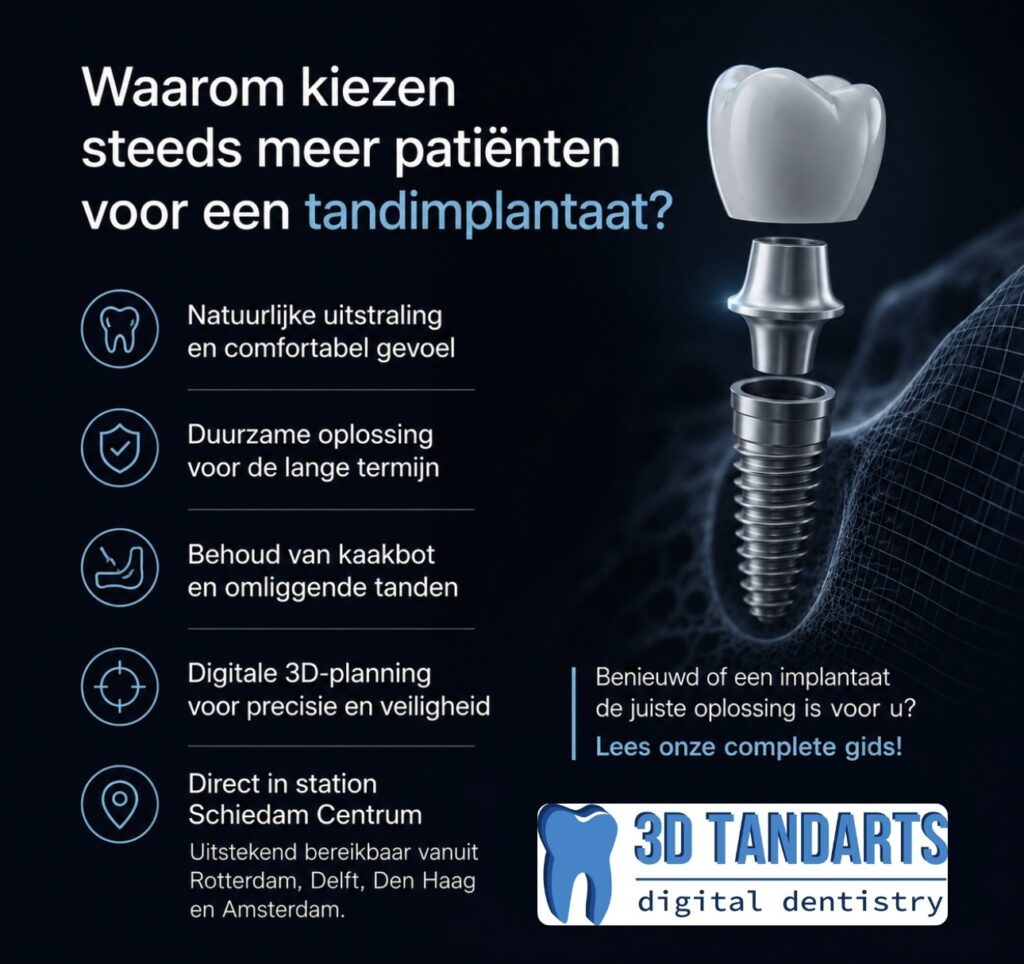
An implant usually consists of:
- the implant itself (the artificial tooth root)
- the abutment (the connector)
- the crown or bridge
Many patients ultimately find implants very stable and natural when eating, speaking and smiling.
When is an implant a good solution?
Implant treatment can be suitable in various situations:
- one missing tooth
- several missing teeth and/or molars
- loss of teeth due to infection or trauma
- teeth that can no longer be saved
- an unstable denture
- a need for more stability when chewing
For many patients it is not only aesthetics that matter, but also comfort and long-term function.
Why shouldn’t a missing tooth be left untreated for too long?
When a tooth is missing, the jawbone at that spot receives less load. As a result, the bone can gradually shrink.
In addition, the surrounding teeth can slowly shift, which can affect:
- the bite
- chewing function
- how easily the teeth can be cleaned
- stability of the teeth
The longer a tooth is missing, the more complex a future implant treatment can sometimes become.
Many patients think implant dentistry is mainly about the surgical placement of the implant. In reality, successful implant treatment starts with a correct diagnosis and accurate planning.
Implant or bridge: what is the difference?
A common question is whether an implant is better than a bridge.
With a traditional bridge, the surrounding teeth are used as supports. These teeth often need to be prepared for this.
With an implant, the adjacent teeth usually remain intact, because the implant is placed independently in the jawbone.
Implants therefore often offer advantages in terms of:
- preserving healthy adjacent teeth
- stability
- restoring function in the area of the missing tooth
- long-term comfort
A bridge can still be a suitable solution in some situations, for example when the adjacent teeth already have large fillings or crowns.
The right choice always depends on your individual situation.
How does implant treatment work?
Implant treatment usually consists of several steps.
1. Consultation and diagnosis
During the first consultation we assess:
- the health of the gums and jawbone
- the position of the surrounding teeth
- the bite
- the available space
- any infections
- your general health
We also discuss your expectations, wishes and possible treatment options.
2. CBCT scan and digital 3D planning
For modern implant dentistry, accurate diagnostics are essential.
That is why we often use a CBCT scan. This gives a three-dimensional view of the jawbone and important anatomical structures.
With digital implant planning we can determine precisely in advance:
- where the implant will be placed
- how much bone is available
- how the final crown will be supported
- whether additional treatments are needed
In aesthetically visible areas, the position of the implant is often at least as important as the implant itself.
3. Placing the implant
The implant is placed in the jawbone under local anaesthetic.
Many patients ultimately find this treatment less demanding than they expected.
In some situations we use guided implant surgery, in which a surgical guide helps to place the implant very accurately according to the digital plan.
4. Healing phase
After placement, the implant needs time to fuse firmly with the bone.
This period usually lasts a few months, depending on:
- bone quality
- location of the implant
- oral health
- lifestyle habits such as smoking
- any bone grafting
5. Placing the crown or bridge
When the implant is completely stable, the final crown or bridge is placed.
We take the following into account:
- function
- aesthetics
- bite
- colour
- natural integration with your teeth
Does a dental implant hurt?
Many patients find implant treatment nerve-racking beforehand. That is understandable.
The treatment is carried out under local anaesthetic. During the procedure, the treatment area is numb; afterwards, temporary tenderness or swelling may occur.
After the treatment, temporary symptoms may occur, such as:
- mild swelling
- tenderness
- post-operative discomfort
- a bruised feeling
These symptoms usually disappear within a few days.
For many patients, implant treatment turns out easier than expected.
How long does a dental implant last?
With good oral hygiene and regular check-ups, implants can last decades.
Long-term success depends on factors including:
- good cleaning
- healthy lifestyle habits
- sufficient bone support
- correct placement
- regular aftercare
After many years, the crown on the implant may sometimes need to be replaced sooner than the implant itself.
Are dental implants safe?
Modern implant dentistry is a well-researched and predictable treatment.
Technologies such as:
- CBCT diagnostics
- digital implant planning
- guided implant surgery
- intraoral scanners
provide more information for planning and can help to carry out the planned implant position carefully.
An implant is not simply a screw in the bone, but part of a carefully planned treatment in which function, aesthetics and long-term stability come together.
What does a dental implant cost?
The cost of an implant depends on several factors, including:
- the number of implants
- type of crown or bridge
- complexity of the treatment
- any bone grafting
- materials and techniques used
At 3D Tandarts we work with clear treatment plans and transparent communication about the treatment and the expected costs.
Implant dentistry in Schiedam, easy to reach from Rotterdam
When choosing implant treatment, patients choose not only by distance, but above all by trust, quality and accessibility.
Our practice is located right inside Schiedam Centrum station and is easy to reach from:
- Rotterdam Centraal
- Rotterdam Blaak
- Delft
- The Hague
- Leiden
- Amsterdam
- Utrecht
- Vlaardingen
- Maassluis
Many patients simply combine their treatment with a train or metro journey, with no parking problems or busy city traffic.
For implant treatment, which often requires several appointments, a practice right next to a station turns out to be surprisingly practical for many people.
Why do patients choose 3D Tandarts?
At 3D Tandarts we combine modern digital implant dentistry with a calm and personal approach.
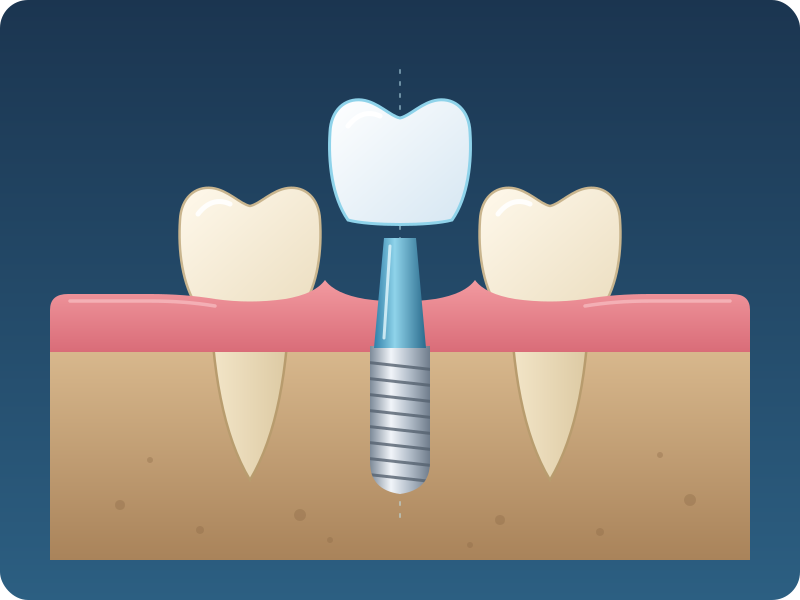
Our focus is on:
- accurate diagnosis
- digital 3D planning
- safe placement of implants
- transparent communication
- aesthetic and functional results
- long-term aftercare
We treat patients from Schiedam, Rotterdam and surrounding towns who are looking for modern implant dentistry with attention to quality, comfort and long-term results.
When is an implant not possible?
Not every patient can have an implant straight away.
Implant treatment can be more complex in cases of:
- insufficient bone volume
- active gum inflammation
- poor oral hygiene
- uncontrolled diabetes
- smoking
- certain medical conditions
In many cases, however, solutions still exist, for example with additional treatments or adapted treatment planning.
Maintaining your implants
Like natural teeth, implants need good care.
Key points are:
- brushing twice a day
- cleaning between teeth and implants
- regular check-ups
- professional cleaning when needed
Good aftercare plays an essential role in the long-term success of implant dentistry.
Conclusion
A dental implant is a modern, durable and natural solution for replacing missing teeth.
Successful implant dentistry is not only about the implant itself, but above all about:
- correct diagnosis
- digital planning
- accurate placement
- good oral hygiene
- long-term aftercare
At 3D Tandarts in Schiedam we combine modern digital implant dentistry with accurate 3D planning and a personal approach for patients from Rotterdam, Schiedam and the wider Randstad.
Frequently asked questions
Frequently asked questions about dental implants
Is a dental implant suitable for everyone?
Not always straight away. Healthy gums, sufficient bone volume and good oral hygiene are important conditions. During a consultation we carefully assess your situation.
How long does implant treatment take?
The total treatment time depends on the situation, but usually consists of several phases spread over a few months.
Can an implant be placed straight after a tooth is extracted?
In some cases this is possible. It depends, among other things, on the amount of bone, the presence of infection and the location of the tooth.
Is an implant better than a bridge?
In many situations an implant offers advantages because the surrounding teeth usually remain intact. Even so, a bridge can sometimes also be a suitable solution.
How do I look after an implant?
Good oral hygiene, daily cleaning and regular check-ups are essential for long-term success.
Knowledge base
Latest articles

Hidden root canals: why a tooth can keep causing problems after root canal treatment
Pain after root canal treatment? Learn how a hidden or missed canal happens and how the microscope and CBCT help. Book an assessment in Schiedam.

Surgical microscope for root canal treatment in Schiedam
What does a surgical microscope do in root canal treatment? See how precision and CBCT help save your tooth. Book at 3D Tandarts in Schiedam.
Implant consultation in Schiedam: find out which treatment suits you
Is a dental implant right for you? Find out what an implant consultation in Schiedam involves: examination, advice and a treatment plan. Book today.
Questions about your situation?
During a consultation we look at your situation and discuss the options.