For more stability, comfort and confidence with an unstable denture
Written by Danilo Di Vico — dentistry and digital implantology at 3D Tandarts Schiedam
– Last updated: 22 September 2026
Do you have a denture that is unstable, shifts while you eat or makes you feel insecure when you talk or smile? Then an overdenture on implants may be a suitable solution. An implant overdenture (a denture that clicks onto implants) is more stable than a conventional denture because it clicks onto implants in the jaw. It remains removable, so you can clean it thoroughly.
Many people put this treatment off because they fear pain, cost, surgery or disappointment. That is understandable. An overdenture is not a standard solution for everyone. Whether it suits you depends on your jawbone, oral health, medical situation, current denture and reimbursement through your health insurance.
At 3D Tandarts in Schiedam we therefore look first at the cause of your symptoms. Sometimes an adjustment or a new denture is enough. In other situations an implant overdenture can give a great deal of stability, comfort and confidence.
Short answer: what is an overdenture on implants?
An overdenture on implants is a removable denture that clicks onto implants in the jaw. It offers more retention than a conventional denture and is often considered for an unstable lower denture caused by jawbone loss.
Do you have an unstable denture?
An unstable denture often develops because the jaw changes over time. After tooth loss the jawbone gradually shrinks. As a result, a denture that once fitted well fits less well later. This happens mainly in the lower jaw, because there is less surface area to keep the denture stable.
An unstable denture is not just a technical problem. It can affect eating, speaking, smiling and social confidence. Many patients first try denture adhesive, avoid certain foods or get used to small discomforts. Yet struggling on for a long time is not always wise, especially with recurring sore spots or pain.
Common problems with an unstable denture
Problems that often lead people to consider an overdenture:
- the lower denture shifts while eating or talking;
- the denture comes out when you smile or yawn;
- sore spots or small wounds develop;
- you use denture adhesive every day;
- chewing feels insecure or painful;
- you avoid hard or chewy foods;
- you feel self-conscious in company;
- the denture still feels unstable despite earlier adjustments.
If these problems keep coming back, it makes sense to have the fit and the cause assessed.
Why the lower denture is the one that most often becomes unstable
The lower denture causes problems more often than the upper one. This is because the lower jaw is narrower, has less supporting surface and is constantly moved by the tongue, lips and chewing muscles. The upper denture can often still find support through suction against the palate. For the lower denture that retention is largely missing.
As the bone in the lower jaw shrinks further, the base on which the denture rests becomes flatter and flatter. The denture can then tilt or shift more easily. Implants can then act as artificial tooth roots onto which the overdenture clicks.
When adhesive or an adjustment is no longer enough
Denture adhesive can help temporarily, but it usually does not solve the cause. An adjustment or reline of the denture can also be worthwhile when the denture no longer fits well. But if the jaw offers too little support, the denture often remains unstable.
An assessment is especially sensible if you still have problems despite adjustments. During a consultation we can look at whether your current denture can be improved or whether implants are a better solution.
Do you recognise several of these problems? You do not yet need to know which treatment is required. An initial assessment at 3D Tandarts in Schiedam can make clear where the problem comes from.
Do you recognise these problems? Book an assessment at 3D Tandarts in Schiedam. During the consultation we look at whether an adjustment, a new denture or an overdenture on implants is the most logical solution.
You can make an appointment with 3D Tandarts here.
What is an overdenture on implants?
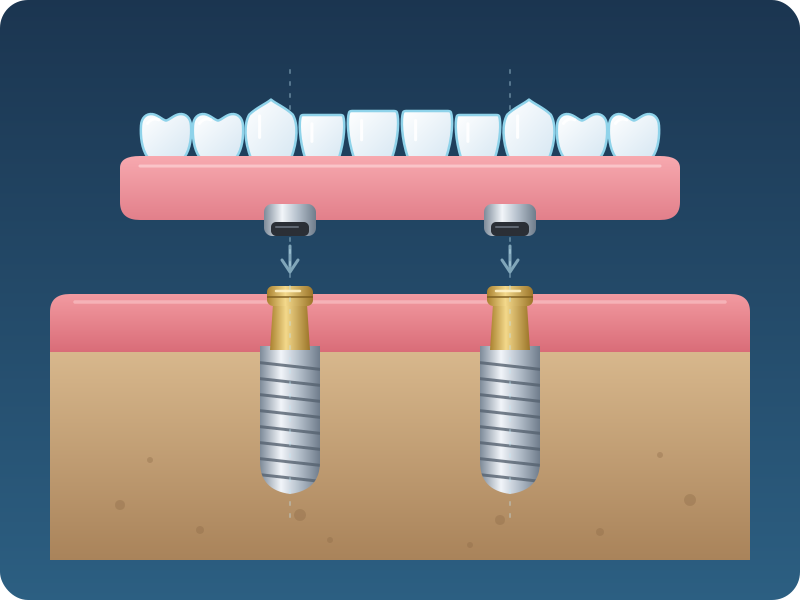
An overdenture on implants is a removable denture that clicks onto implants in the jaw. The implants provide extra retention, so the denture is more stable than a conventional denture. You can take the overdenture out yourself to clean it.
An overdenture is also called an implant-retained denture, snap-in denture or denture on implants. The treatment is often considered for people with a complete denture that has insufficient retention.
How does an overdenture click into place?
Implants are placed in the jawbone and fuse with it. Attachments are fitted on these implants. The overdenture is made so that it clicks onto these components.
There are various attachment systems, such as stud attachments, locators or a bar. Which system is suitable depends on the jaw, the number of implants, the space in the mouth and the stability you want.
Is an overdenture fixed or removable?
An overdenture sits more firmly than a conventional denture, but it is not the same as fixed teeth. You can take the overdenture out yourself. This is important for daily cleaning of the denture, the gums and the implant components.
This nuance matters. Some patients think an overdenture stays in permanently like a fixed bridge on implants. It does not. An overdenture offers more retention, but remains a removable denture.
Difference between an overdenture, a conventional denture and fixed teeth
- Solution: Conventional denture; Does it stay in place?: No, rests on the gums; Removable?: Yes; Suitable for: Adequate fit and retention
- Solution: Overdenture on implants; Does it stay in place?: Clicks onto implants; Removable?: Yes; Suitable for: An unstable denture with little retention
- Solution: Fixed teeth on implants; Does it stay in place?: Screwed in or fixed in place; Removable?: Usually cannot be removed by the patient; Suitable for: Different treatment goals, the right conditions and a different budget
An overdenture is therefore an intermediate form: more stable than a conventional denture, but more practical to clean than a fully fixed construction.
Who is an overdenture suitable for?
An overdenture is mainly suitable for people with a complete denture that has insufficient retention, often because of jawbone loss. Whether you are actually suitable depends on your jawbone, gums, health, oral hygiene and the technical possibilities of the denture.
Suitability cannot be reliably determined from symptoms alone. Two patients with the same problem can still receive different treatment advice.
Situations in which an overdenture is often considered
An overdenture can be considered when:
- your lower denture often becomes unstable;
- you cannot chew well with your current denture;
- you have recurring sore spots;
- your denture remains unstable despite adjustment;
- you need a lot of denture adhesive;
- you feel insecure when speaking or smiling;
- there is insufficient retention for a conventional denture;
- there is enough jawbone and healthy oral conditions for implants.
Especially with an unstable lower denture, an overdenture can make a big difference, because implants give the denture extra anchorage.
When an overdenture may not be possible straight away
An overdenture is not always immediately possible. Possible reasons are:
- insufficient jawbone;
- active infections;
- insufficient oral hygiene;
- certain medical risk factors;
- smoking or other factors that can affect healing;
- unrealistic expectations;
- a current denture that first has to be assessed differently or adjusted.
Sometimes gum treatment, better oral hygiene, a new denture or additional diagnostics are needed first.
Why a personal examination is needed
Online information can help you understand what an overdenture is, but it cannot determine whether implants are a sensible choice for you. For that, the dentist has to look at your mouth, jaw, denture, oral mucosa and medical situation.
A consultation is therefore not an obligation to have treatment. It is above all a way of getting clarity: what is the cause of your problem, what options do you have and which solution suits your situation best?
Unsure whether your symptoms are serious enough? That is precisely when an assessment can be worthwhile. Sometimes a small adjustment is enough; sometimes an overdenture turns out to be the most logical next step.
How is it assessed whether you can have an overdenture?
Before an overdenture is recommended, we need to examine why your denture is unstable and whether implants are justified. The assessment usually consists of an examination of your current denture, jawbone, gums, oral hygiene and medical background.
This step is important because an overdenture only works well when the foundation is right. Implant treatment requires healthy tissues, sufficient stability and realistic expectations.
Assessment of your current denture
The dentist first looks at your existing denture. We assess:
- does the denture still fit well?
- are there sore spots or irritation?
- is the bite evenly distributed?
- is the denture worn?
- is a reline or replacement possible?
- is the problem mainly in the denture or in the jaw?
This prevents implants from being considered too quickly when another solution may be enough.
CBCT scan for an accurate assessment of the jaw
For successful implant treatment, a good assessment of the jawbone and the tissues around the implants is essential.
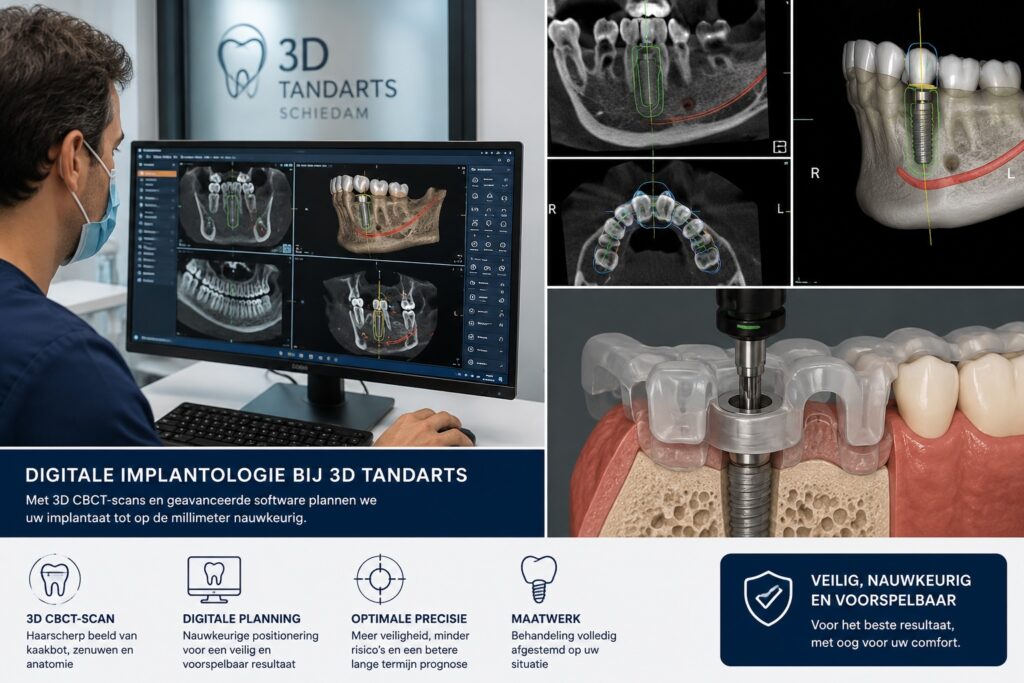
That is why we routinely take a CBCT scan (3D scan). This advanced imaging gives an accurate three-dimensional picture of the jawbone, the anatomical structures and the space available for the implants.
Based on this scan the treatment can be planned digitally. When a surgical guide (guided implant surgery) is clinically worthwhile, it can be used to transfer the planned implant position to the mouth during treatment. The choice between guided and freehand placement is made case by case.
Medical factors that can have an influence
Your general health also plays a role. Think of medication use, diabetes, smoking, previous radiotherapy, medication that affects bone or conditions that affect wound healing. That does not automatically mean implants are impossible, but it can influence the planning and risk assessment.
Careful treatment advice takes the whole patient into account, not just the jaw.
When additional imaging is needed
Additional imaging is especially important when the jaw is narrow, a lot of bone loss is suspected or implants have to be placed close to nerves or other anatomical structures. A 3D scan can help to plan more safely and accurately.
At 3D Tandarts we have modern digital diagnostics, including CBCT imaging when clinically necessary. This allows us to assess the jaw, bone structure and anatomical risk zones more accurately before treatment advice is given.
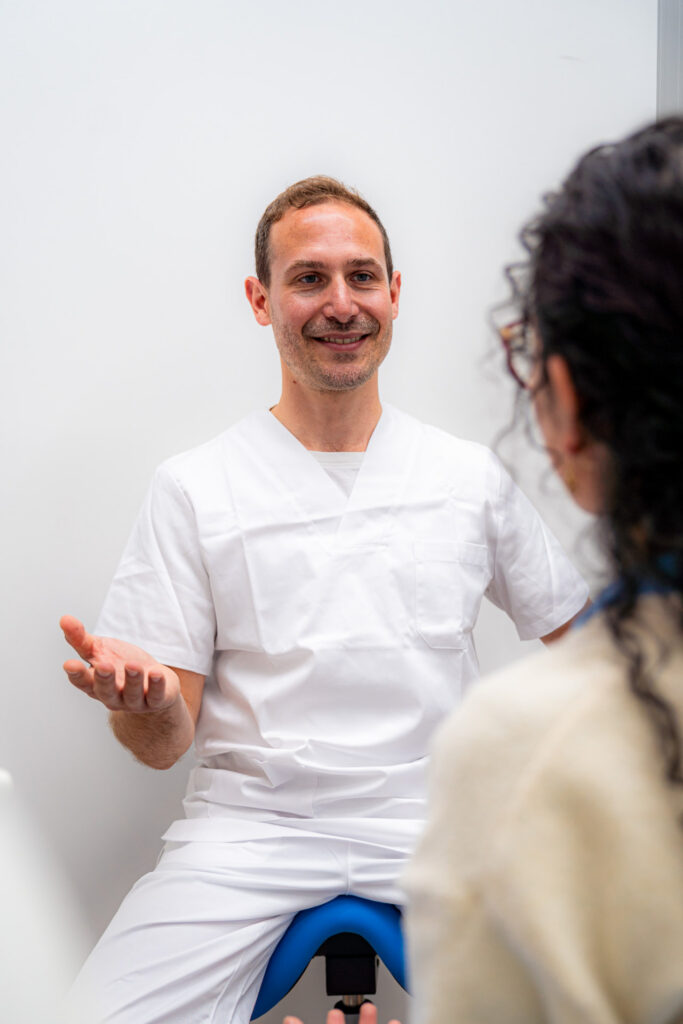
How does overdenture treatment work at 3D Tandarts in Schiedam?
Overdenture treatment usually takes place in several steps: intake appointment, examination, treatment plan, any insurance application, placement of implants, healing, making or adjusting the denture, and aftercare.
The exact order can differ per patient. It depends on the jaw, the type of denture, the insurance, the healing and whether collaboration with an implant dentist, oral surgeon or denturist is needed.
Step 1 — Intake appointment, examination and treatment plan
During the intake appointment we assess your symptoms, wishes, current denture and the situation in your mouth. The dentist discusses what bothers you: an unstable fit, pain, eating problems, embarrassment or insecurity.
Then we look at which solution suits best. That may be an adjustment, a new denture, an overdenture or sometimes another implant solution.
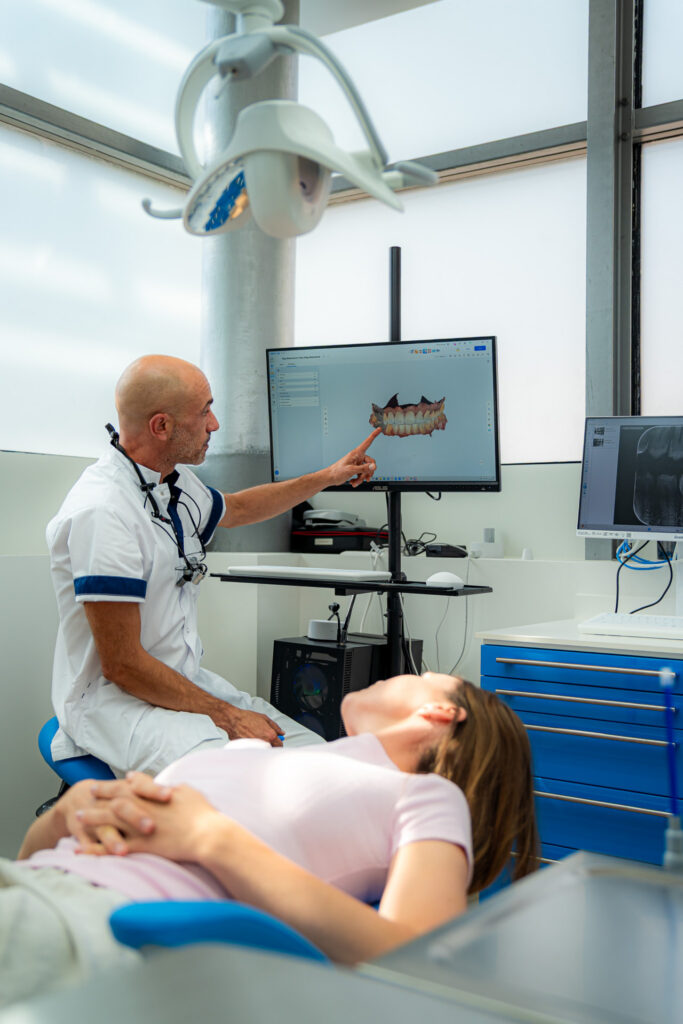
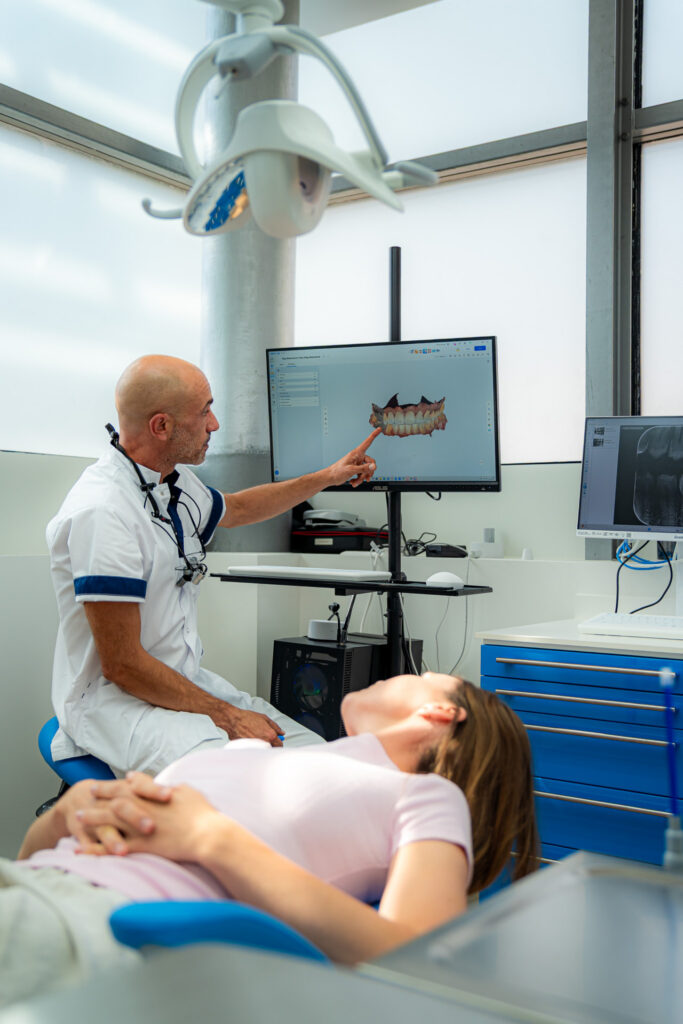
We take a CBCT scan to obtain a very accurate 3D image of the jaw. Based on this the treatment can be planned digitally and guided implant surgery is used, for precise and predictable placement of the implants.
Step 2 — Insurance application and cost discussion
When an overdenture appears to be medically indicated, reimbursement through health insurance may be possible. Sometimes prior approval is required. The exact route depends on your insurer, policy and indication.
If reimbursement is not possible or not complete, it must be clear which costs you pay yourself. A good cost discussion should take place before the treatment.
Step 3 — Placement of the implants
The implants are placed in the jaw. This is usually done under local anaesthetic. The treatment area is numb during the procedure. Afterwards, temporary tenderness, post-operative pain or swelling may occur.
Where clinically indicated, guided implant surgery can be used. The desired implant position is planned digitally, and a surgical guide can help transfer this plan to the mouth during treatment.
Step 4 — Healing period
After placement the implants need time to fuse with the jawbone. This process is called osseointegration.
During healing and directly after the treatment the jaw may be tender. Swelling or some discomfort may also occur. You will usually receive instructions on eating, cleaning and what you should and should not do.
A frequently asked question is whether you have to go without teeth during this period. That depends on the situation. We often look at how temporary function and appearance can be preserved as well as possible, but this has to be discussed individually.
Step 5 — Making or adjusting the denture
After healing the overdenture is made or adjusted. We look at fit, bite, aesthetics, the click mechanism and comfort. The aim is a denture that clicks on securely, but can still be removed easily for cleaning.
Step 6 — Fitting, check-up and aftercare
After fitting, the dentist checks that the overdenture works well. Sometimes small adjustments are needed. In the longer term check-ups also remain important, because the attachment parts can wear and implants need to be kept clean.
Do you find the process daunting? That is normal. A clear explanation beforehand often helps to reduce fear of pain, cost and unknown steps.
Do you want to know which step you need?
With an unstable denture an overdenture is not always needed straight away. Sometimes an adjustment is enough, sometimes implant treatment is sensible. During an intake appointment at 3D Tandarts in Schiedam we assess your current denture, jaw and symptoms, so that you know which route makes sense.
Do you want to know exactly how implant treatment works?
In our detailed article we explain step by step what you can expect – from the first intake appointment to the final placement of the crown or denture.
How many implants are needed for an overdenture?
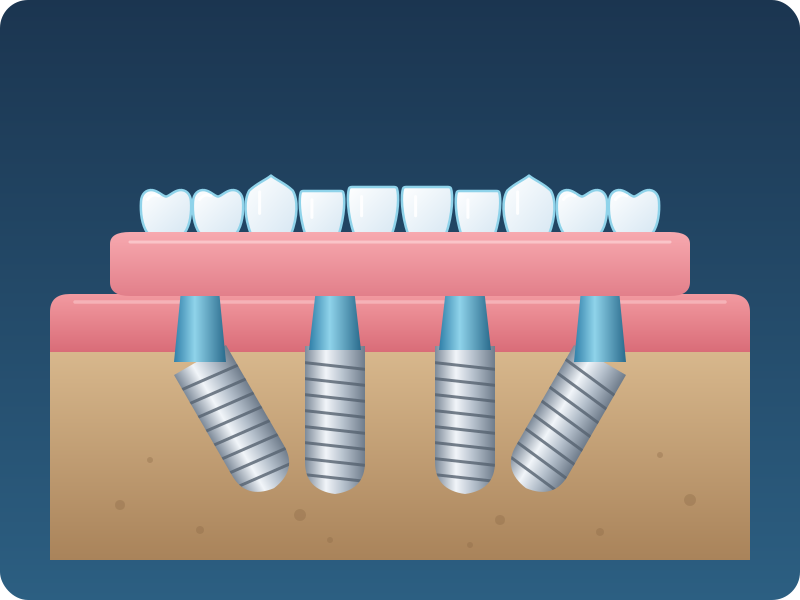
For an overdenture in the lower jaw, two implants are often enough. For the upper jaw more implants are usually needed, because the upper jaw is structured differently and often requires different support and stability.
The exact number of implants depends on your jawbone, denture, bite, oral mucosa, space in the mouth and the attachment system chosen.
Overdenture in the lower jaw
With an unstable lower denture, two implants are often placed in the lower jaw. These give the denture extra retention, which can reduce shifting and tilting.
The lower jaw is often where patients notice the biggest difference, because a conventional lower denture naturally has less retention.
Overdenture in the upper jaw
An overdenture in the upper jaw often requires a different assessment. The bone quality and anatomy of the upper jaw differ from those of the lower jaw. It also matters whether the palate can be partly left uncovered and how much stability is needed.
That is why more implants are often needed in the upper jaw than in the lower jaw. This always has to be planned individually.
Why can the number of implants differ per patient?
The number of implants is not a fixed choice based on preference alone. The dentist or implant dentist looks at:
- amount of jawbone;
- quality of the bone;
- shape of the jaw;
- distribution of forces during chewing;
- type of attachment;
- space for the denture;
- medical risk factors;
- the stability wanted.
A good treatment plan does not aim for “as many as possible” implants, but for a stable, safe and suitable solution.
What does an overdenture on implants cost?
The cost of an overdenture on implants depends on your situation, the number of implants, the type of denture, the diagnostics needed, the attachment system, any additional treatments and reimbursement by your health insurance.
A figure found online can therefore never predict exactly what you will pay yourself. The most important thing is to distinguish between total treatment cost, reimbursement, co-payment, deductible (eigen risico) and any additional costs.
Do you want to know what an overdenture would cost in your situation? During a consultation we discuss your jaw, denture, insurance and possible reimbursement. That way you get clarity before you decide. You can easily make an appointment here.
If you would like to read up in advance, our detailed article tells you everything about the cost of an implant, the factors that determine the price and which reimbursements are possible.
Why prices found online never match your personal situation exactly
An overdenture is tailor-made. The cost can differ because of:
- lower or upper jaw;
- number of implants;
- stud attachments, locators or bar;
- new denture or adjustment of the existing denture;
- diagnostics such as an X-ray or 3D scan;
- any additional treatment;
- reimbursement and policy conditions;
- co-payment and deductible.
That is why a personal cost estimate is only reliable after an examination.
Which components affect the cost
The cost can consist of several components:
- intake appointment and diagnostics;
- implant placement;
- any imaging;
- prosthetic construction;
- making or adjusting the overdenture;
- check-ups and aftercare;
- maintenance or replacement of attachment parts in the longer term.
Not every component is always reimbursed in the same way. That makes a clear explanation beforehand important.
Co-payment, deductible and supplementary insurance
With an overdenture several financial terms can get mixed up:
- reimbursement: the part paid by your health insurance;
- co-payment (eigen bijdrage): the part you have to pay yourself;
- deductible (eigen risico): the compulsory or voluntary deductible that may apply;
- supplementary insurance: can sometimes affect certain components, depending on your policy.
Many patients find this confusing. That is understandable. Always ask for an explanation based on your personal situation and insurance.
When do you get a personal cost estimate?
A personal cost estimate only makes sense once it is clear:
- what the diagnosis is;
- whether implants are needed and justified;
- which jaw is being treated;
- which type of denture is needed;
- whether reimbursement is possible;
- whether prior approval is needed.
At 3D Tandarts in Schiedam we can use the assessment to work out which steps are needed to get a clear picture of the costs.
Is an overdenture reimbursed by health insurance?
In the Netherlands, an overdenture on implants can be partly reimbursed under basic health insurance, subject to conditions, especially when the jaw has shrunk severely and there is insufficient retention for a conventional denture. Reimbursement is not automatic, however.
A medical indication is often needed and prior approval from the health insurer may be required. In addition, a co-payment and the deductible (eigen risico) may apply.
When reimbursement is possible
Reimbursement is usually linked to medical necessity. That means it is not only about the wish for more comfort, but about whether a conventional denture does not function adequately because of the condition of the jaw.
Factors that can play a role:
- severely shrunken jaw;
- insufficient retention for a conventional denture;
- recurring functional problems;
- assessment by a dentist, implant dentist or oral surgeon;
- the health insurer’s conditions.
Why approval from the health insurer may be needed
Because implants and an overdenture are expensive treatment, the insurer often wants to assess beforehand whether the conditions are met. This is done through an application for authorisation.
That can feel uncertain for patients. It is actually intended to give clarity beforehand about reimbursement and out-of-pocket costs.
What 3D Tandarts can explain during the process
During a consultation we can discuss:
- whether your symptoms fit a possible indication;
- which diagnostics are needed;
- which information is important for reimbursement;
- which costs you may have to pay yourself;
- which follow-up steps make sense.
The exact reimbursement is ultimately decided by the health insurer, not the dental practice.
What you can check yourself beforehand
You can already check beforehand:
- your basic insurance;
- supplementary insurance;
- how much of your deductible (eigen risico) is still outstanding;
- the conditions for dentures on implants;
- whether your insurer asks for prior approval;
- any contracted-care conditions.
If in doubt, bring your insurance details to the appointment. That helps to discuss more specifically which route applies to you.
Advantages and disadvantages of an overdenture
An overdenture usually offers more stability than a conventional denture, especially with an unstable lower denture. At the same time it remains a removable denture that needs maintenance, cleaning and check-ups.
A reliable decision therefore requires an honest picture of both the advantages and the limitations.
Main advantages
An overdenture can help with:
- more retention while eating;
- less shifting of the denture;
- more confidence when speaking;
- less dependence on denture adhesive;
- better distribution of chewing forces;
- more comfort with an unstable denture;
- more self-confidence in social situations.
For many patients the feeling of security matters most: thinking less about the denture while eating, talking or smiling.
Possible disadvantages and limitations
An overdenture also has points to consider:
- implants require surgical treatment;
- the process takes time;
- reimbursement is not always automatic;
- daily cleaning remains necessary;
- attachment parts can wear;
- check-ups remain important;
- it does not always feel the same as natural teeth;
- not everyone is immediately suitable.
These disadvantages do not mean an overdenture is not a good solution. They help you make a realistic choice.
What an overdenture does and does not solve
An overdenture can improve many stability problems, but it does not solve everything automatically. It can provide retention, but it cannot bring back natural teeth. It can improve chewing, but the bite, muscles and getting used to it also remain important. It can give confidence, but it requires daily maintenance.
Good treatment therefore starts with realistic expectations.
Risks and long-term maintenance
An overdenture on implants is a reliable solution when it is properly planned, placed and maintained. Nevertheless there are risks, such as inflammation around implants, wear of attachment parts, sore spots or loss of stability.
Most risks are reduced by good oral hygiene, regular check-ups and contacting us promptly if you have symptoms.
You can find more on this subject here.
Possible risks around implants
Risks can include:
- discomfort or swelling after placement;
- inflammation of the gums or tissue around implants;
- peri-implantitis;
- insufficient fusion of an implant with the bone;
- loosening or wear of components;
- sore spots caused by the denture;
- reduced fit due to changes in the jaw.
Not every risk can be fully prevented, but good diagnostics and aftercare make a big difference.
Daily cleaning of an overdenture
An overdenture must be taken out and cleaned every day. The implant components in the mouth must also be cleaned thoroughly.
Important points:
- clean the denture as instructed;
- keep the implant parts clean;
- check the gums and oral mucosa;
- do not sleep with the denture in if that is advised against;
- use aids that suit your situation.
A common misconception is that implants need less maintenance than natural teeth. In reality, implants require consistent care.
Checking and maintaining attachment parts
Attachment parts can wear over time. Rubber inserts, locators or other attachments may hold less firmly. That does not automatically mean the implant is failing. Often maintenance or replacement of parts is enough.
Regular check-ups help to spot small problems early.
When you should get in touch
Get in touch when:
- the overdenture suddenly feels less stable;
- you get pain or swelling;
- bleeding or inflammation develops;
- you have a sore spot that does not go away;
- the clicking feels different;
- a component appears damaged;
- cleaning becomes difficult.
Waiting when you have symptoms can make problems bigger. An early check-up is usually simpler than repairs later.
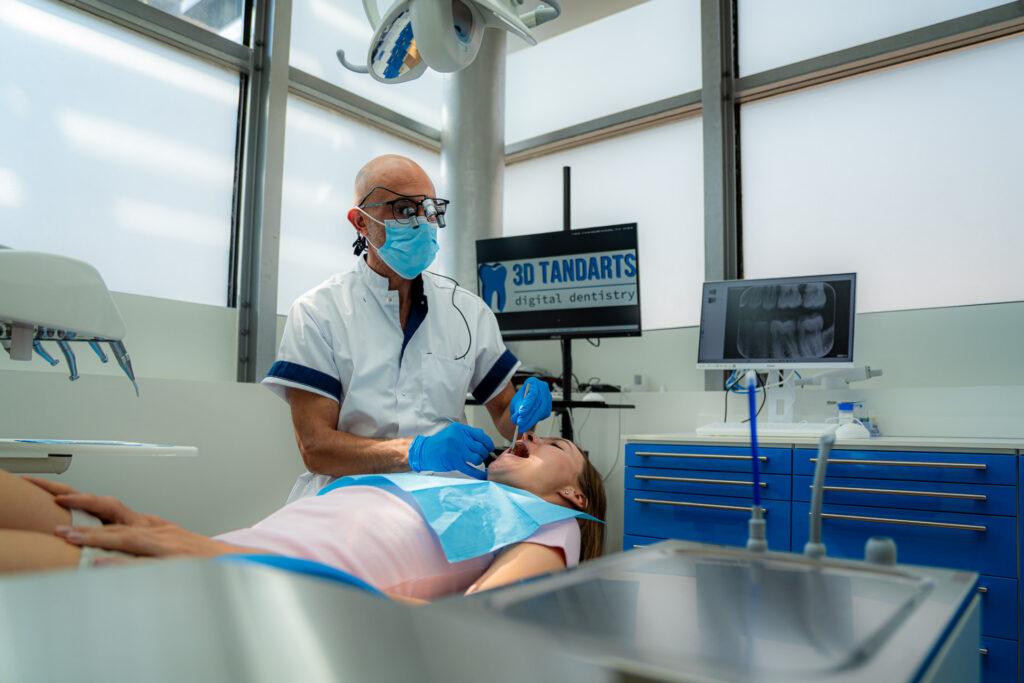
Recovery and getting used to an overdenture
After implants are placed a recovery period is needed. During this period tenderness, swelling and temporary restrictions when eating may occur. Getting used to the overdenture after it is fitted is also normal.
Most uncertainty arises because patients do not know what is normal. A good explanation beforehand helps you get through the process more calmly.
What is normal after implant placement?
After implant placement the following can occur temporarily:
- tenderness;
- swelling;
- mild discomfort;
- having to eat carefully;
- temporary sensitivity to pressure;
- need for an extra check-up or adjustment.
You will receive instructions on pain relief, oral hygiene, eating and when to get in touch. Follow these instructions carefully. You can read more about this in our detailed article.
Eating during the recovery period
In the first phase soft food is often more comfortable. It is important not to put unnecessary load on the wound area. Later, eating is built up gradually.
Many patients ask whether they can eat everything again straight away. The honest answer is: usually not immediately. The jaw has to heal and the denture has to be properly adjusted. Patience in this phase helps the final result.
Getting used to the new overdenture
Even when the overdenture fits well technically, getting used to it can take time. Your muscles, tongue and chewing pattern have to adapt. Speaking and eating sometimes feel different at first.
Adjustments after fitting are normal. An overdenture is tailor-made, and small corrections may be needed to improve comfort and stability.
When recovery needs extra attention
Get in touch if you:
- have increasing pain;
- still have clear swelling;
- notice fever or pus;
- cannot chew because of pain;
- have a sore spot that is not improving;
- cannot seat the overdenture properly;
- feel that something is unstable.
If in doubt, it is better to have it checked than to carry on for too long.
Comparing an overdenture with other solutions
An overdenture is not always the only solution for an unstable denture. Sometimes a new denture, a reline or a fixed implant solution may suit better. The right choice depends on the cause of the problem, your jawbone, budget, wishes and health.
A good dentist does not automatically recommend implants, but compares the options.
Overdenture versus conventional denture
- Feature: Retention; Conventional denture: Rests on gums and jaw; Overdenture on implants: Clicks onto implants
- Feature: Stability; Conventional denture: Depends on jaw shape; Overdenture on implants: Usually more stable
- Feature: Surgery needed; Conventional denture: No; Overdenture on implants: Yes
- Feature: Maintenance; Conventional denture: Daily cleaning; Overdenture on implants: Daily cleaning + implant care
- Feature: Cost; Conventional denture: Usually lower; Overdenture on implants: Usually higher, sometimes partly reimbursed
- Feature: Suitable when retention is poor; Conventional denture: Limited; Overdenture on implants: Often better suited
A conventional denture can work perfectly well when the jaw offers sufficient support. With severe instability an overdenture may be more logical.
Overdenture versus relining
Relining means the inside of the denture is made to fit again. This can help when the denture no longer fits well but the jaw still offers enough support.
Relining is less invasive than implants, but does not always help when there is too little retention because of jawbone loss. That is why we first need to examine where the instability comes from.
Overdenture versus fixed teeth on implants
Fixed teeth on implants usually cannot be removed by the patient and feel different from an overdenture. This solution can be attractive, but it requires different conditions, different costs, different cleaning and often a more complex treatment plan.
An overdenture is often more practical to clean and, for a completely toothless jaw, can offer a good balance between stability, maintenance and cost.
When another solution may suit better
Another solution may be better when:
- your current denture can easily be improved;
- you do not want implant treatment;
- there is insufficient bone or there are medical limitations;
- you specifically want a fixed solution;
- your expectations do not fit a removable overdenture;
- maintaining implants is not feasible.
The best choice is the solution that suits your mouth, health, expectations and daily life.
Why choose 3D Tandarts in Schiedam for an overdenture?
An overdenture takes more than just placing implants. Treatment starts with a good analysis of your current denture, jawbone, oral mucosa, bite, symptoms and expectations. Only then can it be determined whether an overdenture really is the right solution.
At 3D Tandarts in Schiedam we combine personal assessment with modern digital diagnostics and clear explanation. Our aim is not to automatically steer every patient towards implants, but to determine which solution is the most predictable and suitable.
Digital diagnostics and CBCT when needed
In complex situations additional imaging may be needed. CBCT imaging allows the jaw to be assessed in three dimensions. This helps in estimating bone volume, anatomical structures and possible treatment risks.
For patients with a shrunken jaw or uncertainty about implants, this digital assessment can be important for making a safe and realistic treatment plan.
Assess first, treat afterwards
With an unstable denture the cause is not always the same. Sometimes the denture is worn. Sometimes the jaw has changed. Sometimes the bite plays a part. And sometimes the foundation really is insufficient for a stable conventional denture.
That is why we first assess whether a less invasive solution is possible. Only when implants are logical and justified is an overdenture discussed as a treatment option.
Do you have doubts or are you apprehensive about implant treatment? Then also read our article on fear of implant treatment and find out how we ensure a safe and comfortable treatment. You can find the article here.
Clear explanation of cost and reimbursement
Cost and reimbursement are often confusing with an overdenture. There may be reimbursement from basic insurance, a co-payment, a deductible (eigen risico) or additional conditions from the health insurer.
At 3D Tandarts we take this discussion seriously. You need to understand beforehand which steps are needed, where the uncertainties lie and which information matters for your personal situation.
Local aftercare in Schiedam
Overdenture treatment often involves several appointments. After fitting, check-ups, small adjustments or maintenance may also be needed. A practice close by can then be practically important.
3D Tandarts in Schiedam is accessible for patients from Schiedam, Rotterdam, Vlaardingen, Maassluis and the surrounding area. Local aftercare makes it easier to have things checked in good time when something does not feel right.
When is it sensible to make an appointment?
It is sensible to make an appointment when your denture is regularly unstable, causes pain, limits what you can eat or makes you feel insecure. You do not need to know beforehand whether you need an overdenture. A consultation is precisely meant to assess that.
Many people wait a long time because they think the problems “come with the territory”. But recurring sore spots, poor chewing or social embarrassment are good reasons to seek help.
Signs that an assessment is worthwhile
Make an appointment when:
- your lower denture often shifts;
- you use denture adhesive every day;
- you have pain or sore spots;
- you avoid certain foods;
- speaking feels insecure;
- your denture comes out when you smile;
- you are unsure whether implants are possible;
- you want to know whether reimbursement is possible.
These signs do not automatically mean you need implants. They do mean an assessment is sensible.
What you can bring to the appointment
Preferably bring:
- your current denture;
- information about your symptoms;
- your health insurance details;
- any earlier treatment plans;
- questions about cost, pain or reimbursement;
- information about medication or health.
Feel free to write down beforehand what worries you. Many patients find it hard to remember everything during a consultation.
What to expect at the intake appointment
During the intake appointment the dentist discusses your symptoms, examines your mouth and assesses the denture. Then we explain which follow-up steps make sense.
That may be:
- adjusting the denture;
- a new denture;
- additional diagnostics;
- assessment for an overdenture;
- referral or collaboration with a specialist;
- a discussion of cost or reimbursement.
An intake appointment does not oblige you to have treatment. The aim is clarity: what is going on, what options do you have and which choice suits you?
Book an assessment at 3D Tandarts in Schiedam
Do you have an unstable denture, do you often use denture adhesive, or are you unsure whether an overdenture on implants suits you? An assessment at 3D Tandarts in Schiedam can give you clarity.
During the consultation we look at your current denture, jawbone, oral health and wishes. Then we honestly discuss which solution is the most logical: adjusting, replacing, an overdenture or another treatment route.

Overdenture on implants at 3D Tandarts in Schiedam
At 3D Tandarts in Schiedam you can have an unstable denture assessed and receive advice on possible solutions, including an overdenture on implants. We first look at your symptoms, your current denture and the cause of the problem.
For patients from Schiedam, Rotterdam and the South Holland region, local accessibility matters, especially because overdenture treatment can involve several appointments. Clear explanation and good aftercare are therefore just as important as the treatment itself.
Intake appointment for an unstable denture in Schiedam
During an intake appointment we assess whether your denture still fits well and whether implants could be worthwhile. Sometimes a less invasive solution is enough. Sometimes further examination is needed.
The aim is not to start a treatment straight away, but to give reliable advice.
Accessible for patients from the Rotterdam area
3D Tandarts is located in Schiedam and is therefore also convenient for patients from the Rotterdam area, Vlaardingen, Maassluis and surroundings. For treatments with several steps, a practice that is easy to reach can be practically important.
Local aftercare also makes it easier to plan check-ups, adjustments or questions easily.
Personal treatment advice and cost discussion
Because cost and reimbursement differ per patient, we discuss this on the basis of your situation. We look at the diagnosis, possible indication, treatment options and any steps towards the health insurer.
A personal cost discussion prevents misunderstandings and helps you decide calmly.
When referral or collaboration may be needed
Sometimes collaboration with an implant dentist, oral surgeon or denturist is needed. That depends on the complexity of the jaw, the implant planning and the type of denture.
When additional specialist care is needed, the treatment plan stays clearly coordinated, so that you know who carries out which step and why.
Frequently asked questions
Frequently asked questions about an overdenture
How does an overdenture on implants work?
An overdenture works by using implants in the jaw as anchors for a removable denture. Attachments are placed on the implants and the denture clicks onto them. This makes it more stable than a conventional denture, but you can still take it out yourself for cleaning.
How many implants are needed for an overdenture?
For an overdenture in the lower jaw, two implants are often enough. The upper jaw usually needs more implants. The exact number depends on your jawbone, bone quality, denture, bite and the stability you want. This can only be determined properly after an examination.
Is an overdenture removable?
Yes. An overdenture clicks onto implants but remains removable. You take it out of your mouth to clean it. This distinction matters: an overdenture is more stable than a conventional denture, but it is not the same as a fixed implant bridge.
How much does an overdenture on implants cost?
The cost differs from patient to patient. It depends on the jaw, the number of implants, diagnostics, the attachment system, the denture and reimbursement by your health insurance. A reliable cost estimate can only be given after an examination and assessment of your personal situation.
Is an overdenture reimbursed?
Under certain conditions an overdenture can be partly reimbursed by basic health insurance, especially when a severely resorbed jaw leaves a conventional denture with too little retention. Reimbursement is not automatic. A medical indication is often required, and sometimes prior approval from your health insurer.
What is the co-payment for an overdenture?
A co-payment (eigen bijdrage, the part you pay yourself) may apply to an overdenture. The deductible (eigen risico) may also apply. The amount depends on your insurance, policy conditions and treatment plan. That is why it is important to look not only at the total cost, but also at reimbursement, co-payment and deductible.
What are the disadvantages of an overdenture?
The disadvantages are that implants have to be placed, the process takes time, maintenance remains necessary and reimbursement is not always a given. The attachment parts can also wear. An overdenture usually feels more stable than a conventional denture, but not exactly the same as natural teeth.
Can implants become inflamed?
Yes, the tissue around implants can become inflamed, especially with insufficient cleaning or risk factors such as smoking or certain health conditions. Inflammation around implants is called peri-implantitis. Good oral hygiene, check-ups and contacting us promptly if you have symptoms are important to limit the risks.
How do I look after an overdenture?
You clean the overdenture outside the mouth every day and also clean the implant parts in your mouth thoroughly. Regular check-ups are also needed. The attachment parts can wear and sometimes have to be replaced or adjusted. Good cleaning is essential for keeping your implants in the long term.
Does having implants placed hurt?
Implants are usually placed under local anaesthetic. You should not feel any sharp pain during the treatment. Afterwards there may be tenderness, swelling or some discomfort. These symptoms are usually managed with instructions and, if necessary, pain relief. Discuss any anxiety with your dentist beforehand.
How long does recovery after implants take?
The initial healing usually takes days to weeks, but the implants take longer to fuse with the jawbone. The total treatment time depends on your jaw, the number of implants, healing and the prosthetic planning. During the consultation you will be given an estimate for your situation.
Can I eat during the healing period?
Usually you can eat, but soft food is often recommended in the first phase. The surgical area should not be put under too much strain. Exactly what you can eat depends on the treatment and any temporary denture. You will receive personal instructions for this.
What should I look for when choosing a dentist for an overdenture?
Look for clear explanations, experience with prosthetic and implant treatment, transparency about costs, attention to risks, good aftercare and easy accessibility. A good practitioner also discusses alternatives and tells you honestly when an overdenture is not the best solution.
Can I have my current denture assessed first?
Yes. That is often a sensible first step. Sometimes your current denture can be adjusted or relined. In other cases it turns out that implants are needed for sufficient stability. An assessment helps to avoid unnecessary or wrong treatment.
Can I come to 3D Tandarts in Schiedam for advice about an overdenture?
Yes, at 3D Tandarts in Schiedam you can have an unstable denture assessed and get advice on possible solutions. During a consultation we look at the cause of your symptoms and whether an implant overdenture could be worthwhile for you.
Is 3D Tandarts easy to reach from Rotterdam or Vlaardingen?
Yes, 3D Tandarts in Schiedam is also easy to reach for patients from the Rotterdam area, Vlaardingen, Maassluis and surroundings. That can be practical when several appointments, check-ups or aftercare visits are needed.
Can I get a second opinion on my unstable denture?
Yes, a second opinion can be useful if you have doubts about earlier advice, reimbursement, implants or alternatives. Bring your current denture, any treatment plans and your insurance information so that the situation can be assessed properly.
Conclusion: when is an overdenture a good choice?
An overdenture on implants can be a good solution when a conventional denture offers too little retention, especially with an unstable lower denture. It can give more stability, comfort and confidence when eating, speaking and smiling.
At the same time, an overdenture is not a standard solution for everyone. The right choice depends on your jawbone, oral health, medical situation, current denture, expectations and reimbursement. Sometimes an adjustment or a new denture is enough. Sometimes an overdenture is the most logical step.
The key points:
- an overdenture clicks onto implants, but remains removable;
- an unstable lower denture in particular can benefit greatly from implants;
- suitability has to be examined personally;
- cost and reimbursement differ per situation;
- maintenance and check-ups remain important;
- realistic expectations are essential;
- a consultation helps you get clarity without any immediate obligation.
Do you have an unstable denture, do you often use denture adhesive, or do you notice that eating and speaking are becoming insecure? Then an assessment at 3D Tandarts in Schiedam is a logical next step. You can easily book your appointment by clicking here.
During a consultation we look at the cause, which solutions fit and whether an overdenture on implants could be a sensible choice for you. That way you get clarity before making a decision.

Dentistry and digital implantology at 3D Tandarts Schiedam
Knowledge base
Latest articles

Hidden root canals: why a tooth can keep causing problems after root canal treatment
Pain after root canal treatment? Learn how a hidden or missed canal happens and how the microscope and CBCT help. Book an assessment in Schiedam.
Surgical microscope for root canal treatment in Schiedam
What does a surgical microscope do in root canal treatment? See how precision and CBCT help save your tooth. Book at 3D Tandarts in Schiedam.
Implant consultation in Schiedam: find out which treatment suits you
Is a dental implant right for you? Find out what an implant consultation in Schiedam involves: examination, advice and a treatment plan. Book today.
Questions about your situation?
During a consultation we look at your situation and discuss the options.