
Last updated: 4 October 2026
Dental implant treatment: a complete step-by-step plan
A missing tooth can have more consequences than many people think. Besides aesthetic concerns, tooth loss can affect your chewing, speech, oral health and self-confidence. That is why more and more patients choose a dental implant as a lasting solution.
Even so, implant treatment often raises questions. How exactly does the treatment work? Does an implant hurt? How long does the process take? Do I have enough jawbone? And am I actually suitable for an implant?
Although every situation is unique, implant treatment usually follows a set structure. In this article we explain step by step what you can expect, which factors influence the success of an implant and how you can best prepare for treatment.
What is a dental implant?
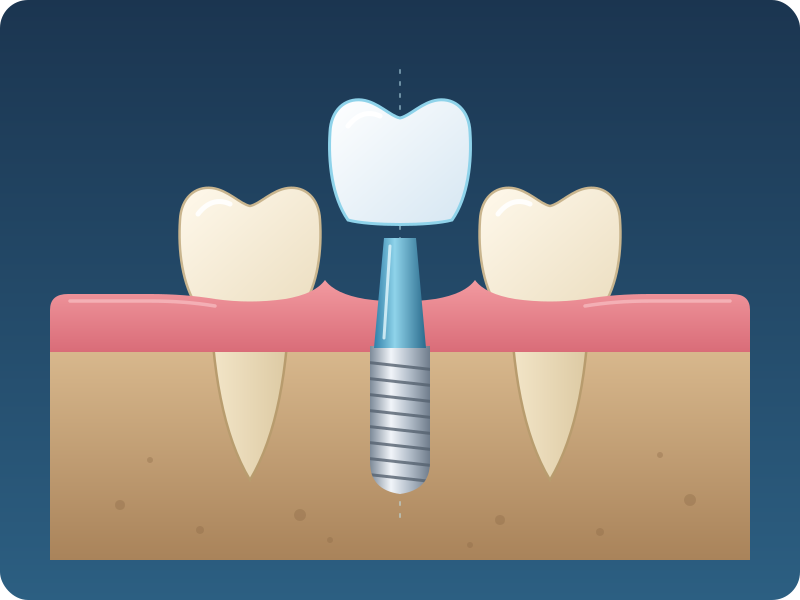
An implant is an artificial tooth root that is placed in the jawbone. The implant is usually made of titanium, a material that is well accepted by the body.
After placement, the implant fuses with the jawbone. A crown, bridge or implant overdenture can then be attached to it.
The great advantage of an implant is that it offers a fixed solution for a missing tooth, without the neighbouring teeth having to be altered.
When is an implant used?
An implant can be a suitable solution when:
- one tooth is missing;
- several teeth are missing;
- all teeth are missing;
- an unstable denture does not give enough support;
- a lasting replacement is wanted for a lost tooth.
When is an implant a good solution?
Every patient has different wishes and a different oral situation. That is why we always look at the full picture.
An implant may be a good option if you:
- want to chew comfortably again;
- are looking for a fixed solution;
- want to feel less self-conscious about your smile;
- want to limit further bone loss;
- want a natural appearance.
During an implant consultation we assess whether an implant is the most predictable solution for your situation.
How does implant treatment work? The complete step-by-step plan
Step 1: Intake and implant consultation
Every implant treatment begins with a thorough consultation.
During this appointment we discuss:
- your medical history;
- medication use;
- previous dental treatment;
- any complaints;
- your expectations.
We also examine your teeth, molars, gums and bite.
The aim of this appointment is not to start treatment straight away, but to assess which solution offers the best long-term prognosis.
Why is the first consultation so important?
Many factors influence the success of an implant.
Not only the amount of bone, but also gum health, oral hygiene and general health play an important role.
A good diagnosis is therefore the foundation of successful treatment.
Step 2: Diagnostics and 3D planning
When an implant looks possible, a thorough diagnostic examination follows.
Depending on your situation, we may use:
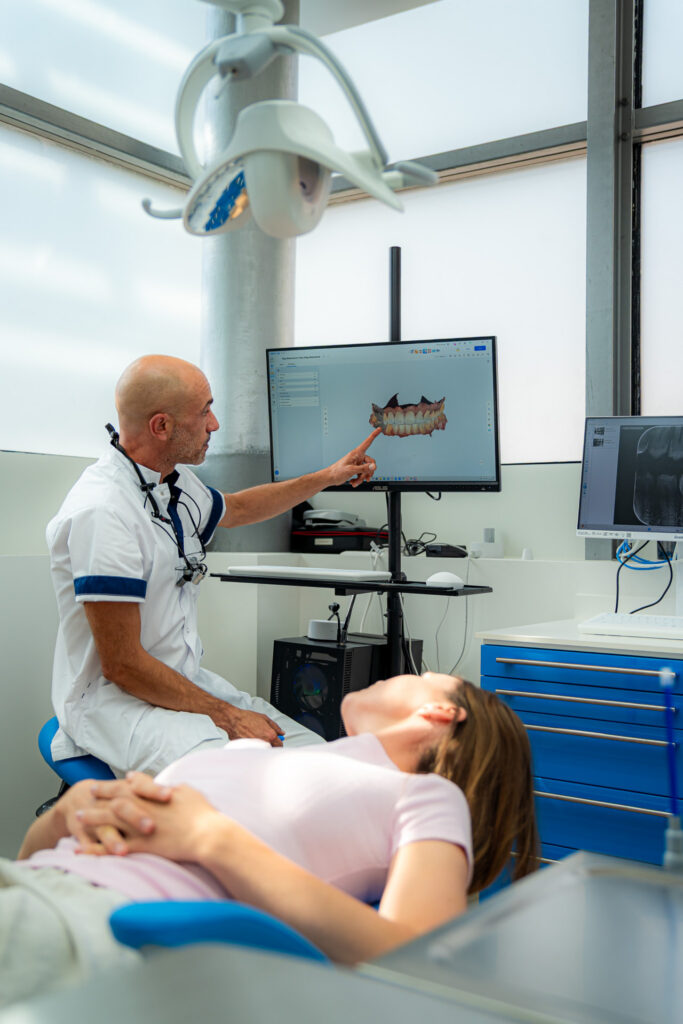
- digital intraoral scans;
- X-rays;
- CBCT 3D scans.
With this information we assess:
- the amount of jawbone;
- the quality of the bone;
- the position of nerves;
- the position of the maxillary sinus;
- the ideal position of the implant.
Why is a CBCT scan important?
An implant is not simply placed at the site of the missing tooth.
For a predictable result, the position must be planned precisely.
With 3D diagnostics, important anatomical structures can be made visible and the treatment can be prepared digitally.
This increases the safety and predictability of the treatment.
Step 3: Personal treatment plan
After the examination you receive a personal treatment plan.
In it we discuss:
- the treatment steps;
- the expected duration;
- any additional treatment;
- alternative options;
- the long-term prognosis.
Every patient is different. That is why the treatment plan is fully tailored to your personal situation.
Step 4: Tooth extraction, if needed
Sometimes the tooth is already missing.
In other cases a damaged tooth first has to be removed before an implant can be placed.
Depending on the situation:
- the implant can be placed immediately;
- a healing period may be needed first.
Which option is most suitable depends on factors such as bone quality, infection and the position of the tooth.
Step 5: Bone grafting, if needed
Not every patient has enough jawbone for an implant.
When a tooth has been missing for a long time, the jawbone can slowly shrink.
Why does bone loss occur?
Bone loss can be caused by:
- long-term tooth loss;
- periodontitis;
- infections;
- trauma;
- long-term use of a denture.
Is bone grafting always necessary?
No.
Many patients turn out to have enough bone for implant placement.
When there is a shortage, bone grafting can in many cases offer a solution.
The aim of bone grafting is not to create as much bone as possible, but to create a stable foundation for an implant that will succeed in the long term.
Step 6: Placing the implant
When all the conditions are met, the implant is placed.
The treatment is carried out under local anaesthetic.
During the procedure you may feel pressure or vibrations, but normally no sharp pain.
Many patients end up finding the treatment less demanding than they expected beforehand.
How long does it take to place an implant?
In many cases the treatment takes between 30 and 90 minutes.
This depends, among other things, on:
- the number of implants;
- the location in the mouth;
- any additional procedures.
Step 7: Healing and osseointegration
After placement, the most important phase of the treatment begins.
This phase is called osseointegration.
During this process the implant fuses with the jawbone.
Why is osseointegration so important?
The strength of the bond between implant and jawbone ultimately determines the stability of the implant.
Although the gums often heal relatively quickly, the jawbone needs more time to recover fully.
Successful osseointegration is the foundation of a long-lasting result.
Step 8: Placing the abutment
When the implant has fused sufficiently, an abutment is placed.
The abutment forms the connection between the implant and the final crown.
This step ensures that the definitive restoration can be attached firmly and securely.
Step 9: Placing the final crown
After successful healing, the final crown is made.
We take the following into account:
- colour;
- shape;
- function;
- bite;
- aesthetics;
- ease of cleaning.
The aim is a result that works well and looks natural.
Is an implant visible?
A well-made implant crown usually blends seamlessly with the natural teeth.
Many people cannot tell that a tooth is supported by an implant.
Step 10: Aftercare and check-ups
An implant needs the same attention as natural teeth.
Regular check-ups remain important.
During these check-ups we assess:
- the health of the gums;
- the stability of the implant;
- oral hygiene;
- any changes around the implant.
Why is aftercare so important?
Good aftercare helps prevent complications such as peri-implantitis.
Peri-implantitis is an inflammation around the implant that can lead to bone loss if it is not treated in time.
Which factors influence the success of an implant?
Successful implant treatment depends on several factors.
The quality of the jawbone
Enough healthy bone is essential for stable anchoring of the implant.
Healthy gums
Gum inflammation often has to be treated before an implant can be placed.
Oral hygiene
An implant needs daily care.
Good oral hygiene helps prevent complications.
Smoking
Smoking can slow wound healing and increase the risk of complications.
That is why we always discuss this during the consultation.
What happens if a missing tooth is not replaced?
Many patients think that a single missing tooth has few consequences.
In the longer term, however, changes can occur such as:
- shifting teeth;
- reduced chewing function;
- extra load on other teeth;
- loss of jawbone;
- changes in the bite.
The longer a tooth is missing, the greater the chance of these changes.
Dental implant or bridge: what is the difference?
Both an implant and a bridge can replace a missing tooth.
Advantages of an implant
- neighbouring teeth do not need to be reshaped;
- natural loading of the jawbone;
- fixed solution;
- natural function;
- preservation of bone volume.
When can a bridge be a good choice?
In some situations a bridge can be a suitable solution.
The best choice depends on:
- the condition of the surrounding teeth;
- the space available;
- oral health;
- your personal preference.
During a consultation we discuss the different options.
How long does implant treatment take?
The total treatment time differs from patient to patient.
Factors that influence treatment time are:
- amount of jawbone;
- whether bone grafting is needed;
- location of the implant;
- speed of healing;
- general health.
A simple implant treatment is often quicker than one that requires additional procedures.
During the consultation we can give a realistic estimate of your personal treatment pathway.
Does implant treatment hurt?
This is one of the most frequently asked questions.
Thanks to local anaesthetic, you should not feel sharp pain during the treatment.
After the treatment the following may occur temporarily:
- slight swelling;
- tenderness;
- pain afterwards;
- discomfort when chewing.
These reactions are part of the normal healing process.
For most patients the treatment turns out to be easier than they expected beforehand.
How likely is an implant to succeed?
Modern implant treatments are among the most predictable treatments in dentistry.
Overall success depends on:
- precise planning;
- enough jawbone;
- good oral hygiene;
- regular check-ups;
- general health.
A careful diagnosis and good aftercare play an important part here.
Am I a suitable candidate for a dental implant?
Many adults are eligible for an implant.
Key requirements are:
- enough jawbone;
- healthy gums;
- good oral hygiene;
- stable general health.
Only an individual examination can determine which options are available for your situation.
Frequently asked questions
Frequently asked questions about dental implants
Can I have a dental implant if I have bone loss?
Yes, in many cases additional treatment such as bone grafting is possible.
How long does a dental implant last?
With good oral hygiene and regular check-ups, an implant can function well for many years.
Is a dental implant better than a bridge?
That depends on your personal situation. Both treatments have their own advantages and disadvantages.
Can a dental implant be rejected?
An implant is not rejected the way a donor organ can be. However, infection or insufficient healing can affect its success.
When can I eat normally again?
This varies from patient to patient. You can usually go back to soft foods quickly.
Can I have several implants placed at the same time?
Yes. Depending on the situation, several implants can be placed during the same procedure.
Am I too old for a dental implant?
Age is usually not the most important factor. General health and oral health are often more decisive.
Implant consultation in Schiedam
Are you missing a tooth and want to know whether an implant is suitable for you?
During an implant consultation at 3D Tandarts in Schiedam we assess your oral health, the amount of jawbone available and the options for a predictable, long-term result.
With modern diagnostics and digital 3D planning, we can draw up a treatment plan that is fully tailored to your situation.
You will receive clarity about the options, the expected treatment steps and the most suitable solution for your oral health.
A well-informed decision starts with an accurate diagnosis.
Knowledge base
Latest articles

Hidden root canals: why a tooth can keep causing problems after root canal treatment
Pain after root canal treatment? Learn how a hidden or missed canal happens and how the microscope and CBCT help. Book an assessment in Schiedam.

Surgical microscope for root canal treatment in Schiedam
What does a surgical microscope do in root canal treatment? See how precision and CBCT help save your tooth. Book at 3D Tandarts in Schiedam.
Implant consultation in Schiedam: find out which treatment suits you
Is a dental implant right for you? Find out what an implant consultation in Schiedam involves: examination, advice and a treatment plan. Book today.
Questions about your situation?
During a consultation we look at your situation and discuss the options.