Implants with bone loss: solutions with or without bone grafting in Schiedam
Written by Danilo Di Vico — dentistry and digital implant dentistry at 3D Tandarts Schiedam
– Last updated: 1 October 2026
Many patients are told that they have “too little bone” for implants. In reality, this often does not mean that an implant is impossible.
At 3D Tandarts in Schiedam, located inside Schiedam Centrum station, modern techniques such as 3D scans, bone grafting and digital planning mean that in many cases we can place implants even when there is bone loss.
The only way to know for sure is a personal assessment.
What is bone loss?
Bone loss in the jaw occurs when the jawbone slowly shrinks. This often happens after:
- the loss of a tooth
- long-term wearing of a full or partial denture
- periodontitis (gum disease)
- infections in the jaw
Because this process is gradual, many people only notice it late.
Why is enough jawbone important for an implant?
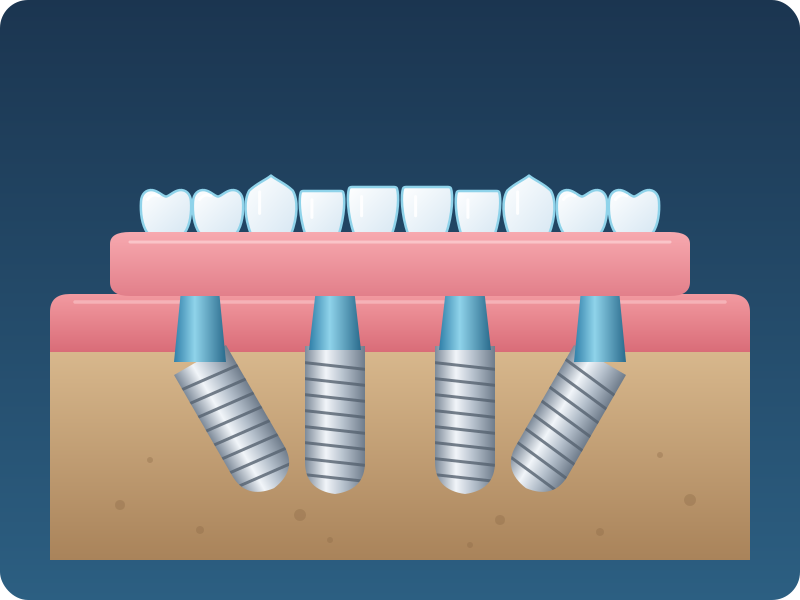
An implant must be able to fuse firmly with the jawbone in order to stay stable and function well for many years. That is why we look not only at the amount of bone, but also at its quality and at the planned implant site.
The assessment takes into account, among other things:
- the height and width of the jawbone;
- the density and quality of the bone;
- the distance to nerves and the sinus;
- the position of the future crown or bridge;
- the ability to keep the implant clean.
The aim is not just to place an implant, but to achieve a predictable and lasting end result.
How do we check whether you have enough bone?
How is this determined in practice?
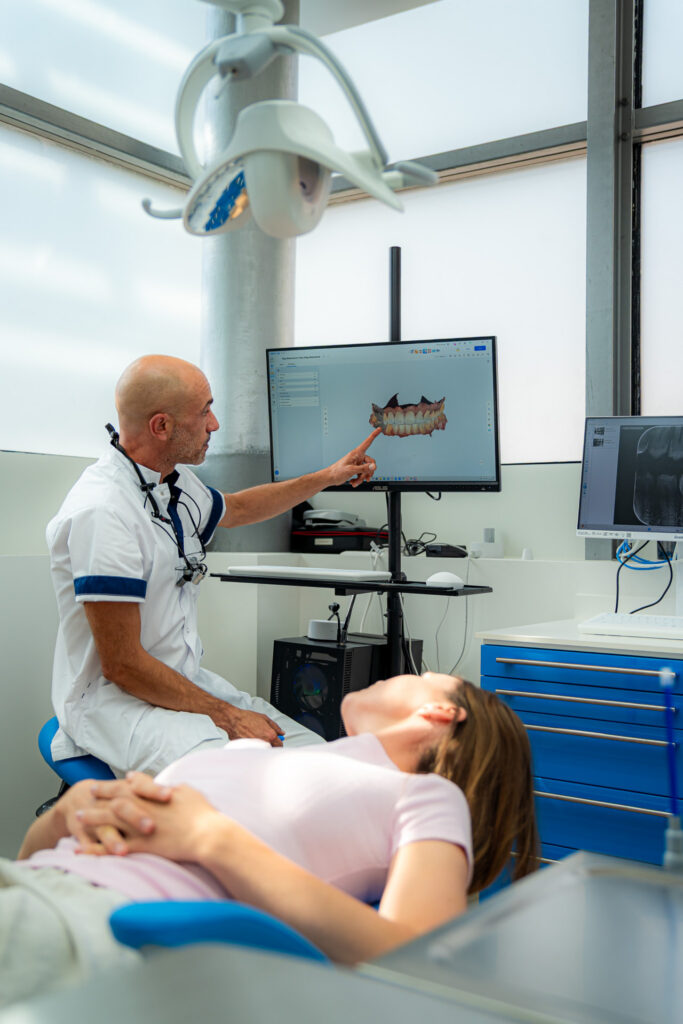
Assessing bone height, nerves and the position of the crown is not done by feel, but through a structured digital planning process.
1. 3D scan of the jaw (CBCT)
A CBCT scan of the jaw is taken.
This makes the following visible in three dimensions:
- the exact amount of bone
- the course of the nerve
- the position of the sinus
- any bone defects
This forms the basis for further planning.
2. Digital planning of the implant
Using specialised software, the implant is placed virtually. This is part of computer-guided implant surgery, in which the position of the dental implant is determined digitally before the actual procedure and is often transferred with a surgical guide.
This establishes:
- the optimal angle and position of the implant
- the available bone height and width
- the distance to nerves and sinus
- the relationship with the future tooth position
This makes it easier to assess in advance which implant position is appropriate in relation to the available bone and relevant anatomical structures.
3. Prosthetic planning of the tooth
The position of the implant is determined by the final tooth, not the other way round.
That is why we plan in advance:
- the shape and position of the crown or bridge
- the functional bite
- the aesthetic match with the other teeth
- the options for oral hygiene
This is also known as prosthetically driven implant dentistry.
4. From plan to surgery
The treatment is carried out on the basis of the digital planning.
Depending on the situation, this is done:
- with a surgical guide
- or with a fully digitally prepared freehand technique
- sometimes in combination with bone grafting
This allows the position planned in advance to be transferred accurately into the mouth.
Why is this important?
The aim is not only to place an implant, but to achieve a predictable and lasting end result that:
- is functionally correct
- looks aesthetically natural
- stays easy to clean
- is stable in the long term
When is an implant possible without bone grafting?
An implant can often be placed straight away when:
- the tooth has not been missing for long;
- enough bone volume is present;
- there is no active infection;
- the implant position is favourable;
- a stable and easy-to-clean end result is achievable.
Even with limited bone loss, an implant can sometimes be placed without additional treatment thanks to careful planning.
Bone grafting for implants
When is bone grafting needed?
When there is not enough jawbone to place an implant safely and stably, bone grafting may be necessary. The aim is to create enough support so that the implant can fuse well and be placed in the right position.
Bone grafting is considered, among other things, in cases of:
- severe bone loss after tooth loss;
- bone loss caused by periodontitis;
- a narrow jaw ridge;
- insufficient bone height;
- bone defects after infections;
- insufficient bone beneath the sinus in the upper jaw.
What forms of bone grafting are there?
Depending on the situation, different techniques are possible.
With limited bone loss, a small local bone graft can be carried out around the implant. With more extensive defects, a regenerative treatment can take place first, before the implant is placed.
In the upper jaw, a sinus lift may also be needed when the sinus leaves too little space for safe implant placement.
Whether bone grafting can take place at the same time as the implant or must first heal separately depends on the amount of bone available and the stability required.
How does the treatment go?
The treatment is usually carried out under local anaesthetic. During the procedure, patients generally feel pressure and vibrations, but no sharp pain.
Afterwards, mild post-operative pain, swelling and tenderness may occur. With larger bone grafts, recovery can be more demanding than with standard implant placement.
How long does recovery take?
Your gums usually heal within a few weeks, while the newly formed bone can take several months to heal completely.
During this period it is often advised to:
- eat soft food for a while;
- keep the treated area clean;
- avoid smoking as far as possible;
- attend check-ups as agreed.
Only when enough bone healing has taken place can the implant be fully loaded.
Implants after periodontitis
An implant may also be possible after periodontitis, provided the inflammation is fully under control and oral hygiene is kept up well.
Regular check-ups and professional aftercare are important to limit the risk of peri-implantitis and new bone loss.
Is a second opinion worthwhile?
A second opinion can be valuable if you have previously been told that implants are not possible or if different treatment advice has been given.
With new imaging and modern treatment techniques, options sometimes turn out to exist that were not considered before.
What alternatives are there?
Not every situation calls for the same solution. Depending on the amount of bone and your wishes, the choice can be:
- an implant without bone grafting;
- an implant combined with bone grafting;
- an implant with a sinus lift;
- a bridge;
- an implant overdenture;
- another prosthetic solution.
The final choice depends on function, aesthetics, maintenance, comfort and the long-term prognosis.
What happens if you wait?
When a missing tooth is not replaced for a long time, the jawbone can shrink further. The neighbouring teeth can also shift, or the treatment can become more complex later.
Not every situation requires immediate treatment, but a timely assessment helps to keep future options open.
How much does an implant cost with bone loss?
The final cost depends on the individual situation and can include:
- diagnostics;
- a 3D scan, if needed;
- bone grafting;
- implant placement;
- the crown or bridge;
- check-ups and aftercare.
That is why a personal quotation is always necessary.
Does an implant or bone grafting hurt?
Thanks to local anaesthetic, you should not feel sharp pain during the treatment. Afterwards, mild post-operative pain, swelling and tenderness are normal and usually temporary.
Most symptoms fade gradually during the first few days after the treatment.
If you would like to know more about this subject, you can click here.
When is an implant less suitable?
An implant is not always the best solution. This may be the case, for example, with:
- active periodontitis;
- insufficient oral hygiene;
- certain medical conditions;
- risk factors that affect bone healing;
- situations in which a very extensive reconstruction would be needed.
In such cases a bridge or an implant overdenture can be a better choice.
Conclusion
Bone loss does not automatically mean that an implant is impossible. Thanks to modern diagnostics and techniques such as bone grafting, many patients can still be treated successfully.
Which treatment is most suitable is determined on the basis of a personal examination, clinical assessment and, when indicated, additional 3D imaging. In this way a treatment plan can be drawn up that takes into account function, cleanability, anatomy and the expected long-term prognosis.

Dentistry and digital implant dentistry at 3D Tandarts Schiedam
Knowledge base
Latest articles

Hidden root canals: why a tooth can keep causing problems after root canal treatment
Pain after root canal treatment? Learn how a hidden or missed canal happens and how the microscope and CBCT help. Book an assessment in Schiedam.

Surgical microscope for root canal treatment in Schiedam
What does a surgical microscope do in root canal treatment? See how precision and CBCT help save your tooth. Book at 3D Tandarts in Schiedam.
Implant consultation in Schiedam: find out which treatment suits you
Is a dental implant right for you? Find out what an implant consultation in Schiedam involves: examination, advice and a treatment plan. Book today.
Questions about your situation?
During a consultation we look at your situation and discuss the options.