
Last updated: 4 October 2026
Short answer
In most cases, root canal treatment is preferable when a tooth can be saved predictably. However, if the tooth is severely damaged or the prognosis is poor, extraction with a suitable replacement may be the better choice.
Introduction
Has your dentist told you that a tooth can no longer be saved? When a tooth is inflamed or infected, there are usually two treatment options:
- keep the tooth with a root canal treatment;
- or remove the tooth (extraction).
Many people ask themselves “Root canal treatment or extraction? Which is the best choice?” or “Is a root canal treatment still worth it, or is it wiser to have the tooth removed straight away?”
Sometimes an extraction seems quicker, simpler or cheaper. Yet that is not automatically the best solution. In modern dentistry there is an important guiding principle: if a tooth can be saved in a predictable way, that is usually preferable.
A natural tooth works better than any replacement. It feels natural, adapts to chewing movements, and helps keep the surrounding teeth and the jawbone healthy and stable. That is why a tooth is only removed when saving it no longer has a good or lasting prognosis.
That does not mean, however, that root canal treatment is always the right choice. If a tooth is severely damaged, cracked or can no longer be restored properly, extraction may be the wisest treatment. After a tooth is extracted you also need to think about the next step: you need to decide whether the space is left empty or replaced, for example with a dental implant, a bridge or a denture. A dental implant is often the best replacement.
The most important question is therefore not:
“Which treatment is cheaper?”
But:
“Which treatment offers the best chance of a healthy, lasting set of teeth in the long term?”
At our dental practice 3D Tandarts in Schiedam we do not only assess the infection, but the complete situation. Among other things, we look at:
- how much healthy tooth structure remains;
- whether the tooth can be restored in a lasting way;
- the condition of the gums and the jawbone;
- any cracks or fractures;
- the load on the tooth during chewing;
- your overall oral health and your treatment plan for the future.
On that basis we advise whether root canal treatment offers the best chance of saving the tooth, or whether extraction with a suitable replacement is ultimately the most lasting solution.
Comparison table
- Aspect: Purpose; Root canal treatment: to save the natural tooth.; Tooth extraction: to remove a tooth that can no longer be saved.
- Aspect: When recommended; Root canal treatment: for an inflamed or infected pulp (nerve), deep decay, trauma or infection, as long as the tooth can still be restored.; Tooth extraction: for severe damage, a fracture, an infection that cannot be treated, or when the tooth can no longer be restored.
- Aspect: Treatment; Root canal treatment: removal of the nerve, cleaning and disinfecting the root canals and sealing the tooth.; Tooth extraction: extraction, removal of the tooth; possibly followed by an implant, bridge or denture.
- Aspect: Advantages; Root canal treatment: keeping your own tooth, keeping chewing function and supporting the jawbone and tooth position.; Tooth extraction: definitive removal of the problem tooth and a solution for infections that cannot be treated.
- Aspect: Disadvantages; Root canal treatment: a crown is often needed and regular check-ups remain important.; Tooth extraction: permanent tooth loss, possible bone loss and the need for a replacement.
- Aspect: Keeps your own tooth; Root canal treatment: ✔ Yes; Tooth extraction: ✖ No
- Aspect: Pain during treatment; Root canal treatment: performed under local anaesthetic; pressure or other sensations may still be felt.; Tooth extraction: performed under local anaesthetic; some soreness afterwards is possible for a few days.
- Aspect: Treatment time; Root canal treatment: one or more appointments depending on the situation.; Tooth extraction: usually one appointment; a replacement requires extra steps.
- Aspect: Recovery; Root canal treatment: a quick return to daily activities in most cases.; Tooth extraction: the gum heals within a few days, the bone takes longer to heal.
- Aspect: Cost; Root canal treatment: often higher than an extraction, but keeping the tooth avoids later costs.; Tooth extraction: lower at first, but a replacement can increase the total cost.
- Aspect: Prognosis; Root canal treatment: usually excellent with correct treatment and a good restoration.; Tooth extraction: a predictable procedure, but the functional result depends on the replacement.
- Aspect: Predictability; Root canal treatment: high when enough tooth structure remains and the technique is good.; Tooth extraction: high for the extraction itself, but dependent on the follow-up treatment.
- Aspect: Risk of failure / complications; Root canal treatment: small, but re-infection or a fracture may require retreatment or extraction.; Tooth extraction: small, but a dry socket, infection or delayed healing is possible.
- Aspect: Long-term result; Root canal treatment: a functional tooth can last many more years with good care.; Tooth extraction: without a replacement there is a risk of teeth shifting and bone loss.
When is root canal treatment usually preferable?
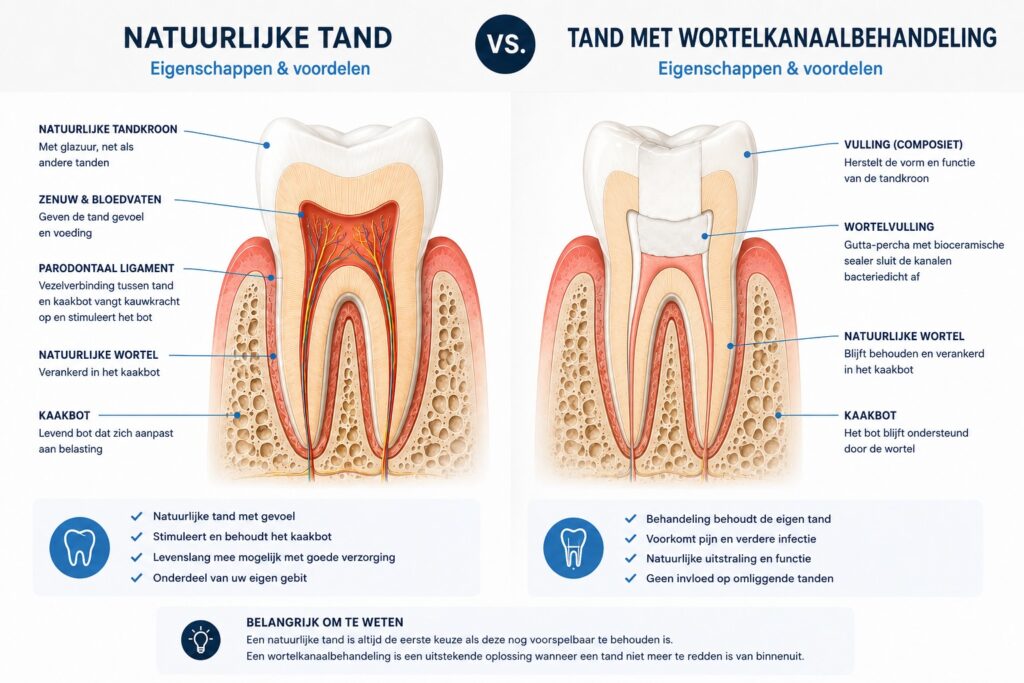
A root canal treatment is intended to remove the inflamed or dead pulp (the “nerve”) from the tooth. During a root canal treatment the root canals are carefully cleaned, disinfected and sealed so that bacteria cannot cause a new infection.
After a root canal treatment, a well-restored tooth can in many cases continue to function without problems for years and remain firmly anchored in the jawbone.
In many cases, root canal treatment is therefore the best choice when:
- the root structure is still healthy and stable;
- there is no vertical root fracture;
- enough tooth structure remains to restore the tooth properly;
- the tooth can be adequately rebuilt after treatment, if necessary with a crown;
- the long-term prognosis is favourable.
In precisely these situations, keeping your own tooth can prevent further problems and more complex treatments in the future.
When is root canal treatment usually not a good choice?
Although dentists prefer to keep a natural tooth, root canal treatment is not the best solution in every situation. The treatment only adds value if the tooth can still function in a lasting way afterwards and has a good long-term prognosis.
Root canal treatment is often not a good choice when:
- there is a vertical root fracture, because this usually cannot be treated in a lasting way;
- the tooth can no longer be restored properly, for example because too little healthy tooth structure remains;
- severe bone loss due to advanced periodontitis has greatly reduced the stability of the tooth;
- the tooth has broken beyond repair, so that a reliable restoration is no longer possible.
That does not mean a tooth automatically has to be extracted as soon as one of these situations is present. The final decision always depends on the combination of clinical examination, X-rays, any CBCT images and the expected long-term prognosis.
The starting point remains the same: root canal treatment only makes sense when the chance of keeping the tooth for a long time is high enough.

Why do dentists prefer to save a tooth?
Replacing a natural tooth seems simple these days thanks to implants. Yet a dental implant is always a replacement and not the same as your own tooth.
Your own tooth:
- feels natural when you chew;
- distributes chewing forces in a natural way;
- helps keep neighbouring teeth stable;
- prevents teeth from shifting;
- often better preserves the natural shape of the gum.
That is why an implant is usually seen as an excellent solution when saving the tooth is no longer possible, but not as the first choice when a tooth can still be saved predictably.
An implant replaces a missing tooth very well, but it can never completely replace the natural tooth root and the original sensation.
Why is a crown sometimes needed after root canal treatment?
A root canal treatment does not automatically make a tooth weaker, but many teeth that need this treatment are already severely damaged by a large filling, extensive decay or a fracture. As a result, there is sometimes not enough healthy tooth structure left to protect the tooth in the long term.
In such cases, a crown can strengthen the tooth and reduce the risk of it breaking while chewing. Whether a crown is needed depends on several factors, such as the amount of remaining tooth structure, the position of the tooth in the mouth and the load during chewing. Molars at the back of the mouth in particular have to withstand large chewing forces and therefore benefit from a crown more often than front teeth.
So not every tooth that has had a root canal treatment automatically needs a crown. The choice is always made on the basis of the individual situation and the expected long-term prognosis.
When is extraction sometimes the best choice after all?
Not every tooth can or should be saved.
The aim is not to keep a tooth at all costs. A treatment only makes sense when the chance of a long-lasting, stable result is high enough. When that chance is absent, extraction is sometimes the most predictable solution.
This may be the case, for example, with:
- a vertical root fracture;
- very extensive bone loss due to periodontitis;
- a tooth that can no longer be restored properly;
- severe damage deep below the gum line;
- recurring infections despite correct earlier treatment;
- a poor long-term prognosis.
In these situations, removing the tooth may ultimately carry less risk than investing in a treatment with a limited chance of success.
After an extraction we always discuss which solution best suits your situation, such as an implant, a bridge or, depending on your wishes, sometimes no replacement at all.
When is an implant needed after all?
Read more about the comparison between an implant and a root canal treatment in our article on implant or root canal treatment.

There is no standard answer
On the internet people often ask:
“Is root canal treatment better than extraction?”
The honest answer is:
It depends entirely on the tooth.
Not only the current situation matters, but also how the tooth is expected to function in five, ten or fifteen years.
Two molars can look almost the same on an X-ray, while one can be kept for many years and the other has almost no predictable prognosis left.
That is why a good diagnosis is far more important than the choice between the two treatments itself.
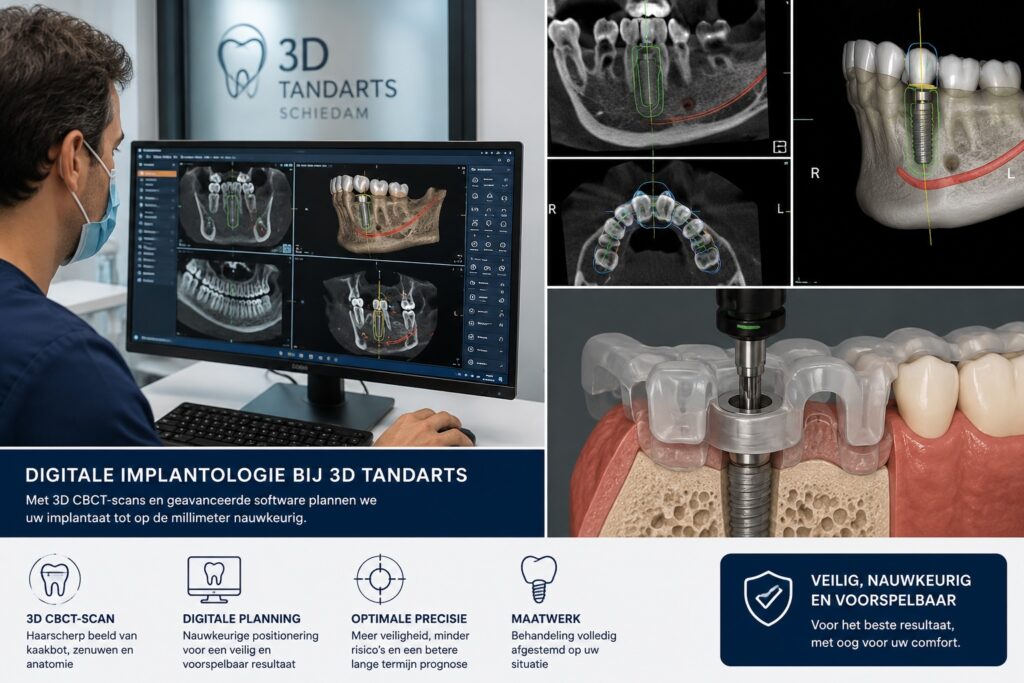
At 3D Tandarts we do not make this decision based on a single image. We combine the clinical examination with digital X-rays and, when needed, a CBCT scan to assess the situation in three dimensions. That way we can carefully discuss the advantages and disadvantages of each treatment option with you before you decide.
Are you unsure whether your tooth can still be saved?
A careful examination can often make clear which treatment offers the best prognosis in your situation.
Book a consultation for a careful examination and personal treatment advice, and we will make clear which path is best for you.
What are the advantages and disadvantages of both treatments?
Both root canal treatment and tooth extraction have advantages and disadvantages. Which treatment is best depends not only on the current infection, but above all on the expected situation in five, ten or even twenty years.
Our advice is therefore never based on which treatment is easiest today, but on which solution offers the greatest chance of success in the long term.
Advantages of root canal treatment
When a tooth has a good prognosis, keeping it often offers important advantages.
1. You keep your own tooth
A natural tooth remains, where possible, the best solution. It works in a natural way and prevents the surrounding teeth from shifting.
2. No gap in your teeth
After an extraction a gap is created. If it is not replaced, neighbouring teeth can slowly tilt and the opposing tooth can over-erupt. That can disturb your bite and make future treatments more complicated.
3. Less bone loss
As soon as a tooth is removed, the jawbone in that place gradually begins to shrink. This is a normal biological process.
By keeping a tooth, the bone is usually better preserved.
4. Often the most conservative solution
A successful root canal treatment means a healthy neighbouring tooth does not need to be prepared for a bridge, and it can postpone an implant for years or even permanently.
Possible disadvantages of root canal treatment
No treatment offers a 100% guarantee.
Although the success rate of a correctly performed root canal treatment is high, there are situations in which additional treatment may be needed.
For example:
- complex canal anatomy;
- a root canal that was not found earlier;
- new bacterial leakage through a defective filling or crown;
- a fracture of the tooth at a later stage.
Sometimes a root canal retreatment or surgical root-end treatment (apicoectomy) is needed. In other cases extraction ultimately turns out to be the best solution after all.
That does not mean, however, that the original treatment “failed”. The mouth is constantly changing, and even a previously successful treatment can develop new problems many years later. A well-sealed root canal can become infected again if bacteria later get in through a leaking filling or crown.
Advantages of an extraction
There are situations in which an extraction is precisely the wisest choice.
When a tooth can no longer be reliably saved, removing it prevents you from investing time, money and treatments in a tooth with a very limited prognosis.
An extraction:
- removes the source of infection;
- can quickly relieve pain and infection;
- allows a predictable replacement, for example with an implant;
- avoids several treatments ultimately leading to the same end result anyway.
That is precisely why we ourselves sometimes advise against treating a tooth when the chance of long-term success is too small.
Disadvantages of an extraction
Extracting a tooth sometimes seems the simplest solution, but it is important to also look at the longer-term consequences.
After an extraction, the following can happen, among other things:
- the jawbone gradually shrinks;
- neighbouring teeth can shift;
- the bite can change;
- chewing can become less comfortable;
- a later implant treatment can become more complicated if a lot of bone is lost.
That is why before an extraction we almost always also discuss how the resulting space can be restored if needed.
Does every extracted tooth have to be replaced?
No. Not every extracted tooth automatically has to be replaced. Whether that is wise depends on the position of the tooth, its function in your mouth, your bite and your personal situation.
For instance, wisdom teeth are usually not replaced, because they often play no important role in chewing. Some back molars also do not always need to be replaced, for example when the bite stays stable and the surrounding teeth function well.
For other teeth, such as front teeth that play an important role in chewing, replacement is often advisable. That way problems such as shifting teeth, changes in the bite and gradual bone loss can be limited.
The decision whether or not to replace a tooth is therefore always tailor-made. During a consultation we assess not only the missing tooth, but also how your entire set of teeth can best stay healthy and functional in the long term.
What is often the best choice in the long term?
A frequently asked question is:
“What lasts longer: a root canal treatment or an implant?”
There is no simple answer to that.
A well-treated natural tooth can function without problems for decades.
An implant also has excellent survival rates, but it equally requires good oral hygiene, regular check-ups and enough healthy bone and gum.
An implant is therefore not a “better version” of a natural tooth.
In fact, many dentists follow an important principle:
A healthy natural tooth that can be saved is usually more valuable than an implant.
An implant becomes particularly interesting when the natural tooth can no longer be saved predictably.
Does the price play a role?
Short answer: for many patients, yes.
Many patients search Google for: “Is a root canal cheaper than an implant?”, but it is still wise not to look only at today’s costs.
An extraction sometimes seems cheaper than a root canal treatment.
But when the missing tooth is later replaced by an implant with a crown or a bridge, the total cost can end up being higher.
On the other hand, an extensive root canal treatment is not always wise when the tooth would have only a poor prognosis afterwards.
That is why we always look at the whole treatment and the expected lifespan of each option, not only at the price of one individual treatment.
To make the differences clear, below you will find a general comparison between a root canal treatment and an extraction followed by an implant. Which treatment is ultimately the best choice always depends on the prognosis of the tooth and your personal situation.
- Root canal: Keeps your own tooth; Extraction + implant: Tooth replaced
- Root canal: Often lower total cost; Extraction + implant: Often a more extensive treatment process
- Root canal: Not always possible; Extraction + implant: Only with a poor prognosis
Why is a correct diagnosis more important than the treatment itself?
The biggest mistake is often not the choice of root canal treatment or extraction.
The biggest mistake is a wrong diagnosis.
A tooth can hurt, for example, while the problem actually comes from:
- a crack in the tooth;
- the gums;
- a neighbouring molar;
- excessive loading due to bruxism;
- an infection that is barely visible on a standard X-ray.
That is why before giving final treatment advice we take the time to determine the cause carefully.
Sometimes a standard X-ray is enough.
In other cases a CBCT scan provides three-dimensional information that is not visible on a standard image. That helps avoid unnecessary treatments and make a better-founded decision.
At 3D Tandarts we do not treat an X-ray, but a patient. The final decision comes from the combination of symptoms, clinical examination and imaging.

How do we make this decision at 3D Tandarts?
Perhaps you expect a dentist to say straight away:
“This tooth has to be extracted.”
Or on the contrary:
“We’ll do a root canal treatment.”
In reality that decision is rarely so simple.
At 3D Tandarts we do not start with the treatment, but with the diagnosis.
First we want to understand why the tooth is causing problems and above all whether keeping it is realistic in the long term.
That is why we assess, among other things:
- the cause of the infection;
- how much healthy tooth structure remains;
- the quality of existing fillings or crowns;
- the condition of the jawbone;
- the health of the gums;
- any cracks or fractures;
- the load during chewing;
- your overall oral health;
- your wishes and expectations.
Only when all these factors are clear do we discuss together which treatment is the most appropriate.
Our starting point is simple:
We do not recommend the treatment that earns the most, but the treatment that gives your teeth the best future.
Sometimes that means a root canal treatment.
Sometimes an extraction.
And sometimes we first advise further investigation before we make a final choice.
When is a second opinion a good idea?
Are you in doubt about earlier treatment advice?
That happens more often than you might think.
Sometimes a patient is told that a tooth can no longer be saved, while keeping it turns out to be possible after all.
In other cases an extensive root canal treatment is proposed, while the chance of long-term success is in fact very small.
A second opinion can then help to gain more clarity and is especially valuable when the proposed treatment is far-reaching or when several treatment options seem possible.
That does not mean the first dentist is wrong. Different practitioners can sometimes assess the same situation differently, especially when the situation is not clear-cut.
An independent assessment often gives more peace of mind and helps you make a well-considered decision.
Frequently asked questions
Frequently asked questions
Does a root canal treatment hurt?
Thanks to modern local anaesthetic, most patients experience little to no pain during the treatment. Afterwards the tooth may be tender for a few days, especially when chewing. These symptoms usually go away on their own.
Is extraction quicker than a root canal treatment?
The procedure itself often takes less time. That does not mean, however, that the total treatment process is shorter too. After an extraction the wound has to heal. If you want to replace the tooth with an implant or bridge, several more appointments usually follow.
Is an implant better than a root canal treatment?
Not when a tooth still has a good prognosis. An implant is an excellent solution for a lost tooth, but it never completely replaces the properties of a natural tooth. That is why we only try to remove a tooth when keeping it is no longer justifiable.
Can every infected tooth still be saved?
No. That depends on several factors, such as:
- the amount of remaining tooth structure;
- the presence of a root fracture;
- the quality of the jawbone;
- the severity of the infection;
- the possibility of restoring the tooth in a lasting way.
A careful examination is therefore always necessary.
What happens if I do nothing?
An infection usually does not go away on its own. On the contrary: bacteria can spread further, so that the pain increases, more bone is lost or an abscess eventually develops. The longer you wait, the lower the chance may become that the tooth can still be saved.
Is root canal treatment always successful?
No. Although a correctly performed root canal treatment has a high chance of success, no treatment can offer a 100% guarantee. The final result depends, among other things, on the severity of the original infection, the anatomy of the root canals, the quality of the restoration afterwards and good oral hygiene. Regular check-ups therefore remain important.
Can a tooth hurt again after a root canal treatment?
Yes, that is possible. Sometimes a new infection develops over time, for example because of a leaking filling or crown, a root canal that was not found earlier or a fracture of the tooth. Pain does not automatically mean the treatment has failed, however. A careful examination is needed to determine the cause and to decide whether retreatment, a surgical procedure or another solution is the most suitable.
How do I know whether my tooth can still be saved?
That can only be assessed after a careful clinical examination. The dentist looks not only at the infection, but also at the amount of healthy tooth structure, the presence of cracks or fractures, the condition of the jawbone and the possibility of restoring the tooth in a lasting way. If needed, additional X-rays or a CBCT scan can help to determine the prognosis more accurately.
Summary
There is no standard answer to the question:
“Is root canal treatment better than extraction?”
The right choice depends on the condition of the tooth, the cause of the problem and the expected long-term prognosis.
In many cases, keeping the natural tooth is preferable.
However, when the tooth can no longer be saved predictably, extraction is sometimes the wisest solution.
Key points
- keeping a natural tooth is usually preferable
- extraction is sometimes the best choice
- a good diagnosis is more important than the treatment itself
- look at the long term, not only at the cost
Unsure about the best treatment?
Have you been told that a tooth needs to be treated or removed? Or would you like to know whether a root canal treatment still makes sense in your situation?
At 3D Tandarts in Schiedam we take the time to assess your situation carefully. With a thorough clinical examination and, when needed, digital X-rays or a CBCT scan, we discuss the different options, their advantages and disadvantages and the expected long-term prognosis.
That way you can make a decision based on clear information and realistic treatment advice, with confidence in the treatment you choose.

Focus areas: Endodontics and Digital Implantology · BIG registration: 29919697202
Knowledge base
Latest articles

Hidden root canals: why a tooth can keep causing problems after root canal treatment
Pain after root canal treatment? Learn how a hidden or missed canal happens and how the microscope and CBCT help. Book an assessment in Schiedam.

Surgical microscope for root canal treatment in Schiedam
What does a surgical microscope do in root canal treatment? See how precision and CBCT help save your tooth. Book at 3D Tandarts in Schiedam.
Implant consultation in Schiedam: find out which treatment suits you
Is a dental implant right for you? Find out what an implant consultation in Schiedam involves: examination, advice and a treatment plan. Book today.
Questions about your situation?
During a consultation we look at your situation and discuss the options.