How we assess whether your molar can still be saved
Written by Alessio Deiana — dentist at 3D Tandarts Schiedam, with a special interest in restorative dentistry, digital implant dentistry and microscope-assisted endodontics.
– Last updated: 29 September 2026
A molar that unexpectedly breaks after a root canal treatment can be quite a shock. Many people immediately wonder whether the tooth can still be saved or whether a crown or even a dental implant will be needed. Patients usually hope that the missing part can simply be filled in. Sometimes that is indeed possible, but in many cases the question is not how we can fill the gap, but whether the molar is still strong enough to last for years.
At 3D Tandarts in Schiedam, near Rotterdam, we assess patients with a broken molar after a root canal treatment every day. That is why we look beyond the fracture itself. We evaluate how much healthy tooth tissue is still present, check the quality of the root canal treatment and decide which restoration offers the best chance of a durable result. Sometimes that is a composite filling, more often an inlay, onlay or crown, and in some situations a dental implant ultimately turns out to be the most predictable solution.
Our aim is always the same: to keep as much healthy tooth tissue as possible, without compromising on the long term.
The first question: how much healthy tooth tissue is left?
The most important decision is usually made before we even think about the type of restoration.
It is not the size of the broken piece that determines the treatment, but the amount of healthy tooth tissue that can still provide enough support.
Broadly speaking, we distinguish four situations.
The damage is limited
When only a small part of the molar has broken off and the remaining walls are sturdy, a composite restoration can often be an excellent solution. The molar remains largely intact and can usually be restored without extensive treatment.
There is a lot of tooth tissue left, but the molar is structurally weakened
After a root canal treatment, a large part of the original tooth structure is often missing. Even when the outside still looks reasonably intact, the molar can be considerably weakened inside. In this situation we often choose an adhesive restoration, such as an onlay, to protect the remaining tooth during chewing.
A larger part of the molar is missing
When one or more walls have been lost, we carefully assess whether an adhesive restoration still has enough hold or whether a full crown offers more predictability. The location of the fracture, the thickness of the remaining walls and the load during chewing all play an important role here.
The molar can no longer be restored predictably
Sometimes a fracture runs deep below the gum or even continues into the root. Severe vertical root fractures or a very small remnant of healthy tooth tissue can also mean that keeping the molar is no longer a durable solution. In that case we discuss an extraction and the options for a dental implant.
Why a good diagnosis matters more than a quick repair
Many patients ask during the first consultation:
“Can you just fill it?”
That seems a logical question. Still, a quick repair is not always the best treatment.
A large composite filling can replace the missing tooth tissue, but it does not automatically take over the original strength of the molar. When the remaining tooth walls are thin, they keep flexing during chewing. As a result, another piece may break off in time or the restoration may come loose.
That is why we assess not only what is missing, but above all what is still there.
A restoration must not only fit well; it must also be able to protect the molar for years.
That is exactly why every treatment at 3D Tandarts starts with a careful diagnosis and personal treatment advice.
Not sure whether your molar can still be kept? During a consultation we map out the situation carefully and discuss which treatment offers the best long-term prognosis in your case.
How do we examine a broken molar?
During the examination we assess, among other things:
- how much healthy tooth tissue is still present;
- how deep the fracture runs;
- whether the existing restoration still seals properly;
- the quality of the earlier root canal treatment;
- any signs of infection around the root tip;
- any indications of a root fracture.
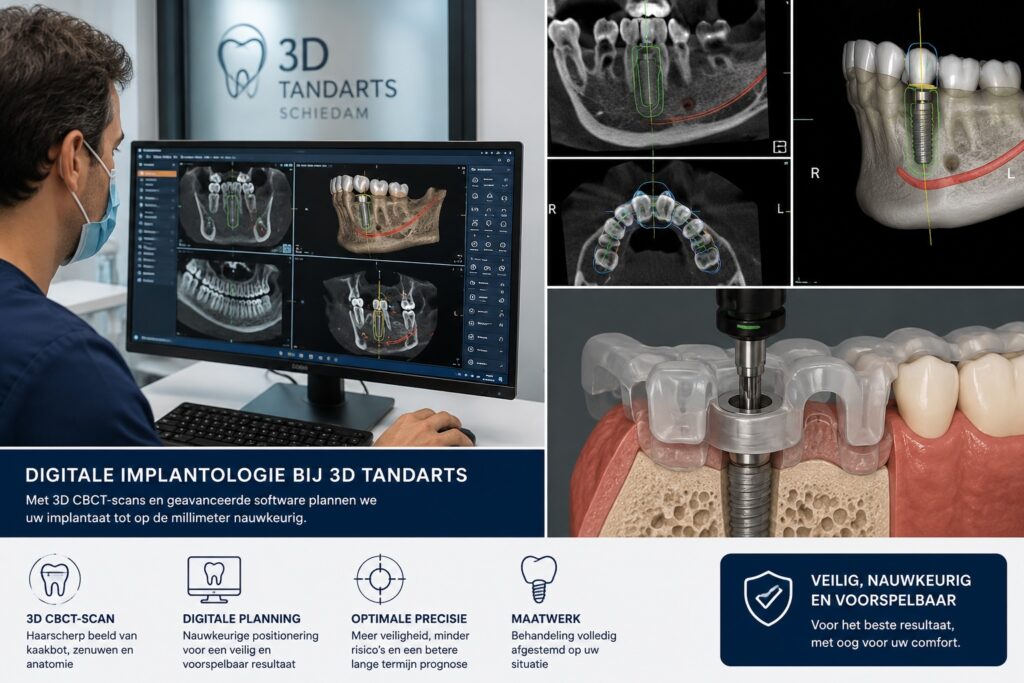
For this we combine a clinical examination with digital X-rays. When the situation is complex or a regular X-ray gives too little information, a CBCT scan (3D X-ray examination) may be needed. This allows us to assess the roots, the surrounding bone and any hidden problems far more precisely.
Only when we know the full picture can we decide which treatment has the greatest chance of long-term success.
When is a regular filling still enough?
A composite filling remains an excellent restoration when the damage is limited and the molar has kept enough healthy tooth tissue.
That is usually the case when:
- only a small part of the molar is missing;
- the cusps are still strong;
- the remaining tooth walls are thick enough;
- the root canal treatment was done well;
- the molar shows no signs of overload.
In these situations a composite restoration can function well for years.
However, when a large part of the molar is missing or the cusps are badly weakened, simply filling it in usually offers too little protection. We then look at restorations that actively support the remaining tooth structure instead of just filling the missing part.
When do we choose an inlay, onlay or crown?
When a regular filling offers too little protection, we look at restorations that reinforce the remaining tooth structure.
Which solution is most suitable depends on the amount of healthy tooth tissue that is still present and on how the molar is loaded during chewing.
In our practice in Schiedam we try, when that is justified, to keep as much healthy tooth tissue as possible. That is why we regularly choose adhesive restorations when they offer a good long-term prognosis.
Inlay
An inlay replaces only the lost tooth tissue within the chewing surfaces. The outer cusps are largely preserved.
An inlay is mainly suitable when:
- the damage is limited to the central part of the molar;
- the cusps are still strong enough;
- there is enough healthy enamel to bond the restoration reliably.
Onlay
When one or more cusps are weakened, we often prefer an onlay.
An onlay covers not only the missing part of the molar but also protects the vulnerable cusps. This distributes the chewing forces better across the remaining tooth tissue.
For many molars that have had a root canal treatment, an onlay therefore offers a predictable and tissue-preserving solution. Less healthy tooth tissue needs to be removed than with a full crown, while the molar is still better protected than with a large composite filling alone.
That is why, when the clinical situation allows, we often prefer an adhesive restoration to a more invasive treatment.
When is a crown the best choice?
Not every molar can be restored with an inlay or onlay.
When a large part of the crown of the tooth has been lost or there is too little healthy tooth tissue left to bond a restoration reliably, a full crown can be the most predictable solution.
A crown surrounds the entire clinical crown of the tooth and protects the remaining tooth tissue from further fracture.
Whether a crown is possible depends, among other things, on:
- the amount of healthy tooth tissue;
- the quality of the remaining tooth walls;
- the bite load;
- the position of the molar in the mouth;
- the quality of the root canal treatment.
Sometimes a core build-up is needed first to create enough support for the crown. Only when there is not enough hold for this may a post be necessary. A post does not strengthen the tooth; it serves only to give the core build-up enough retention. That is why we try to limit its use to situations where it is truly needed.
Which crown do we choose?
When a crown is needed, we decide together which material best suits the situation.
We look not only at strength, but also at aesthetics, the colour of the underlying tooth and the position in the mouth.
During the crown consultation at our practice in Schiedam we discuss not only which material is technically possible, but also which solution best suits your bite, aesthetic wishes and long-term prognosis.
Monolithic zirconia
For molars at the back of the mouth, monolithic zirconia is often an excellent choice.
This material is very strong and wear-resistant and can withstand high chewing forces well. It also masks dark underlying tooth colour better than glass ceramic, for example when a tooth has become discoloured after a root canal treatment.
Zirconia with layered ceramic
When a more natural appearance is wanted as well as strength, a crown with a zirconia framework and a ceramic outer layer can be a good solution.
This combines the mechanical properties of zirconia with aesthetics that come closer to natural teeth.
E-max
For front teeth and many premolars we often choose lithium disilicate (E-max).
This material lets light through in a natural way and therefore comes very close to the appearance of a healthy tooth.
When the underlying tooth is darkly discoloured, however, we carefully assess whether E-max can give a sufficiently aesthetic result. In some cases zirconia gives a better-looking final result because it masks the discolouration better.
So there is no single best material. The right choice depends on the individual situation.
Would you like to know which restoration is most suitable for your molar?
During a crown consultation we assess how much healthy tooth tissue is still present and discuss whether an inlay, onlay, crown or another treatment is the best long-term solution.
A restoration is only as good as the root canal treatment beneath it
A perfectly fitting crown or onlay cannot make up for an inadequately performed root canal treatment.
That is why at 3D Tandarts in Schiedam we also carefully assess the biological situation of the tooth before every final restoration.
We look at, among other things:
- the quality of the root filling;
- any infection around the root tip;
- missed root canals;
- signs of leakage or bacterial contamination;
- possible root fractures.
When we have doubts about the prognosis of the existing root canal treatment, we first discuss whether retreatment is necessary before investing in a final restoration.
Sometimes observing first is wiser than treating straight away
Not every doubtful root canal treatment needs to be redone immediately.
When a molar is free of symptoms, shows no clear infection and looks sufficiently stable, an observation period can be a sensible choice.
In our practice we sometimes use a digitally designed temporary crown that is worn for a few months.
This lets us assess whether the tooth stays biologically stable before we make a final restoration.
If the molar stays free of symptoms and follow-up X-rays show no abnormalities, we can invest in a final crown or onlay with more confidence.
If symptoms or signs of infection do appear during the observation period, we can first revise the root canal treatment before the final restoration is placed.
In this way we try to avoid unnecessary treatments and unnecessary costs as far as possible.
When is a dental implant the wisest choice?
Our starting point is always the same: to keep a natural tooth when that is a predictable long-term solution.
Still, there are situations in which restoring the tooth is no longer justified. Making a restoration on a tooth with a poor prognosis can lead to new treatments, extra costs and ultimately loss of the molar anyway.
In those cases we discuss honestly whether a dental implant offers a better solution.
This may be the case, for example, when:
- the molar has a vertical root fracture;
- the fracture runs deep below the gum or even through the root;
- there is too little healthy tooth tissue left to support a restoration reliably;
- an infection does not heal despite a well-performed retreatment;
- the tooth no longer has a stable prognosis because of severe bone loss.
We assess every situation individually. Age, oral hygiene, chewing forces, general health and your wishes all play a role in the final choice.
How does treatment with a dental implant work?
When a dental implant is the best solution, we first draw up a careful treatment plan.
Using digital X-rays and, if necessary, a CBCT scan, we assess the amount of bone and the ideal position of the implant.
Depending on the situation:
- the implant can be placed directly after the molar is extracted;
- a healing period may be needed first;
- or limited bone grafting may be carried out before the implant is placed.
Once the implant has integrated with the jawbone, we place the final crown. Here too we choose the material that best suits the location in the mouth and the patient’s aesthetic wishes.
Thanks to digital implant planning, at our practice in Schiedam we can plan the treatment precisely in advance and assess which approach is the most predictable.
How we make our decisions
At 3D Tandarts in Schiedam we do not believe in standard solutions. Every patient receives a treatment plan tailored to the clinical situation and the long-term prognosis of the molar.
Every broken molar is assessed in the same logical order.
Step 1: Can the molar still be kept predictably?
We assess how much healthy tooth tissue is still present and whether it offers enough support for a durable restoration.
Step 2: Is the root canal treatment biologically stable?
A restoration only has a chance of success when the tooth is free of active infection and the root canal treatment has a good prognosis.
When in doubt, we first discuss whether retreatment makes sense.
Step 3: Which restoration fits best?
Depending on the clinical situation we choose:
- a composite restoration;
- an inlay;
- an onlay;
- a crown;
- or, when keeping the tooth is no longer justified, a dental implant.
Our aim is not to carry out the most extensive treatment, but to choose the treatment that offers the greatest chance of long-term success.
Why a good diagnosis makes the difference
Two molars can look almost the same at first glance, while the treatment is completely different.
The amount of healthy tooth tissue, the quality of the root canal treatment, the bite load, teeth grinding and the position of the molar all determine the final prognosis.
That is why we prefer to give well-founded advice after a careful examination rather than carry out a treatment straight away.
A good diagnosis is the foundation of every durable restoration.
In conclusion
A broken molar after a root canal treatment does not automatically have to be lost.
Thanks to modern diagnostics and restorative techniques, many molars can continue to function well for years. At the same time, it is important to stay realistic: not every tooth can or should be kept at all costs.
The right treatment depends on the amount of healthy tooth tissue, the quality of the root canal treatment and the long-term prognosis of the molar.
That is exactly why at 3D Tandarts we take the time to assess every situation carefully before we draw up a treatment plan together.
Would you like to know whether your broken molar can still be saved?
A broken molar does not automatically have to be lost. During a consultation at 3D Tandarts in Schiedam we examine how much healthy tooth tissue is still present, assess the quality of the root canal treatment and discuss honestly which treatment offers the greatest chance of a lasting result in your situation.
Knowledge base
Latest articles

Hidden root canals: why a tooth can keep causing problems after root canal treatment
Pain after root canal treatment? Learn how a hidden or missed canal happens and how the microscope and CBCT help. Book an assessment in Schiedam.

Surgical microscope for root canal treatment in Schiedam
What does a surgical microscope do in root canal treatment? See how precision and CBCT help save your tooth. Book at 3D Tandarts in Schiedam.
Implant consultation in Schiedam: find out which treatment suits you
Is a dental implant right for you? Find out what an implant consultation in Schiedam involves: examination, advice and a treatment plan. Book today.
Questions about your situation?
During a consultation we look at your situation and discuss the options.