Not enough jawbone: does that mean an implant is not possible?
Written by Danilo Di Vico, dentist at 3D Tandarts Schiedam.
Last updated: 26 September 2026
Short answer: no. Not enough jawbone does not automatically mean an implant is impossible. In many situations, bone grafting means an implant can still be placed safely and stably.
Many people hear for the first time during an implant consultation that there is not enough jawbone. That can come as a shock. You may be wondering:
- Is it too late?
- Is an implant still possible?
- Do I now need an extra operation?
- What will this cost?
- How long will the process take?
These questions are understandable. In practice we regularly see patients who assume an implant is completely off the table as soon as there is bone loss. That is often not the case. The first step is always a careful assessment of your situation.
The aim of bone grafting is not simply to “make more bone”. The aim is to create enough bone to place an implant in a safe, stable and predictable way.
Not sure whether you have enough bone for an implant?
Why enough bone is needed for implant stability
Many patients think an implant is no longer possible when they hear that there is not enough jawbone. We regularly see patients who have waited for years because they thought their options were limited. In reality, implants often turn out to be possible after all following a careful assessment.
A dental implant works as an artificial tooth root. To function well for many years, it has to be firmly anchored in the jawbone.
After placement, the bone grows onto the implant. This process is called osseointegration. It requires enough bone volume.
An implant needs not only enough bone height, but also enough bone width. When the bone is too narrow or too low, this can affect:
- the stability of the implant;
- the position of the implant;
- the aesthetic end result;
- long-term predictability.
That is why the amount of bone present is carefully examined before every implant treatment.
What is bone grafting for an implant?
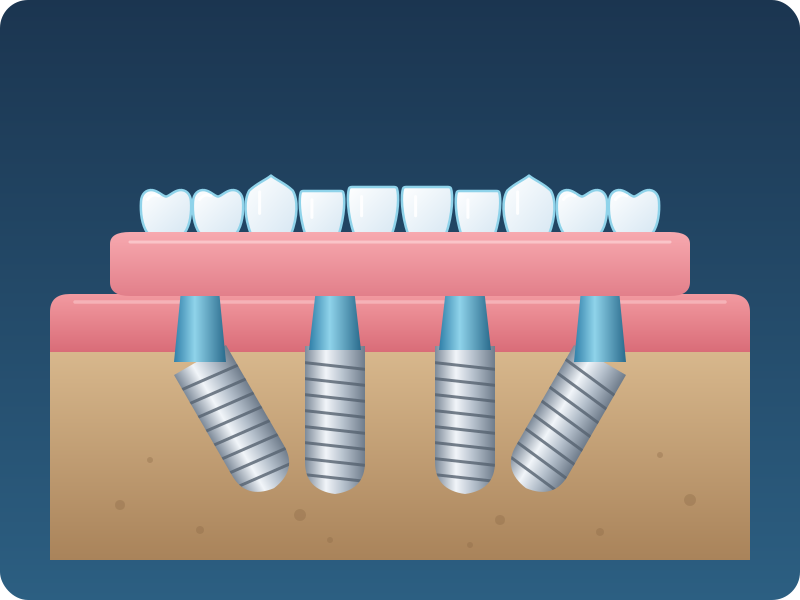
Bone grafting is a treatment in which the volume of the jawbone is increased so that an implant can be placed safely and stably.
Bone grafting is also referred to as:
- jawbone reconstruction;
- bone augmentation;
- bone restoration;
- guided bone regeneration (GBR)
Depending on the situation, your own bone, bone substitute material or a combination of both may be used.
Bone grafting, bone augmentation and jawbone reconstruction: what is the difference?
For patients, these terms usually mean the same thing: making up for a lack of jawbone.
In implant dentistry, different terms are sometimes used:
- Term: Bone grafting; Meaning: General, patient-friendly term
- Term: Bone augmentation; Meaning: Clinical term for increasing bone volume
- Term: Jawbone reconstruction; Meaning: Emphasises that it concerns the jawbone
- Term: Guided Bone Regeneration; Meaning: Technique in which membranes are used to allow new bone to form
In practice, these terms often refer to the same treatment goal: creating enough bone for implant placement.
When is bone grafting needed?
Bone grafting may be needed when there is not enough bone to place an implant stably.
Situations in which this is more common include:
- a tooth has been missing for a long time;
- bone loss due to periodontitis;
- earlier infections around a tooth root;
- trauma or an accident;
- natural anatomical limitations;
- bone loss after an extraction.
Common misconception
Many patients think a missing tooth is only an aesthetic problem.
After a tooth is lost, the jawbone in that area undergoes natural remodelling. As a result, bone volume can gradually decrease, particularly in the period following extraction.
Bone width versus bone height
An important topic that is often not explained well enough is the difference between bone width and bone height.
Insufficient bone width
The bone is too narrow for an implant.
Insufficient bone height
The bone is not high enough because:
- the maxillary sinus sits low;
- a nerve runs close by;
- a lot of bone loss has occurred.
These two situations often call for different treatment strategies.
That is why an accurate diagnosis is essential.
Difference between the upper jaw and the lower jaw
The location of the implant plays an important role.
Upper jaw
The maxillary sinus (sinus maxillaris) is located in the upper jaw.
When there is little bone at the molars in the upper jaw, a sinus lift may be needed.
Lower jaw
An important nerve runs through the lower jaw.
When bone height is insufficient, it must be carefully assessed how much space is available to avoid damaging this nerve.
This is one of the reasons why a CBCT scan is often valuable.
How do we determine whether you have enough jawbone?
An implant dentist cannot determine on the basis of an oral examination alone whether bone grafting is needed.
The assessment usually consists of:
- Clinical examination
- Review of your medical situation
- Analysis of existing X-rays
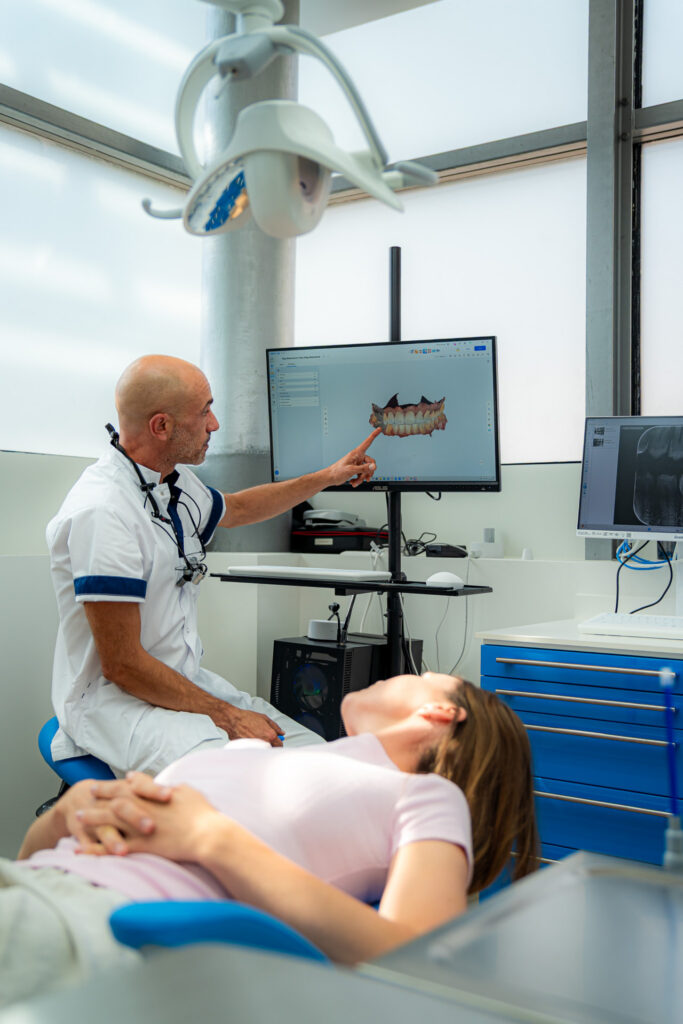
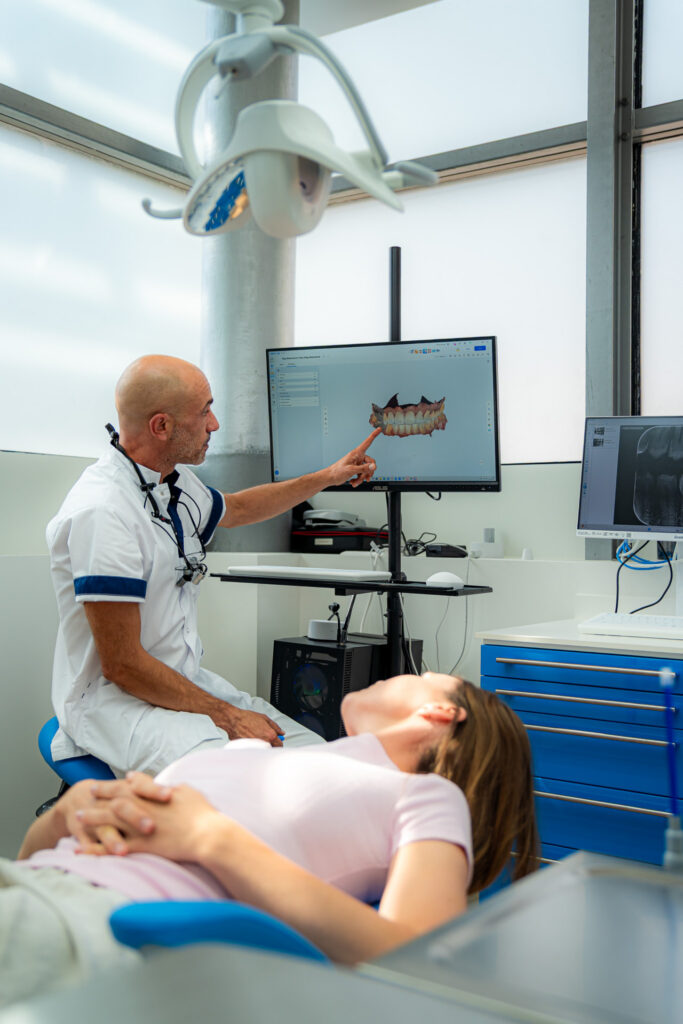
- Where appropriate, a CBCT scan (3D scan)
X-ray versus 3D scan (CBCT)
An ordinary X-ray provides valuable information, but does not always show the full picture.
A CBCT scan shows in three dimensions:
- how much bone is present;
- how wide the bone is;
- how high the bone is;
- where the nerve runs;
- where the maxillary sinus is located;
- which implant position is possible.
For complex implant treatments, this can be an important part of treatment planning.
What does the implant dentist assess on a scan?
Among other things, the analysis looks at:
- bone height;
- bone width;
- bone density;
- position of the nerve;
- position of the sinus;
- expected implant position;
- aesthetic possibilities;
- risk factors.
This produces a treatment plan that fits your personal situation.
Have your jawbone assessed with a 3D scan.
What types of bone grafting are there?
Minor local bone grafting
For limited defects, a small bone correction can sometimes be carried out during implant placement.
This is often less extensive than patients expect.
Staged bone grafting
For larger defects, the bone is built up first.
Implant placement follows after healing.
Bone grafting at the same time as implant placement
Sometimes the implant and the bone grafting can take place in the same treatment.
This is only possible when sufficient primary stability of the implant can be achieved.
Sinus lift
A sinus lift is a specific form of bone grafting in the upper jaw.
Extra space is created under the maxillary sinus so that implants can be placed.
Which materials are used?
Your own bone
Sometimes your own bone is used.
Advantages:
- biologically active;
- good healing properties.
Not every situation requires your own bone, however.
Bone substitute material
Bone substitute materials are often used today.
Many patients ask during a consultation:
“Is artificial bone safe?”
The materials used have been developed to support bone formation and have been used in implant dentistry for many years.
Membranes
In certain techniques, a membrane is used to protect the area while the bone heals.
This helps the body to form new bone in the desired location.
How does the treatment work, step by step?
Step 1 – Consultation and diagnosis
Examination of the mouth, teeth, gums and jawbone.
Step 2 – Treatment plan
Discussion of:
- options;
- risks;
- costs;
- duration.
Step 3 – Bone grafting
Placement of bone material where needed.
Step 4 – Healing phase
The body forms new bone.
Step 5 – Implant placement
The implant is placed once enough bone is present.
Step 6 – Crown or final restoration
After healing, the final restoration is made.
How long does the whole process take?
The duration differs from situation to situation.
Wound healing versus bone healing
This distinction is often not explained well enough online.
Wound healing means the gum recovers.
Bone healing means new bone develops and matures.
Many patients feel fine after a few weeks, while bone healing continues for months.
That is why it is not how well you feel that determines when an implant can be placed, but biological healing.
When can the implant be placed?
That depends on:
- amount of bone loss;
- technique chosen;
- quality of the bone;
- general health;
- course of healing.
The exact timing is determined individually.
Does bone grafting hurt?
During the treatment
The treatment is usually carried out under local anaesthetic.
As a result, you normally feel no pain during the procedure.
After the treatment
Afterwards you may experience:
- swelling;
- tenderness;
- mild post-operative pain;
- limited chewing ability.
Many patients expect more pain beforehand than they end up experiencing.
That does not mean everyone recovers in the same way, but it does mean the expectation is often worse than the reality.
When to get in touch
Contact us if you:
- have increasing pain;
- have persistent bleeding;
- see signs of infection;
- are worried about your recovery.
Risks and complications of bone grafting
Like any surgical treatment, bone grafting carries risks.
Possible complications include:
- infection;
- delayed wound healing;
- insufficient bone formation;
- exposure of a membrane;
- swelling;
- temporary tenderness.
Factors that can increase risk
- smoking;
- inadequate oral hygiene;
- active periodontitis;
- certain medical conditions;
- certain medications.
How are risks reduced?
Through:
- good diagnostics;
- careful planning;
- clear aftercare instructions;
- regular check-ups.
What does bone grafting for an implant cost?
There is no standard price that applies to every patient.
Why do costs differ?
Costs are influenced by:
- size of the defect;
- materials used;
- whether a sinus lift is needed;
- diagnostics;
- number of implants;
- complexity of the treatment.
Which components determine the total cost?
Possible components are:
- consultation;
- CBCT scan;
- bone grafting;
- implant placement;
- abutment;
- crown.
That is why it is important not only to compare implant prices, but to look at the complete treatment path.
Is bone grafting reimbursed?
Reimbursement depends on:
- your insurance;
- the indication;
- the type of treatment.
During a consultation we can discuss which costs are expected in your situation.
Receive a personal treatment plan and cost overview.
Can bone grafting be prevented?
Not always, but planning early can sometimes help.
Timely implant planning
An early assessment of the jaw situation can help to map out the available treatment options better. With timely implant planning, it is sometimes possible to look at ways of preserving the existing bone volume as well as possible.
Read more about our implant treatments.
Bone preservation after extraction
In some cases, attention can be given to preserving bone volume directly after an extraction.
Healthy gums
Healthy gums and good oral hygiene remain important for both natural teeth and implants.
When is a second opinion a good idea?
A second assessment can be valuable when:
- you have been told that implants are not possible;
- the proposed treatment is unclear;
- you are unsure about costs or treatment duration;
- you have received different treatment advice.
A second opinion does not mean an earlier diagnosis was wrong. It can help you gain more insight into the options available.
Request an implant consultation or second opinion at 3D Tandarts Schiedam. Click here.
Bone grafting and implants in Schiedam
For patients from Schiedam, Rotterdam, Vlaardingen, Maassluis and other parts of South Holland, a local assessment can be practical, especially when an implant treatment involves several appointments.
At 3D Tandarts, implant planning is tailored to each patient’s individual situation. Modern 3D diagnostics can be used to assess the available bone structure accurately.
During a consultation we discuss:
- how much bone is present;
- whether bone grafting seems necessary;
- which treatment routes are possible;
- which risks and benefits are relevant;
- which cost factors play a role.
Sometimes treatment can take place entirely within the practice. In other situations, collaboration with or referral to a specialist may be appropriate. Transparency about this is important for a realistic treatment plan.
See also:
Frequently asked questions
Frequently asked questions
When is bone grafting needed for an implant?
Bone grafting may be needed when there is not enough bone to place an implant stably. This is determined by a clinical examination and, where appropriate, a CBCT scan.
Can bone grafting be done at the same time as the implant?
Yes, in some situations. This depends on the amount of bone available and whether sufficient primary stability can be achieved.
Is a sinus lift the same as bone grafting?
A sinus lift is a specific form of bone grafting used in the upper jaw when there is not enough bone beneath the maxillary sinus.
What does bone grafting for an implant cost?
Costs differ from situation to situation and depend on the extent of the treatment, the materials used, diagnostics and the rest of the implant treatment.
Why does the price differ from patient to patient?
No two situations are identical. The amount of bone loss, the number of implants and the technique chosen all influence the cost.
Is bone grafting reimbursed?
That depends on your insurance situation and the medical indication. This can be discussed during a consultation.
Can bone grafting fail?
Like any medical treatment, bone grafting carries risks. A careful treatment plan and good aftercare help to reduce the chance of complications.
Is bone grafting dangerous?
Bone grafting is a commonly used treatment in implant dentistry. As with any surgical treatment there are risks, but these are assessed and discussed beforehand.
How long does recovery take after bone grafting?
The gum usually recovers faster than the underlying bone. Final bone healing takes longer and differs from patient to patient.
When can I eat again?
That depends on the treatment and your recovery. Your dentist will give you specific instructions.
What should I look for in an implant dentist?
Important points to look for are:
- experience in implant dentistry;
- clear diagnostics;
- transparent costs;
- an explanation of the risks;
- a clear treatment plan.
Is a second opinion worthwhile if there is not enough bone?
Yes, especially if you are unsure about the proposed treatment or want to know what alternatives exist.
Can I have bone grafting for implants assessed in Schiedam?
Yes. An implant consultation, with 3D diagnostics where appropriate, can give clarity about the amount of jawbone available and the possible treatment options.
Does 3D Tandarts also help patients from Rotterdam and the surrounding area?
Yes. Patients from the Rotterdam region, Vlaardingen, Maassluis and surrounding towns are welcome for implant assessment and treatment planning.
Summary
The key message is simple:
- Not enough jawbone does not automatically mean an implant is impossible.
- Bone grafting is not needed for everyone.
- An accurate diagnosis is essential.
- A CBCT scan can provide important information about bone height, bone width and anatomical structures.
- Costs, risks and treatment duration differ from situation to situation.
- A personal treatment plan is always more important than general information online.
Are you unsure whether an implant is still possible because of bone loss? An assessment is often the quickest way to get clarity. With a careful examination and a realistic treatment plan, you can better understand what options exist in your situation.

His focus includes digital dentistry, microscopic endodontics and implant diagnostics. Within the practice he works daily with intraoral scans, digital treatment planning and modern diagnostic techniques. · BIG number: 29919697202
Knowledge base
Latest articles

Hidden root canals: why a tooth can keep causing problems after root canal treatment
Pain after root canal treatment? Learn how a hidden or missed canal happens and how the microscope and CBCT help. Book an assessment in Schiedam.

Surgical microscope for root canal treatment in Schiedam
What does a surgical microscope do in root canal treatment? See how precision and CBCT help save your tooth. Book at 3D Tandarts in Schiedam.
Implant consultation in Schiedam: find out which treatment suits you
Is a dental implant right for you? Find out what an implant consultation in Schiedam involves: examination, advice and a treatment plan. Book today.
Questions about your situation?
During a consultation we look at your situation and discuss the options.