

Last updated: 3 October 2026
What is endodontic retreatment and when is it needed?
Author:
Danilo Di Vico
Dentistry, surgery and digital implantology at 3D Tandarts Schiedam.
Short answer
Does a tooth keep hurting after a previous root canal treatment? Or has a new infection developed? Then root canal retreatment can sometimes be the best way to keep your natural tooth.
Endodontics is the branch of dentistry that deals with the dental pulp, and endodontic retreatment means treating a tooth again that has already had a root canal treatment, where the first treatment was not (completely) successful.
Many people assume that a root canal treatment is done once and is then finished for good. Fortunately, that is usually the case. Even so, symptoms can return months or even years later, or an infection at the root tip may show up at a check-up.
That raises understandable questions: “Did my first root canal treatment fail?”, “Does the same tooth need to be treated again?”, “Can my tooth still be saved or does it have to be extracted?” or “Do I need an oral surgeon or an endodontist?”.
At 3D Tandarts in Schiedam we do not look only at the X-ray, but at the whole situation. The starting point is simple: keep a natural tooth whenever this can be done safely and predictably.
Not sure whether your tooth can still be saved?
At 3D Tandarts in Schiedam we carefully assess whether retreatment is the best solution, or whether another treatment offers a better chance of long-term success.
What is root canal retreatment?
Root canal retreatment is a treatment in which a previously treated root canal is reopened, cleaned, disinfected and sealed again. The aim is not “to remove the nerve once more”, but to eliminate bacteria from the root canal system that remained despite the first treatment or entered it again later.
During the treatment the existing root filling is removed. The root canals are then examined again, carefully cleaned and disinfected. After that the canals are sealed again to keep the risk of a new bacterial infection as low as possible.
The ultimate goal is the same as with the first treatment: to let the infection heal and to keep the natural tooth when the long-term prognosis is good.
Why might a root canal treatment be needed again?
A common misconception is that retreatment automatically means the first root canal treatment was done wrongly. That is not true.
Even a technically well-performed treatment can cause problems again years later. The mouth is constantly changing, and even a previously successful treatment can be exposed to bacteria again over time.
Common causes include:
- a leaking filling or crown that lets bacteria in again;
- new decay (caries) around the restoration;
- an extra root canal that was not visible or reachable during the first treatment;
- a very complex canal anatomy;
- persistent bacteria or biofilm that remained despite the earlier treatment;
- a fracture or damage to the restoration;
- wear or changes that only develop years later.
That is why an infection after a root canal treatment is not automatically the result of a mistake. And that is exactly why a new diagnosis is so important. The cause determines whether retreatment makes sense.
Which symptoms can point to a new infection?
Not every infection causes pain straight away. Some patients notice nothing for years, while a check-up X-ray still shows an infection around the root tip.
Other patients do have clear symptoms, such as:
- pain when chewing;
- sensitivity to pressure;
- a dull pressure around the tooth;
- recurring toothache in a molar;
- swelling of the gum;
- a fistula (gum boil) that may release pus;
- an unpleasant taste or smell;
- an infection that is only visible on an X-ray or CBCT scan.
These symptoms do not automatically mean that retreatment is necessary, but they are a reason to have the tooth examined carefully.
When is retreatment possible?
Retreating a root canal only makes sense if the tooth then has a good chance of continuing to function healthily for years.
That is why, during the examination, we assess among other things:
- how much healthy tooth tissue is still present;
- whether enough tooth structure remains to allow a durable restoration with a good ferrule after treatment;
- the quality of the existing filling or crown;
- the condition of the jawbone;
- the shape and accessibility of the root canals;
- any cracks or fractures;
- the load on the tooth during chewing;
- the expected long-term prognosis.
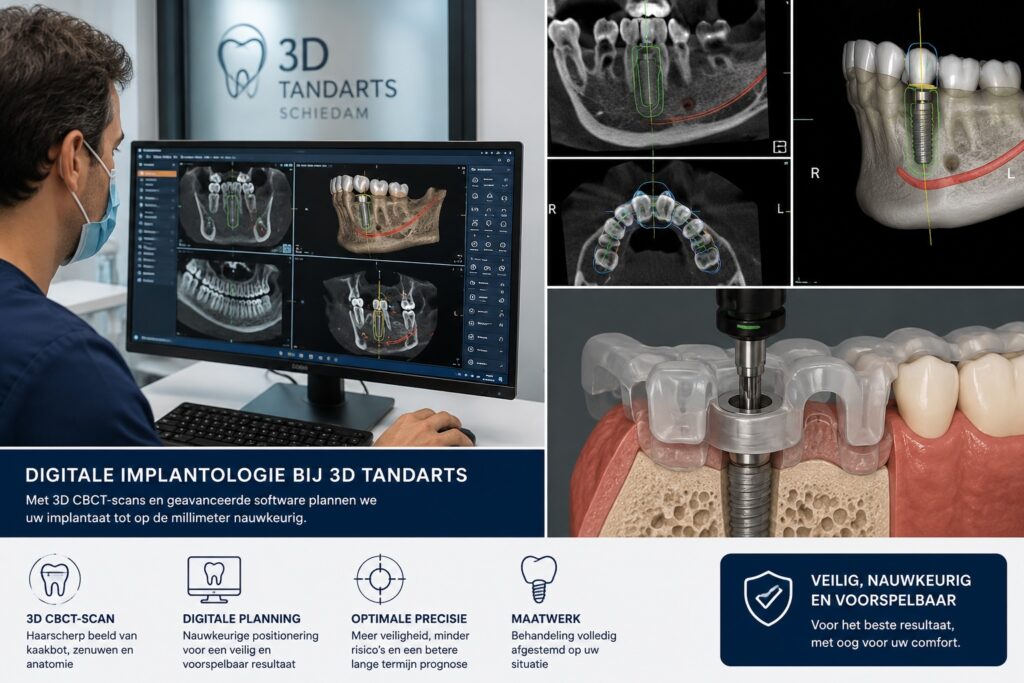
When needed, additional examination with a CBCT scan can be carried out. A CBCT shows the tooth in three dimensions and can provide information that is not always visible on a regular X-ray.
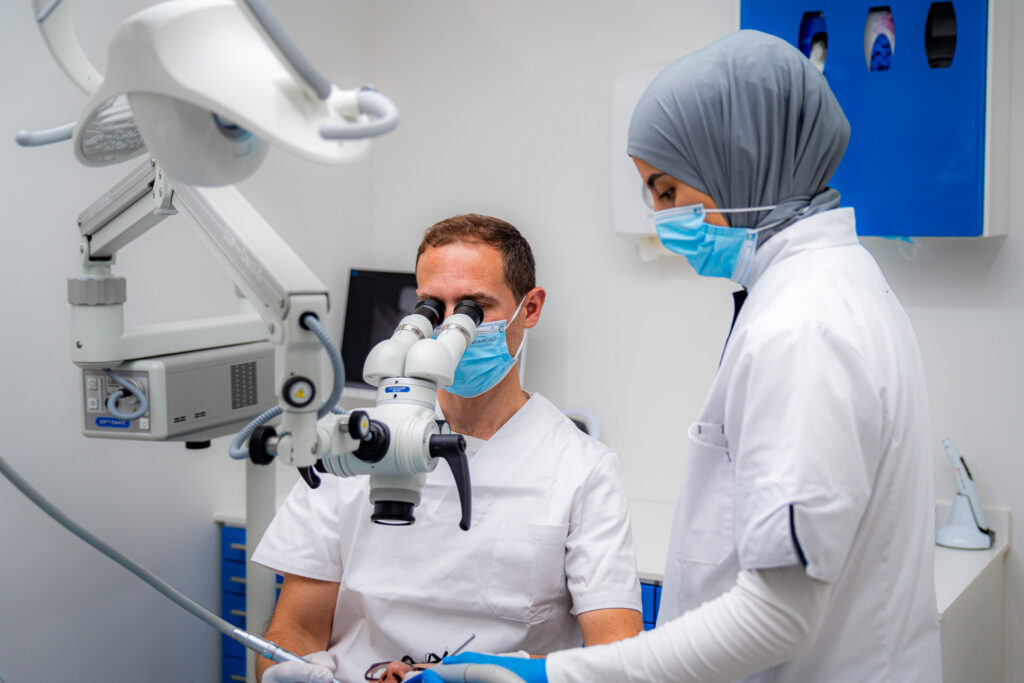
In complex situations, specialist endodontics, if necessary with magnification such as a surgical microscope, can contribute to a precise treatment.
Please note: not every abnormality on a check-up X-ray means that retreatment is needed straight away. When a tooth causes no symptoms and there are signs that the infection is gradually healing, periodic monitoring can sometimes be a reasonable alternative.
When is retreatment usually not a good choice?
Although keeping the natural tooth is usually preferable, retreatment is not always the best solution.
Retreatment mainly adds value when the tooth can still function durably afterwards.
That is often not the case when:
- there is a vertical root fracture;
- too little healthy tooth tissue remains to restore the tooth reliably;
- there is severe periodontal bone loss or a combined endodontic-periodontal condition with an unfavourable prognosis;
- the tooth has broken beyond repair;
- the long-term prognosis is very poor.
How does root canal retreatment work?
Although every situation is different, endodontic retreatment usually follows a set sequence of steps.
1. Careful diagnosis
Before retreatment is started, we first investigate why the earlier root canal treatment did not give a sufficient result. We assess among other things your symptoms, the condition of the tooth, the existing filling or crown, X-rays and, if necessary, a CBCT scan.
Only when the cause of the problem is clear can we decide whether retreatment is the best solution.
2. Removing the existing root filling
During the treatment the old root filling is carefully removed so that the root canals become accessible again. This often requires more precision than a first root canal treatment.
3. Cleaning and disinfecting
The root canals are then examined again, cleaned and intensively irrigated. We look for possible causes of the persistent infection, such as remaining bacteria, a missed root canal, an old root filling that does not seal sufficiently, or complex anatomy.
4. Sealing the root canals again
Once the root canals have been sufficiently cleaned and disinfected, they are sealed again in an airtight way to isolate any remaining bacteria in the root canal system.
A good seal of both the root canals and the final coronal restoration is essential for a long-lasting result.
5. Final restoration
After successful retreatment we assess how best to protect the tooth. Depending on the amount of remaining tooth tissue, this may mean a new filling, a core build-up or a crown.
A good restoration is at least as important as the root canal treatment itself.
Does retreatment hurt?
Fortunately, most patients experience little to no pain during retreatment thanks to effective local anaesthetic.
Afterwards the tooth may be tender for a few days, especially when chewing. This post-treatment discomfort is usually temporary and gradually fades.
If the symptoms increase instead, or swelling develops, it is important to contact your dentist again.
How high is the chance of success?
Retreatment can have an excellent prognosis, but no treatment offers a 100% guarantee.
The chance of success depends on several factors, including:
- the cause of the infection;
- the quality of the original treatment;
- the amount of healthy tooth tissue;
- the quality of the final restoration;
- the presence of a root fracture;
- the general condition of the gums and jawbone.
That is why the prognosis can differ greatly from patient to patient. A careful examination beforehand is more important than general success percentages.
In many cases, retreatment can allow the infection to heal and the tooth to be kept for many more years. Even so, not every infection disappears with retreatment alone. When healing fails to occur despite a carefully performed treatment, surgical root-end treatment (apicoectomy) can be an appropriate next step.
Can retreatment also fail?
Yes. Although many teeth continue to function well for years after retreatment, there is always a chance that the infection does not heal completely or returns later.
This can happen, for example, when bacteria remain despite the treatment, a previously undiscovered root canal turns out to be unreachable, a persistent extraradicular infection is present, a vertical root fracture exists, or the tooth is contaminated by bacteria again later through a leaking restoration.
That does not automatically mean the treatment was done wrongly. Sometimes it only becomes clear during or after the treatment how complex the situation really is.
Although retreatment can often be successful, the final outcome depends on biological healing and the long-term prognosis of the tooth. That is why we always discuss honestly beforehand what you can expect from the treatment.
When is an extraction the better choice after all?
Retreatment is not always the wisest solution. When the chance of long-term preservation is very small, an extraction can ultimately be more predictable than several treatments with a limited prognosis.
This may be the case, for example, with:
- a vertical root fracture;
- severe bone loss;
- insufficient options for restoration;
- an irreparable fracture;
- a very poor long-term prognosis.
In these situations we always discuss which replacement fits best, for example a dental implant, a bridge, a denture or, depending on the situation, sometimes no replacement at all.
Our starting point remains the same: not to carry out as much treatment as possible, but to recommend the treatment that gives your teeth the greatest chance of long-term success.
Why do dentists still try to keep a natural tooth first?
Many patients think a dental implant is automatically better than a tooth that needs to be treated again. That is usually not the case.
When a natural tooth still has a good prognosis, keeping it almost always remains the first choice.
Your own tooth:
- feels natural when chewing;
- helps distribute chewing forces in a natural way;
- keeps the surrounding teeth stable;
- preserves the natural periodontal ligament and the physiological loading of the jawbone;
- often prevents more extensive treatments.
A dental implant is an excellent solution when keeping the tooth is no longer possible, but it never fully replaces the properties of a natural tooth.
That is why we always first examine whether keeping your own tooth is still a sound option.
Why is a good diagnosis more important than the treatment itself?
The most important question is not “Should I have my root canal treated again or is it better to extract the tooth?”, but “Why did the earlier root canal treatment not heal completely?”.
Only once the cause is clear can we decide which treatment offers the greatest chance of long-term success.
An experienced dentist therefore does not look only at an X-ray, but assesses the full situation. Factors that play a role include:
- the cause of the infection;
- the quality of the existing root canal treatment;
- the condition of the restoration;
- the amount of remaining tooth tissue;
- the possibility of restoring the tooth durably after treatment;
- the health of the gums and jawbone;
- any cracks or fractures;
- your symptoms and expectations.
When needed, additional examination with a CBCT scan can provide more clarity. A three-dimensional image sometimes shows abnormalities that are not visible on a regular X-ray.
That is why at 3D Tandarts we never treat just an X-ray, but always the patient as a whole.
When is a second opinion a good idea?
Are you in doubt about earlier treatment advice, or have you received different opinions? Then a second opinion can be valuable.
That does not mean an earlier dentist made a wrong diagnosis. Some situations are complex, and several treatment options can be justified.
An independent assessment can help you to:
- better understand the cause of the infection;
- estimate the prognosis of the tooth more realistically;
- weigh up the pros and cons of retreatment;
- make a decision with more confidence.
Especially when an extraction is recommended or when you would like to keep your natural tooth, a second opinion can give extra clarity.
Frequently asked questions
Frequently asked questions
Is retreatment always successful?
No. No dental treatment offers a 100% guarantee. When the cause of the infection can be properly removed and the tooth otherwise has a good prognosis, the chance of long-term preservation is often favourable. Even so, factors such as a vertical root fracture, new bacterial leakage or a limited restorative prognosis can influence the outcome.
That is why we always discuss honestly beforehand what you can reasonably expect from the treatment.
Can a tooth hurt again after retreatment?
Yes. After the treatment the tooth may be tender for a few days. This is usually a normal reaction of the tissue around the root tip and gradually fades.
If pain or swelling develops again later, that does not automatically mean the treatment has failed. Sometimes additional examination is needed to find the cause.
How long does it take for an infection to heal?
The symptoms often disappear sooner than the infection does on an X-ray. Recovery of the jawbone is a biological process that can take months. That is why follow-up X-rays are usually only taken after some time, to assess whether healing is progressing as expected. Patience is important here.
Can an existing crown stay in place?
That depends on the situation. In many cases retreatment can safely be carried out through an existing crown if it is technically sound and gives sufficient access to the root canals.
If the crown is damaged, leaking or gets in the way of the treatment, it may need to be replaced.
During the examination we discuss which approach offers the best prognosis in your situation.
Is retreatment more expensive than a regular root canal treatment?
Retreatment is often technically more complex than a first root canal treatment and can therefore take more time. The final cost depends on several factors, such as the level of difficulty, the restoration and any additional examination.
More important than the price alone is the question of which treatment offers the greatest long-term chance of keeping your own tooth.
Another frequently asked question: Is a dental implant always a better alternative?
No. When a tooth can still be kept predictably, keeping the natural tooth is usually preferable.
A dental implant is an excellent solution when the tooth can no longer be saved, but it never fully replaces the properties of a natural tooth root.
That is why we always first examine whether keeping the tooth is still a sound option.
Summary
Root canal retreatment is intended to treat a persistent or new infection around a previously treated tooth. That does not automatically mean the first treatment was done wrongly. A new infection often only develops years later because of coronal leakage, new decay or the complex anatomy of the root canals.
Whether retreatment makes sense depends on the cause of the problem and on the expected long-term prognosis of the tooth.
The most important conclusion is therefore not that every tooth should be treated again, but that a careful diagnosis always comes before the right treatment.
Key points
- A previous root canal treatment can cause problems again even years later.
- A new infection does not automatically mean the first treatment failed.
- Retreatment only makes sense when the tooth has a good long-term prognosis afterwards.
- When in doubt, additional examination, such as a CBCT scan, can help to reach the right diagnosis.
- When keeping the natural tooth is a sound option, it is usually preferable to an extraction.
Not sure whether your tooth can still be saved? Do you still have symptoms after an earlier root canal treatment? Or has your dentist told you that retreatment or extraction is needed?
At 3D Tandarts in Schiedam we take the time to investigate the cause carefully before giving treatment advice. With a thorough clinical examination and, when it adds value, digital X-rays or a CBCT scan, we assess whether endodontic retreatment, another treatment or sometimes no treatment at all is the best choice at this point, and whether referral to an endodontist is needed.
Patients from Rotterdam, Vlaardingen and the rest of South Holland also regularly come to our practice for an assessment of complex root canal problems or a second opinion.
That way you receive honest, well-founded and personal treatment advice, so that you can confidently choose the solution that gives your teeth the best future.

Focus areas: Endodontics, Surgery and Digital Implantology · BIG registration: 29919697202
Knowledge base
Latest articles

Hidden root canals: why a tooth can keep causing problems after root canal treatment
Pain after root canal treatment? Learn how a hidden or missed canal happens and how the microscope and CBCT help. Book an assessment in Schiedam.

Surgical microscope for root canal treatment in Schiedam
What does a surgical microscope do in root canal treatment? See how precision and CBCT help save your tooth. Book at 3D Tandarts in Schiedam.
Implant consultation in Schiedam: find out which treatment suits you
Is a dental implant right for you? Find out what an implant consultation in Schiedam involves: examination, advice and a treatment plan. Book today.
Questions about your situation?
During a consultation we look at your situation and discuss the options.