Afraid of the dentist? You are not alone
How dental anxiety develops and why many people put off care
Last updated: 24 September 2026
For some people, dental anxiety starts before they even walk into the practice.
A racing heartbeat on the way to the appointment. A poor night’s sleep beforehand. Tense shoulders in the waiting room. Or the feeling of losing control as soon as the treatment chair tilts back.
It is more common than many people think.
Dental anxiety is also not always visible. Many patients carry on functioning, working, laughing and keeping up their social lives for years, while all the time putting off appointments or avoiding treatment.
That is exactly why dental anxiety is so often misunderstood by the people around them.
Short answer: what is dental anxiety?
Dental anxiety is a form of tension or fear that arises around dental treatment. This fear is not caused only by possible pain. Loss of control, negative experiences, shame, uncertainty and earlier medical events often play at least as big a role. For many people, dental anxiety ultimately comes down to predictability and trust.
Not everyone is afraid of pain
When people talk about dental anxiety, they often think of pain straight away.
In practice, that picture usually turns out to be too simple.
Many patients feel more tension because of:
- loss of control during a treatment;
- unexpected sensations;
- sounds or vibrations;
- shame about their teeth;
- earlier negative experiences;
- the feeling of not being heard.
Some people only develop this fear in adulthood.
Not because they were afraid of the dentist for years, but because one specific experience left a lasting impression.
That may have been a difficult extraction. An anaesthetic that worked less well than it should have. A treatment that felt unexpectedly demanding. Or simply a situation in which someone did not feel taken seriously.

What is the difference between dental anxiety and dental phobia?
Not every form of tension is a phobia.
That distinction matters.
Many people feel nervous before an appointment. That is normal and very common.
With dental phobia, the reaction often goes further.
People sometimes put off check-ups for years, even when pain, infections or problems with function are getting worse.
Direct answer: what is dental phobia?
Dental phobia is a severe form of fear in which someone actively avoids dental care, even when treatment is necessary. The fear reaction becomes so strong that rational considerations often fade into the background. It is not a matter of unwillingness, but of an automatic stress response of the nervous system.
Why does the body sometimes react so strongly?
The human brain is designed to recognise threats.
When an earlier experience is stored as stressful, the nervous system can react again later as soon as similar signals appear.
As a result, some people can feel tension at:
- the smell of a treatment room;
- the sound of instruments;
- lying back in a chair;
- waiting for a treatment.
From the outside this can sometimes seem exaggerated.
Neurologically, however, it is a well-known response.
The body tries to prevent future stress by becoming extra alert.
Direct answer: why do I get stressed at the dentist?
Many people are not reacting to the treatment itself, but to the expectation of what might happen. The brain links earlier experiences to recognisable situations. As a result, tension, sweating, a racing heartbeat or restlessness can appear before a treatment has even begun.
Why do people put off dental care?
One of the most underestimated consequences of dental anxiety is putting things off.
Not because people think their oral health is unimportant.
Quite the opposite.
Many patients think about their teeth regularly, but at the same time feel so much tension that they keep postponing making an appointment.
What starts as a few months of waiting sometimes becomes a period of years.
In the meantime, small problems can get bigger:
- early tooth decay;
- inflamed gums;
- wear;
- fracture lines;
- bone loss around the teeth.
That does not mean every postponed appointment automatically leads to serious problems.
But dentists regularly see relatively simple situations become more complex when diagnosis is put off for years.
Why early diagnosis is often more important than people think
Many patients associate a dental visit directly with treatment.
In reality, good dentistry usually starts with insight.
When problems are discovered early, treatments are often:
- less invasive;
- more predictable;
- kinder to natural tissue;
- simpler to carry out.
That applies to general dentistry, but also to implant dentistry, gum care and restorative treatment.
Direct answer: do I have to be treated straight away if I am anxious?
No. A first appointment does not automatically have to mean treatment. In many situations, the first aim is precisely to map out the situation in your mouth, answer questions and discuss together which follow-up steps may be needed.
Why understanding often helps more than reassurance
Well-meant remarks such as:
“You don’t need to be afraid.”
or
“It really isn’t that bad.”
often have less effect than people think.
Not because they are meant badly.
But because anxiety usually does not come from a lack of logic.
People often only feel calmer once they understand:
- what is going to happen;
- how long something will take;
- which sensations are normal;
- how much control they keep.
Predictability reduces tension.
In practice, that often proves more valuable than general reassurance alone.

What a calm dental approach really means
For patients with dental anxiety, calm is often misunderstood.
Calm does not mean that a treatment will always be simple or completely comfortable.
Calm mainly means that someone knows what is happening.
That may sound obvious, but predictability in particular turns out to be one of the most important factors in reducing tension for many people.
A calm approach therefore often consists of small things:
- an explanation before every step;
- no unexpected actions;
- room to ask questions;
- clear agreements about breaks;
- a pace adapted to the patient.
Many people do not necessarily need more information.
They need information at the right moment.
Why small details often make a big difference
What is routine for a clinician can be an important source of tension for a patient.
We see this regularly.
Some patients feel calmer when instruments are not laid out in view unexpectedly.
Others like to look at a scan or X-ray together first, before treatment options are discussed.
Still others mainly want to know roughly how long an appointment will take.
Remarkably, it is often precisely these small details that determine how someone experiences a treatment afterwards.
Not because they change the treatment.
But because they change the experience.
Direct answer: what helps against dental anxiety during a treatment?
Many patients feel less tension when they know beforehand what is going to happen, when there is room to pause and when they feel they have a say in how the appointment goes. Control and predictability often prove more important than the treatment itself.
The role of modern technology in reducing anxiety
Technology does not take anxiety away.
That would be an unrealistic expectation.
It can, however, make some parts of a treatment easier to understand, more comfortable and more predictable.
One example is the intraoral scanner.
For many patients, a digital scan feels more pleasant than traditional impression trays, especially in the case of a strong gag reflex or a feeling of losing control.
Digital imaging also plays a role.
When people can see their own situation on a screen, a treatment often becomes less abstract.
Uncertainty gives way to insight.
Direct answer: can modern technology help with dental anxiety?
Yes, in some situations it can. Technology does not reduce anxiety automatically, but it can make treatments easier to follow. Digital scans, CBCT imaging and visual treatment planning help many patients to better understand what is going on and why certain choices are made.
Why control is often more important than speed
In dentistry, efficiency is often seen as something positive.
For anxious patients, it is sometimes different.
A treatment that is technically fast does not automatically feel pleasant.
What many people need is the feeling that they still have a say.
That is why a first appointment does not have to turn straight into treatment.
Sometimes a phased approach works better:
- getting to know each other;
- carrying out diagnostics;
- discussing the findings;
- looking at treatment options;
- only then treating.
For many patients, this approach considerably reduces the mental strain.
Direct answer: does everything have to happen in one appointment?
No. For patients with dental anxiety, a phased approach can actually have advantages. By first examining, then discussing and only later treating, there is often more calm and a clearer overview.
Shame plays a bigger role than people think
One subject that is discussed relatively little, but is remarkably often present, is shame.
Not only shame about the teeth themselves, but also, for example, shame about putting off appointments, about being anxious, about earlier choices, about the feeling that it is “too late”.
In practice, that shame is often greater than it needs to be.
Oral health rarely runs perfectly.
Stages of life change.
Work pressure changes.
Health changes.
Priorities change.
That is true for almost everyone.
That is exactly why a non-judgemental approach often helps more than lengthy explanation.
Direct answer: is it bad if I haven’t been to the dentist for years?
No. It is more common than many people think. Although check-ups remain important, guilt usually adds little. The most important step is understanding what the current situation is and what options exist today.
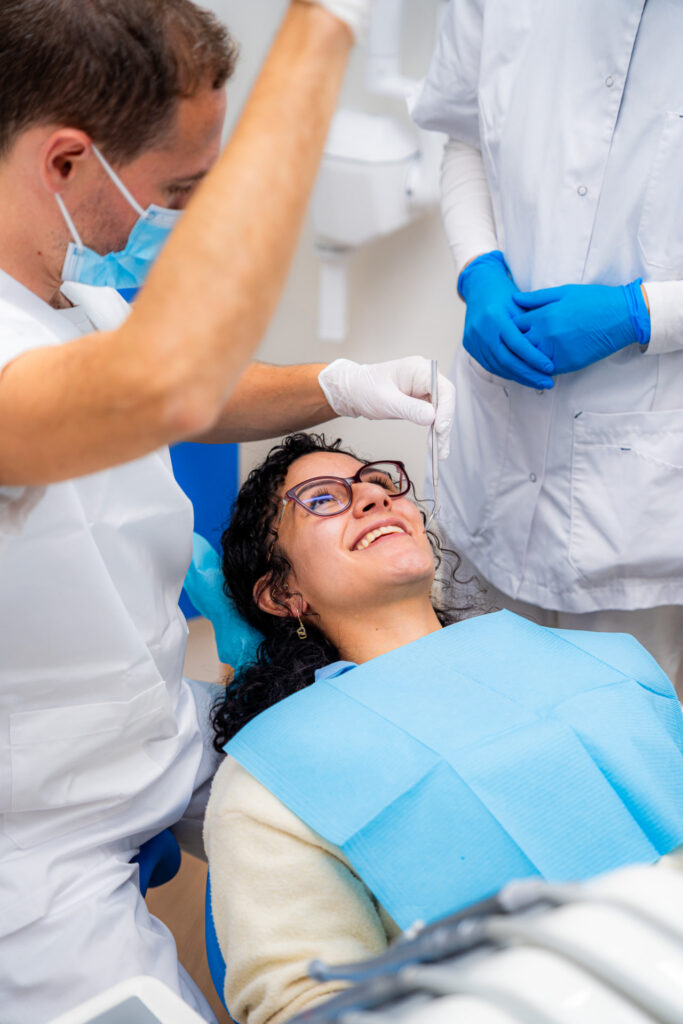
A first appointment does not have to be treatment straight away
Many people put off an appointment because they expect to be treated straight away.
That is not always the case.
A first consultation can instead be meant to:
- discuss your concerns;
- look at scans or photos;
- understand earlier experiences;
- explain treatment options;
- set priorities together.
For many patients, part of the trust that was lost earlier is rebuilt during that very first conversation.
Not because all the problems are solved straight away.
But because the situation finally becomes clear.
Trust usually grows in small moments
People rarely gain trust through one big promise.
Trust usually grows gradually.
A calm explanation.
A clear discussion of the scan.
A clinician who listens before advising.
An agreed pause at the right moment.
The feeling of being taken seriously.
Those are often the moments patients still remember months or even years later.
Technology can refine treatments.
Digital diagnostics can give more insight.
Treatment planning can become more predictable.
But in the end, trust remains a human experience.
Personal advice on dental anxiety
There is no standard solution for dental anxiety.
Every patient brings their own history, expectations and experiences.
That is why a calm approach usually does not start with treating.
It starts with understanding.
During a first consultation we can discuss:
- where the tension comes from;
- which experiences play a role;
- which examinations are needed;
- which treatments may be possible;
- which pace suits you.
For many patients from Schiedam, Rotterdam, Vlaardingen, Delft and the rest of South Holland, that first step turns out to be less daunting than they expected.
Frequently asked questions
Practical questions about dental anxiety
How do you get over a fear of the dentist?
There is usually no quick fix for dental anxiety.
For most people, fear does not go away because someone says a treatment is not that bad. Anxiety often fades when experiences change gradually.
That usually starts with small steps. A first conversation. An examination without treatment. Looking at photos or scans together. Understanding what is going on before any decisions are made.
Many patients notice that their tension eases once they regain a grip on the situation. Not because all the fear disappears at once, but because uncertainty gives way to clarity.
Overcoming dental anxiety is therefore often not a matter of courage, but of trust that is built up step by step.
What to do about extreme dental anxiety?
With extreme dental anxiety, it is important not to think straight away about the treatment itself.
The first step is usually to understand where the fear comes from.
For some people the cause lies in a negative experience in the past. For others, loss of control, shame or fear of pain plays a bigger part.
When the tension is so great that appointments are put off for years, a phased approach can help. A first appointment then does not have to go any further than an introduction, a conversation or a diagnostic examination.
Many people feel relief as soon as they notice that not everything has to happen in one appointment. It is precisely that predictability that often makes the first step possible again.
What treatment exists for people with dental anxiety?
The treatment of dental anxiety usually does not consist of one specific technique.
It is often a combination of clear communication, adapted treatment planning and a pace that suits the patient.
Depending on the situation, this may include:
- extra explanation beforehand;
- shorter treatment sessions;
- scheduled breaks;
- phased treatment;
- additional anaesthetic techniques;
- support for severe anxiety symptoms.
What works best differs from person to person.
That is why a good approach usually begins with listening and understanding, not with treating.
Is sedation available for dental anxiety?
Yes, in certain situations sedation can be considered for patients with severe dental anxiety.
Whether sedation is appropriate depends on several factors, including the nature of the treatment, the medical history and the severity of the anxiety symptoms.
It is important to know that sedation is usually not the first step.
Many patients discover during a calm consultation that their anxiety is easier to manage than they expected. If extra support still turns out to be desirable, we can look together at which options are appropriate and responsible.
The main goal always stays the same: a treatment that is safe, predictable and as comfortable as possible.
Afraid of a first dental appointment?
Many people who are afraid of a first dental appointment expect to be treated straight away.
In reality, a first consultation mostly consists of examination, explanation and discussing possible next steps.
Depending on the situation, a first appointment may consist of a conversation, an examination of the mouth, photos or scans and answering questions. Often the aim is not to treat straight away, but to gain insight into your oral health and possible treatment options.
For many patients, it is precisely that clarity that removes a large part of the tension.
A dentist for anxious patients in Schiedam and Rotterdam
Many patients looking for a dentist for anxious patients in Schiedam, Vlaardingen or the Rotterdam region are not immediately looking for treatment.
Often they first look for an environment in which they can explain their situation, ask questions and discover at their own pace what options exist.
For people with dental anxiety, that first step often proves more important than the treatment itself. Understanding, clear communication and predictability usually form the basis for rebuilding trust.
Conclusion
Dental anxiety is rarely only about pain. Far more often, loss of control, earlier experiences, shame and uncertainty play a part. That is exactly why trust usually does not come from reassurance alone. Trust grows when someone understands what is happening, keeps influence over the process and feels taken seriously.
For many people, overcoming dental anxiety therefore does not begin with a treatment. It begins with the feeling that an appointment is possible again. In fact, a first appointment does not have to mean treatment straight away. Restoring trust begins with insight, explanation and a calm assessment of the situation.
Knowledge base
Latest articles

Hidden root canals: why a tooth can keep causing problems after root canal treatment
Pain after root canal treatment? Learn how a hidden or missed canal happens and how the microscope and CBCT help. Book an assessment in Schiedam.

Surgical microscope for root canal treatment in Schiedam
What does a surgical microscope do in root canal treatment? See how precision and CBCT help save your tooth. Book at 3D Tandarts in Schiedam.
Implant consultation in Schiedam: find out which treatment suits you
Is a dental implant right for you? Find out what an implant consultation in Schiedam involves: examination, advice and a treatment plan. Book today.
Questions about your situation?
During a consultation we look at your situation and discuss the options.